
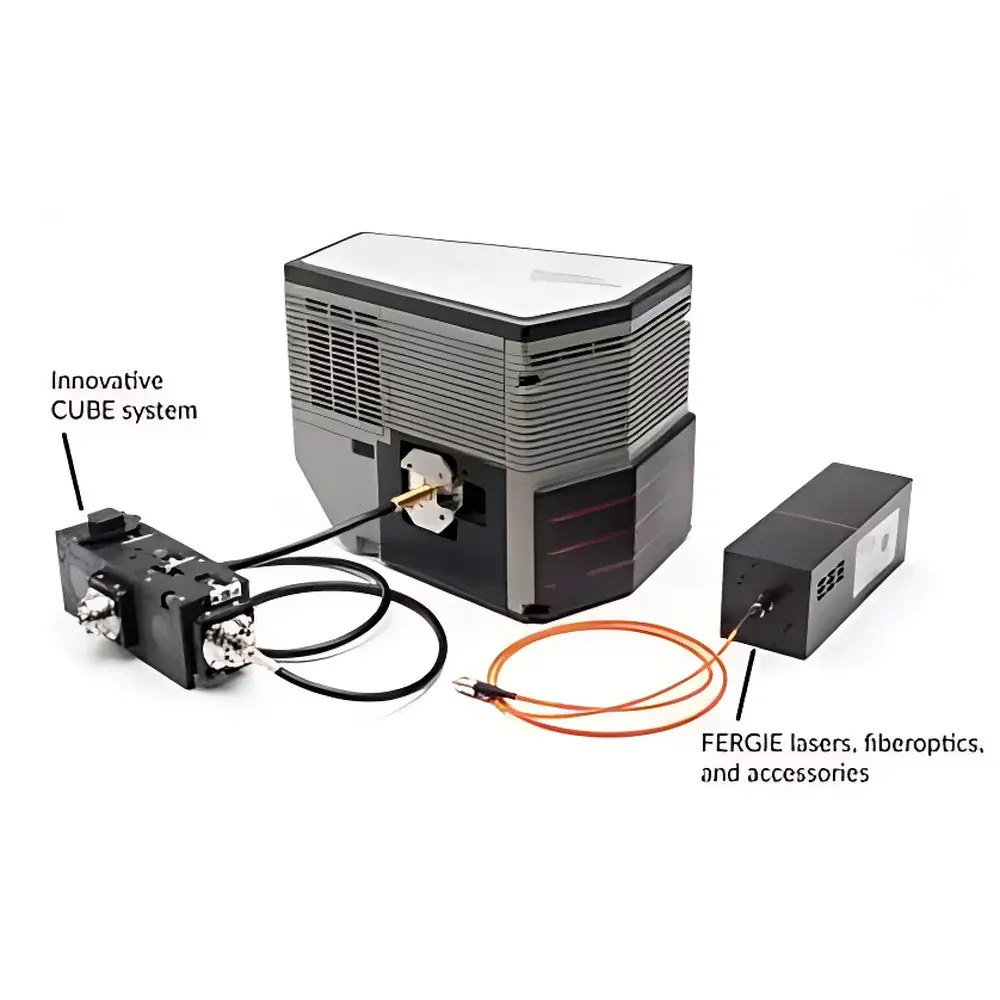
Princeton Instruments Fergie FER-SCI-BRX and FER-SCI-BX Zero-Aberration Imaging Spectrometers
| Brand | Princeton Instruments / Teledyne Princeton Instruments |
|---|---|
| Origin | USA |
| Model | FER-SCI-BRX, FER-SCI-BX |
| Focal Length | 80.8 mm |
| Aperture | f/4 |
| Spectral Resolution (full focal plane) | 0.20–0.24 nm |
| Wavelength Range | UV-NIR (200–1100 nm) and VIS-NIR (400–1100 nm) |
| Grating Options | 295, 600, 1200 g/mm (interchangeable single-grating turret) |
| Slit Widths | 10–500 µm (laser-cut, height 3.3 mm) |
| CCD Type | Back-illuminated, deep-depletion, frame-transfer architecture with eXcelon and UV coating |
| Sensor Format | 1024 × 256 active + 1024 × 256 storage (total 1024 × 512) |
| Peak Quantum Efficiency | 95% |
| Cooling | Thermoelectric to −60 °C |
| Read Noise | 10 e⁻ rms @ 1 MHz |
| Integration Time | Up to 40 minutes (FER-SCI-BRX), several hours (FER-SCI-BX) |
| Spectral Acquisition Rate | 292 fps (FVB mode, FER-SCI-BRX), 124 fps (FVB mode, FER-SCI-BX) |
| Kinetic Mode Speed | >10,000 spectra/s (10-row binning, FER-SCI-BRX), >5,000 spectra/s (10-row binning, FER-SCI-BX) |
| Wavelength Accuracy | 0.26 nm |
| Repeatability | 0.13 nm |
| Spatial Resolution | 38.5 lp/mm @ 50% contrast (Nyquist-limited, full focal plane) |
| Line Transfer Speed | Adjustable 5.6–35 µs/line (FER-SCI-BRX), 15.2–95 µs/line (FER-SCI-BX) |
| Nonlinearity | <1% @ 1 MHz |
| Gain Options | 1.5 or 3 e⁻/ADU |
| Interface | USB 3.0 (3 m cable included) |
| I/O | Three MCX coaxial ports (2 trigger outputs, 1 trigger input), onboard programmable timing generator |
| Software | 64-bit LightField with real-time processing engine, IntelliCal lamp integration for automated wavelength and intensity calibration |
Overview
The Princeton Instruments Fergie FER-SCI-BRX and FER-SCI-BX are zero-aberration, all-in-one imaging spectrometers engineered for high-fidelity spectral and spatial characterization across UV–NIR wavelengths (200–1100 nm). Unlike conventional Czerny–Turner or crossed-beam spectrometers, the Fergie platform employs a patented optical architecture that eliminates coma and astigmatism across the entire focal plane—regardless of grating angle or selected wavelength. This fundamental correction removes instrumental broadening asymmetries, enabling true diffraction-limited spectral line profiles and pixel-accurate spatial registration between spectral and imaging modes. The system integrates a deep-depletion, back-illuminated frame-transfer CCD sensor with >95% peak quantum efficiency, thermoelectric cooling to −60 °C, and sub-10 e⁻ read noise at 1 MHz digitization—making it suitable for low-light applications including time-resolved Raman, fluorescence lifetime mapping, and microspectroscopy. With an 80.8 mm focal length and f/4 throughput, the Fergie delivers optimal balance between light collection efficiency, spectral dispersion, and compact form factor.
Key Features
- Zero-aberration optical design: Full focal-plane elimination of coma and astigmatism across all wavelengths and grating orientations—ensuring symmetric, un-broadened spectral lines and accurate spectral centroid determination.
- Modular CUBE architecture: Pre-aligned, plug-and-play optical modules (light sources, sample chambers, fiber couplers, filters) enable rapid reconfiguration for absorption, transmission, fluorescence, or Raman spectroscopy without realignment.
- Deep-depletion, back-illuminated frame-transfer CCD: Available in two variants—FER-SCI-BRX optimized for ultra-high-speed kinetic acquisition (>10,000 spectra/s in 10-row binned mode), and FER-SCI-BX engineered for extended integration (multi-hour exposures) with enhanced dynamic range.
- eXcelon and UV-enhanced anti-reflection coatings: Maximize quantum efficiency from 200 nm through near-IR, critical for broadband UV resonance Raman or deep-UV photoemission studies.
- IntelliCal-integrated calibration: Automated wavelength and radiometric calibration using NIST-traceable IntelliCal lamps, supporting compliance with ISO/IEC 17025 and GLP laboratory workflows.
- Real-time spectral processing: LightField software provides on-the-fly background subtraction, spectral deconvolution, ROI extraction, and kinetic trace generation—fully scriptable via Python API for integration into automated QA/QC pipelines.
Sample Compatibility & Compliance
The Fergie accommodates diverse sample geometries—from free-space microscopes and fiber-coupled probes to macroscopic transmission cells and custom vacuum chambers—via standardized CUBE mounting interfaces. Its modular slit assembly (10–500 µm laser-cut widths, 3.3 mm height) supports both high-resolution narrow-slit operation and high-throughput wide-slit configurations. All optical paths maintain alignment stability under thermal cycling (±0.5 °C ambient drift), satisfying ASTM E1421-22 requirements for spectrometer repeatability. The system complies with FDA 21 CFR Part 11 when deployed with LightField’s audit-trail-enabled acquisition mode—including electronic signatures, user access controls, and immutable metadata logging. It is routinely validated for USP spectroscopic performance verification and meets ISO 17025 clause 5.5.2 for measurement uncertainty estimation in accredited laboratories.
Software & Data Management
LightField 64-bit acquisition software serves as the unified control and analysis environment. It supports synchronized multi-device triggering (via MCX I/O), hardware-timed kinetic acquisitions, and non-destructive data buffering to RAM or SSD. Raw frames are saved in HDF5 format with embedded calibration metadata (wavelength map, QE curve, dark reference, slit function), ensuring traceability and interoperability with MATLAB, Python (h5py, NumPy), and LabVIEW. Batch processing workflows can be exported as executable scripts, enabling unattended overnight experiments with auto-restart on interruption. For regulated environments, LightField’s optional Validation Package includes IQ/OQ documentation, test protocols, and evidence of compliance with GAMP 5 and Annex 11 requirements.
Applications
- Time-resolved Raman spectroscopy: Sub-microsecond spectral kinetics enabled by frame-transfer readout and programmable exposure sequencing—ideal for monitoring catalytic surface reactions or photoinduced charge transfer.
- Confocal and widefield microspectroscopy: Pixel-registered spectral imaging at diffraction-limited resolution supports material phase mapping, semiconductor defect analysis, and biological tissue phenotyping.
- Plasmonics and nanophotonics: High signal-to-noise ratio in UV enables precise LSPR tracking and Fano resonance characterization in nanostructured metasurfaces.
- Process analytical technology (PAT): Real-time spectral feedback loops integrated into reactor control systems per ICH Q8(R2) guidelines for continuous manufacturing validation.
- Environmental monitoring: Field-deployable configurations (with ruggedized CUBE enclosures) support in situ water quality assessment via UV-Vis absorption or fluorescence fingerprinting.
FAQ
What distinguishes “zero-aberration” from standard spectrometer optical designs?
Zero-aberration refers to the complete suppression of coma and astigmatism across the entire focal plane—achievable only through Fergie’s proprietary off-axis parabolic relay and pupil-matching optics. Conventional designs introduce wavelength-dependent spatial distortion that degrades spectral fidelity and compromises quantitative peak fitting.
Can the Fergie be used for both imaging and spectroscopy without hardware reconfiguration?
Yes—the zero-aberration design ensures identical optical magnification and point-spread function in both imaging and spectral modes. Switching requires only software-selectable readout regions (FVB vs. full-frame), eliminating mechanical realignment or external beam splitters.
Is the system compatible with third-party microscopy platforms?
All Fergie CUBE modules conform to standard SM1 (1.035″-40) threading and kinematic mounting footprints. Adapter plates are available for Olympus, Nikon, Zeiss, and Leica microscope ports, preserving infinity-corrected conjugates and telecentricity.
How is wavelength calibration maintained over long-term operation?
IntelliCal lamp-based recalibration is performed automatically before each acquisition series. LightField stores historical calibration logs, enabling trend analysis of grating encoder drift or thermal lensing effects per ISO/IEC 17025 clause 7.7.
Does the system support synchronization with pulsed lasers or external detectors?
Yes—three MCX I/O channels provide TTL-compatible trigger inputs/outputs with sub-microsecond jitter. The onboard timing generator supports complex pulse sequences (e.g., pump-probe delays, gated detection windows) fully programmable within LightField.





