
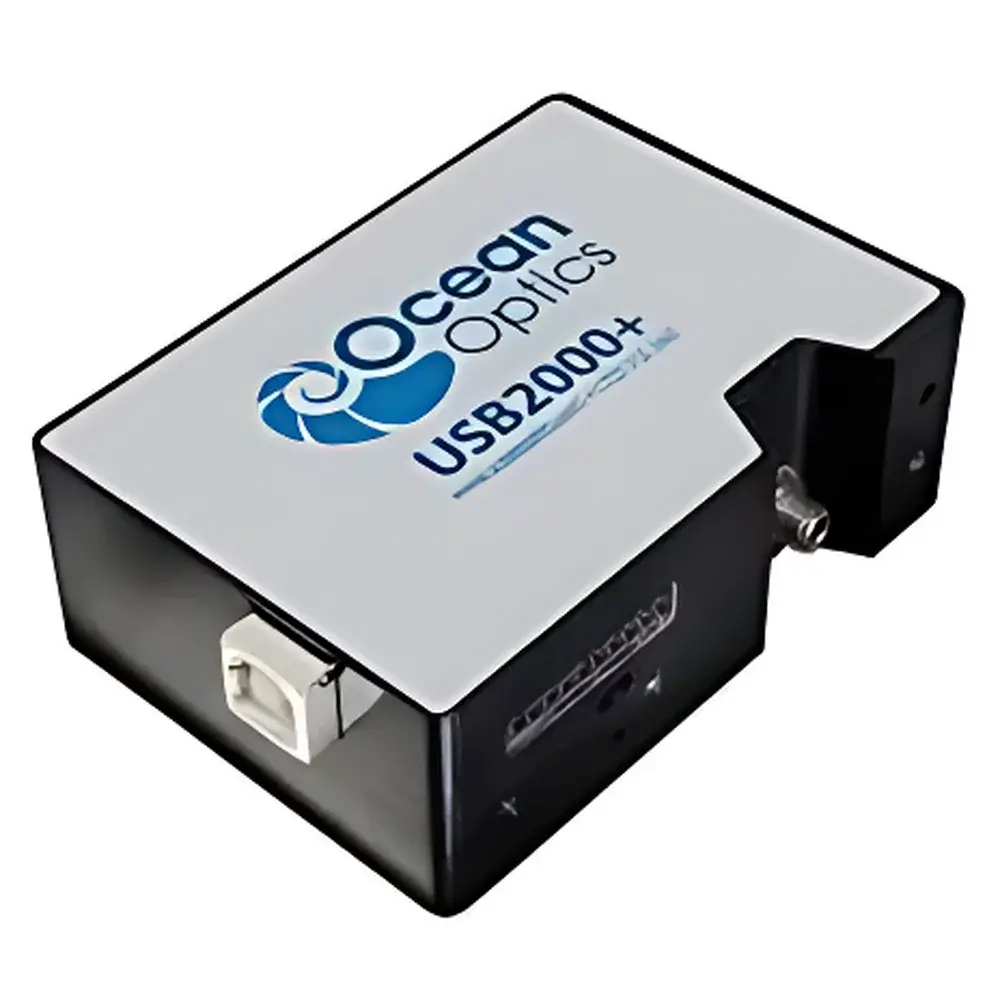
Ocean Optics USB2000+ Compact Fiber Optic Spectrometer
| Brand | Ocean Optics |
|---|---|
| Origin | USA |
| Model | USB2000+ |
| Spectral Range | 200–1100 nm |
| Detector | Sony ILX511B CCD (2048 pixels) |
| Optical Resolution | ~0.3–10.0 nm FWHM |
| Sensitivity | 75 photons/count at 400 nm |
| Signal-to-Noise Ratio | 250:1 (at full signal) |
| Dynamic Range | 2 × 10⁸ (system) |
| 1300 | 1 (single acquisition) |
| Stray Light | <0.05% at 600 nm |
| Integration Time | 1 ms – 65 s |
| Dimensions | 89.3 × 63.3 × 34.4 mm |
| Weight | 190 g |
| Compliance | RoHS, CE |
Overview
The Ocean Optics USB2000+ Compact Fiber Optic Spectrometer is a field-proven, benchtop-grade spectrometer engineered for precision spectroscopic measurements in research laboratories, industrial QA/QC environments, and embedded OEM systems. Based on the well-established Czerny-Turner optical design, it utilizes a fixed grating and slit-based entrance optics coupled to a linear 2048-pixel Sony ILX511B CCD array. Its spectral response spans 200–1100 nm—configurable via interchangeable gratings and slits—enabling tailored performance across UV-VIS-NIR applications. The device operates via high-speed USB 2.0 communication, eliminating the need for external power supplies and supporting real-time spectral acquisition at up to 1,000 spectra per second. This architecture delivers robust signal fidelity, low thermal drift, and consistent inter-unit reproducibility—critical for method transfer and regulatory-compliant workflows.
Key Features
- High-speed acquisition: Up to 1,000 full-spectrum acquisitions per second with 1 ms minimum integration time
- Compact form factor (89.3 × 63.3 × 34.4 mm; 190 g) optimized for portable deployment and space-constrained OEM integration
- Programmable onboard microcontroller enabling custom triggering, synchronization, and hardware-level configuration without host dependency
- Modular optical configuration: 14 standard gratings (covering UV through NIR), 6 slit widths (5–200 µm), and optional L2 collection lenses or cosine correctors (e.g., CC3-DA)
- Self-calibration capability: Wavelength and intensity calibration routines supported via user-accessible software tools
- USB-powered operation: No external power supply required; compliant with USB 2.0 bus-power specifications
- Certified compliance: Fully RoHS-compliant and CE-marked for use in EU and North American regulatory environments
Sample Compatibility & Compliance
The USB2000+ interfaces seamlessly with standard SMA 905 fiber optic cables (core diameters from 50–600 µm), supporting liquid cuvettes, integrating spheres, reflection probes, transmission cells, and remote sampling configurations. Its spectral stability and low stray light (<0.05% at 600 nm) ensure accurate quantification in absorbance, reflectance, fluorescence, and radiometric applications—including those requiring trace-level detection or multi-component spectral deconvolution. For regulated environments, the instrument supports audit-ready data capture when used with OceanView or Ocean Insight’s SDK-enabled applications compliant with FDA 21 CFR Part 11 requirements (electronic signatures, audit trails, and secure user access controls). While not inherently GMP-certified as a standalone unit, its design aligns with ISO/IEC 17025 principles for measurement uncertainty management and GLP documentation practices.
Software & Data Management
Ocean Insight provides native support via OceanView (Windows/macOS), a validated application offering real-time spectral visualization, batch processing, peak identification, and export to CSV, TXT, or HDF5 formats. The spectrometer is fully programmable through the OceanDirect SDK (C/C++, Python, MATLAB, LabVIEW, .NET), enabling integration into automated test benches, inline process monitors, or custom analytical pipelines. All firmware and calibration files are stored onboard, ensuring consistent spectral response across platforms and facilitating instrument interchangeability in multi-system deployments. Raw detector counts, dark-subtracted spectra, and calibrated irradiance/radiance data can be logged with timestamping and metadata tagging—including integration time, grating ID, slit width, and temperature compensation status.
Applications
- UV-VIS absorption and transmission analysis of chemical solutions and thin films
- LED, laser diode, and broadband source characterization (spectral centroid, FWHM, CCT)
- Colorimetry and spectral radiance measurement using NIST-traceable irradiance calibration kits
- In-line pharmaceutical dissolution monitoring and tablet coating uniformity assessment
- Environmental water quality sensing (nitrate, chlorophyll-a, CDOM)
- Plasma emission monitoring in semiconductor etch and deposition tools
- Educational spectroscopy labs requiring rugged, low-cost instrumentation with reproducible pedagogical outcomes
FAQ
Is the USB2000+ suitable for quantitative radiometric measurements?
Yes—when paired with an absolute irradiance calibration (e.g., using a tungsten-halogen lamp traceable to NIST standards) and appropriate collection optics (e.g., CC3-DA cosine corrector), the USB2000+ achieves ±5% uncertainty in irradiance measurements across 350–1000 nm under controlled conditions.
Can I change the grating or slit in the field?
No—the USB2000+ is factory-configured with fixed optical components. Interchangeable gratings and slits require re-alignment and recalibration; users must order pre-assembled modules (e.g., USB2000+UV-VIS, USB2000+XR) rather than modify units post-purchase.
What is the typical warm-up time required for stable operation?
Less than 15 minutes after power-on, with thermal stabilization improving wavelength repeatability to ±0.1 nm over 8-hour continuous operation at ambient temperatures between 15–30 °C.
Does the USB2000+ support synchronized multi-channel acquisition?
Not natively—but multiple USB2000+ units can be triggered synchronously via TTL input/output signals using external logic controllers or supported software APIs, enabling pseudo-simultaneous multi-spectral monitoring.
How often does the wavelength calibration need verification?
Annual verification is recommended for routine lab use; more frequent checks (e.g., daily or per-shift) are advised in high-precision or regulated applications, using mercury-argon or holmium oxide reference sources.





