
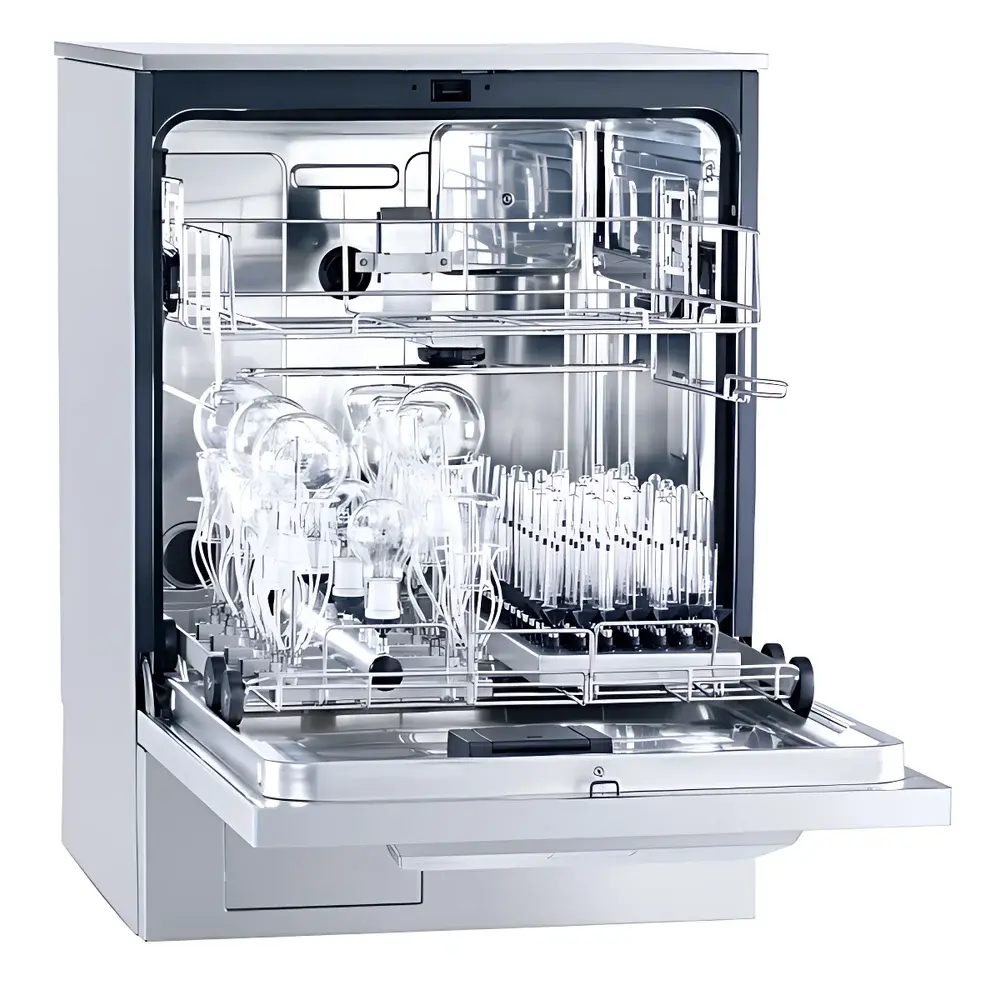
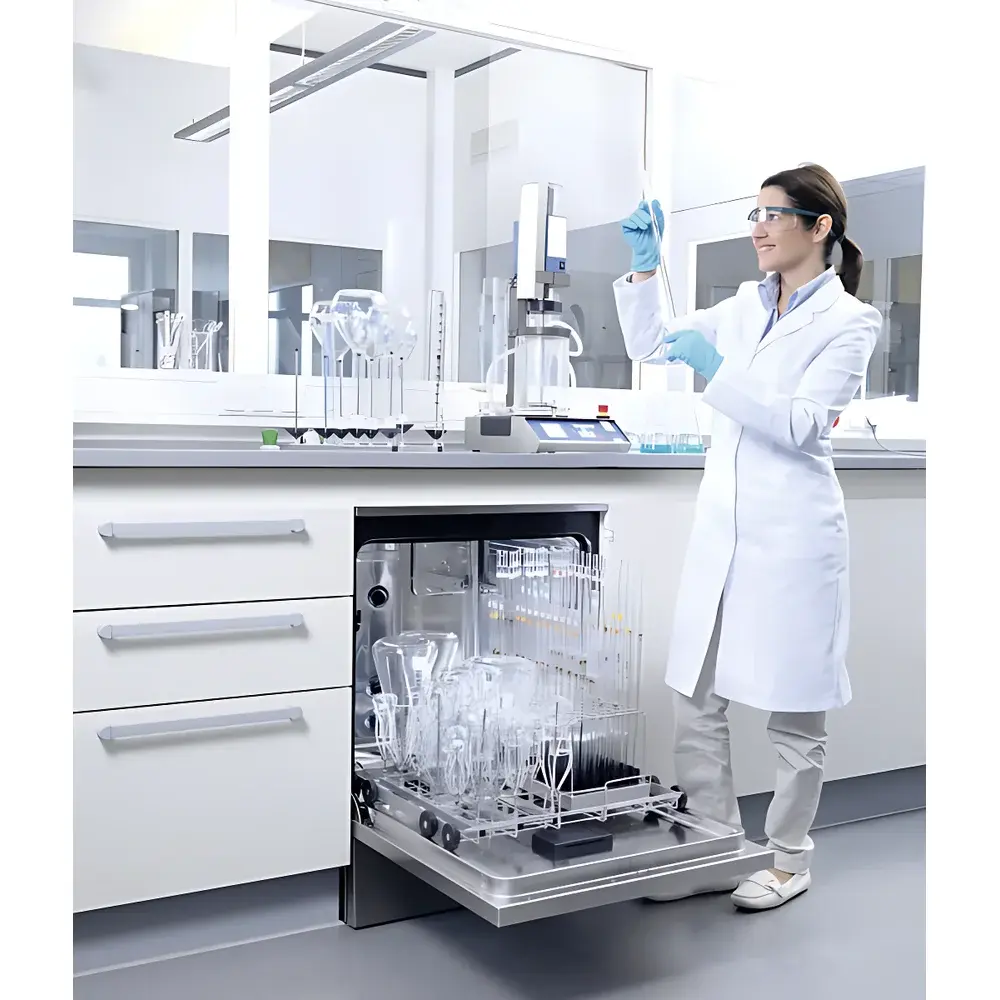
Miele PG8593 Professional Laboratory Bottle Washer
| Brand | Miele |
|---|---|
| Origin | Germany |
| Model | PG8593 |
| Chamber Volume | 175 L |
| Heating Power | Not specified (typical for PG8593: 6.0 kW) |
| Wash Temperature Range | 10–93 °C |
| Detergent Capacity | 5 L or 10 L reservoir |
| External Dimensions (L×W×D) | 835 × 600 × 600 mm |
Overview
The Miele PG8593 is a CE-marked, EN ISO 15883-compliant professional laboratory bottle washer engineered for reproducible, traceable, and validation-ready cleaning of glassware, plasticware, and stainless-steel labware. Designed and manufactured in Gütersloh, Germany, it employs a closed-loop thermodynamic washing cycle combining high-velocity spray arms, precisely controlled temperature ramping, multi-stage rinse protocols (including optional deionized water final rinse), and programmable drying phases. Its 175 L chamber accommodates large-format vessels—including 1 L volumetric flasks, culture bottles, centrifuge rotors, and nested glassware stacks—while maintaining consistent thermal and mechanical energy distribution across load configurations. Unlike benchtop ultrasonic cleaners or manual scrubbing, the PG8593 delivers process-controlled removal of organic residues, biofilms, and inorganic salts in accordance with ISO 15883-1 (general requirements) and ISO 15883-4 (performance testing for washer-disinfectors). It is intended for use in GLP, GMP, and ISO/IEC 17025-accredited laboratories where documentation of cleaning efficacy, audit readiness, and operator safety are non-negotiable.
Key Features
- Stainless-steel AISI 316 chamber and internal components for corrosion resistance against alkaline detergents and acidic rinses
- Three independently controllable spray arms with adjustable pressure (up to 3.5 bar) and rotational symmetry for uniform coverage
- Dual-temperature zone control: pre-wash at 45 °C, main wash up to 93 °C, final rinse with deionized water at ≤25 °C or hot DI rinse at 85 °C
- Integrated detergent dosing system with dual 5 L or 10 L reservoirs supporting enzymatic, alkaline, and neutral formulations (EN 14561 compliant)
- Programmable logic controller (PLC) with password-protected access levels, real-time cycle monitoring, and event logging
- Compliance-ready interface for external data capture: RS232/RS485 serial output, optional Ethernet/IP or Profibus-DP for integration into LIMS or MES systems
- Automatic door lock with thermal interlock and steam condensation management for operator safety during high-temp cycles
Sample Compatibility & Compliance
The PG8593 supports full-cycle processing of diverse labware including borosilicate glass (e.g., Pyrex®, Duran®), polycarbonate and polypropylene containers, stainless-steel beakers and funnels, ceramic crucibles, and silicone-sealed closures. Load configurations may include up to 12× 1000 mL volumetric flasks, 24× 50 mL centrifuge tubes, or mixed batches with custom rack adapters (optional). All standard programs comply with DIN V 1946-4 (hygienic design of lab equipment), EN ISO 15883-1:2012 (washer-disinfector safety), and support validation per ASTM E2575 (standard guide for cleaning validation in pharmaceutical manufacturing). Optional IQ/OQ documentation packages are available for FDA-regulated environments requiring 21 CFR Part 11 electronic records and signature compliance.
Software & Data Management
The embedded Miele LabControl™ firmware provides 20 factory-default cleaning programs—covering routine glassware, tissue culture ware, HPLC vials, and residual analysis vessels—with editable parameters for time, temperature, detergent volume, and rinse count. Each cycle generates a tamper-evident digital log containing start/end timestamps, actual vs. setpoint temperatures, detergent consumption, door open/close events, and fault codes. Logs are exportable via USB or network interface in CSV or PDF format, retaining full audit trail integrity. For centralized fleet management, optional Miele Connect™ software enables remote monitoring, predictive maintenance alerts (based on pump runtime and heater duty cycle), and automated report generation aligned with ISO/IEC 17025 clause 7.7 (control of records).
Applications
The PG8593 serves analytical chemistry labs performing trace-metal analysis (requiring sub-ppb residue limits), biopharmaceutical QC units validating container-closure integrity, clinical microbiology departments processing blood culture bottles, and academic research facilities handling radioactive or cytotoxic samples. Its high-temperature disinfection capability (≥90 °C for ≥5 min) achieves log⁶ reduction of vegetative bacteria per EN 15581, making it suitable for BSL-2 containment workflows. In environmental testing labs, it enables reproducible cleaning of EPA Method 500-series sample bottles prior to GC-MS analysis. The machine is routinely deployed in ISO 13485-certified medical device manufacturing sites for cleaning reusable surgical instrument trays and in food safety labs complying with AOAC Official Methods® for mycotoxin extraction vessel preparation.
FAQ
Does the PG8593 meet FDA or EU regulatory requirements for cleaning validation?
Yes—when operated with validated programs and documented detergent/water quality controls, it supports compliance with FDA 21 CFR Part 11, EU Annex 15, and ISO 15883-4 verification protocols.
Can I integrate the PG8593 into our existing LIMS or MES infrastructure?
Yes—via optional Ethernet/IP, Modbus TCP, or RS485 interfaces; Miele provides protocol documentation and configuration support for seamless integration.
What water quality specifications are required for optimal performance?
Deionized water (≤1 µS/cm conductivity) is recommended for final rinse stages; feed water should meet EN 285 requirements (hardness < 0.1 mmol/L, chlorine < 0.5 mg/L) to prevent scaling and nozzle clogging.
Is third-party validation support available?
Yes—Miele Professional offers IQ/OQ/PQ execution services performed by certified engineers, including thermocouple mapping, residue swab testing, and cycle repeatability studies.
How often does preventive maintenance need to be scheduled?
Miele recommends quarterly service intervals for pump inspection, filter replacement, and spray arm calibration—aligned with ISO 13485 maintenance planning requirements.



