
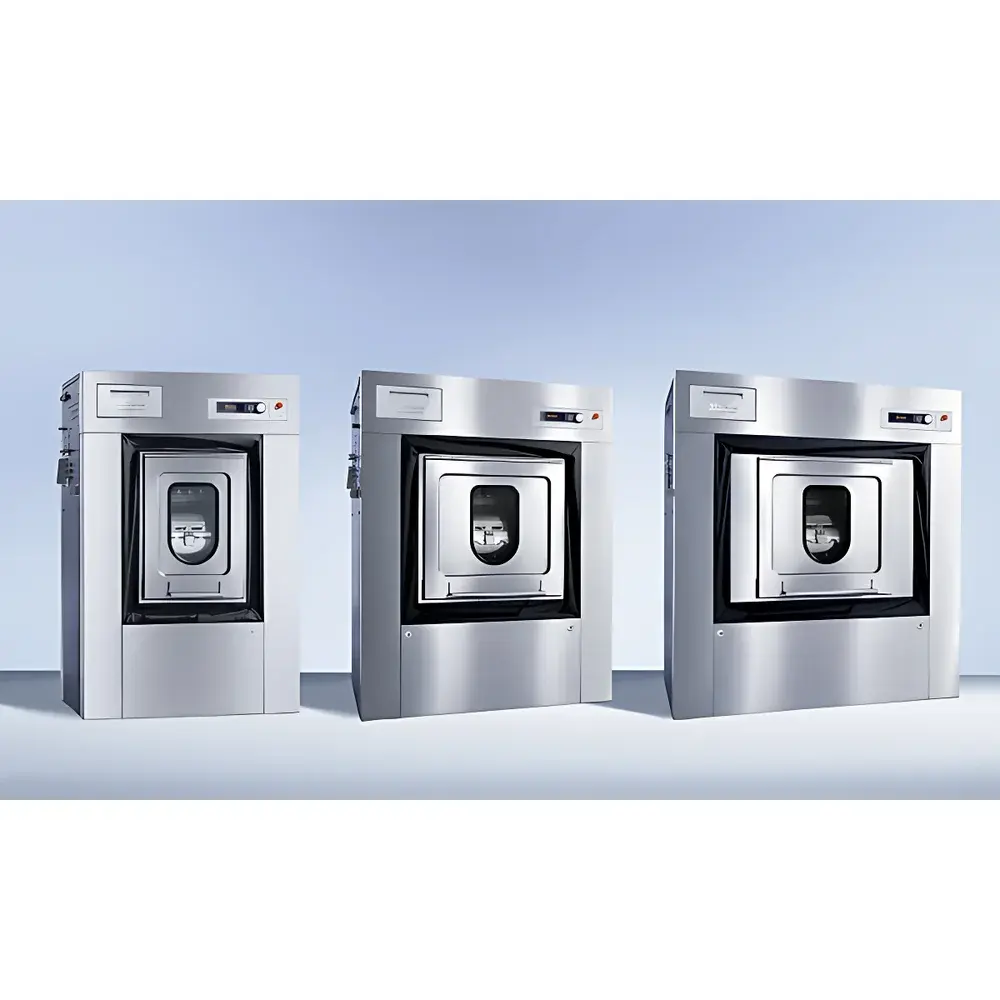
Miele PW6323 Automated Textile Washer for Controlled Environments
| Brand | Miele |
|---|---|
| Origin | Germany |
| Model | PW6323 |
| Drum Capacity | 32 kg (1:10 ratio) / 36 kg (1:9 ratio) |
| Drum Volume | 320 L |
| Max. Spin Speed | 975 rpm |
| G-Force | 360 × g |
| Residual Moisture | 41% |
| Control System | Profitronic M Intelligent Integrated Chip |
| Power Supply | AC 380–415 V, 50–60 Hz |
| Electric Heating Power | 30 kW |
| Total Rated Load | 31 kW |
| Rated Current | 3 × 63 A |
| Water Inlets | 1 × Ultrapure Water / 2 × Filtered Water / 2 × Municipal Water |
| Drain Valve | DN70 |
| Drain Flow Rate | 200 L/min |
| Net Weight | 872 kg |
| Dimensions (H×W×D) | 1705 × 1558 × 890 mm |
Overview
The Miele PW6323 Automated Textile Washer is an engineered solution for the validated, repeatable, and contamination-controlled laundering of critical textiles in regulated pharmaceutical, biotechnology, medical device, and cleanroom environments. Designed according to the principles of process validation and hygienic design, the PW6323 operates on a dual-door isolator architecture—physically separating the “dirty” and “clean” sides of the laundry workflow—to prevent cross-contamination and support ISO 14644-1 Class 5–8 and EU GMP Annex 1 compliant facility layouts. Its core washing mechanism integrates precise temperature control, programmable multi-stage cycles (including pre-wash, main wash, intermediate rinse, final rinse, neutralization, and extraction), and high-G-force spin dynamics (360 × g) to achieve consistent microbial load reduction and particulate removal from garments such as sterile area gowns, controlled-environment coveralls, surgical drapes, cleanroom gloves, face masks, footwear, filter bags, lint-free wipes, and mop heads. The system complies with IEST-RP-CC003.3 (Clothing Elements for Cleanrooms), VDI 2083 Part 5.2 (Decontamination of Textiles in Cleanroom Technology), and relevant cGMP requirements—including the 2010 Chinese GMP Annex on Sterile Production and FDA 21 CFR Part 211 Subpart D (Equipment)—ensuring alignment with global regulatory expectations for textile reprocessing.
Key Features
- Dual-Door Isolation Design: Hermetically sealed front and rear doors with interlocked operation prevent airflow crossover between contaminated and decontaminated zones; integrated pressure differential monitoring supports HVAC integration.
- Honeycomb Drum Architecture: Patented drum geometry with optimized lifters and integrated spray nozzles ensures uniform water distribution, mechanical action consistency, and minimized fabric abrasion during wash and rinse phases.
- High-Efficiency Extraction: 975 rpm spin speed delivers 360 × g centrifugal force, reducing residual moisture to ≤41%—critical for minimizing drying time, energy consumption, and potential recontamination risks in subsequent handling.
- Dual Radiofrequency (RF) Sensing System: Real-time, non-contact detection of fabric mass, moisture content, and load distribution enables adaptive cycle modulation and prevents unbalanced spinning or overdrying.
- Profitronic M Intelligent Control Platform: Embedded microprocessor-based system with audit-trail-capable logging, password-protected user roles, and configurable parameter limits per program—designed to meet ALCOA+ data integrity criteria and support 21 CFR Part 11 compliance when deployed with appropriate IT infrastructure.
- Multi-Source Water Management: Dedicated inlets for ultrapure water (≥18.2 MΩ·cm), filtered water (≤0.2 µm), and municipal supply enable phase-specific water quality selection—essential for final rinse conductivity control and endotoxin mitigation.
Sample Compatibility & Compliance
The PW6323 accommodates a broad spectrum of regulated textiles used across Grade A–D cleanrooms and aseptic processing suites. Validated load configurations include single-layer and multi-layer sterile gowns (polyester/cotton blends, SMS nonwovens), nitrile and latex gloves, Tyvek® coveralls, stainless-steel-reinforced shoe covers, hydrophobic PTFE filter bags, and microfiber cleaning cloths. All standard programs are developed in accordance with ISO 15883-4 (Washer-Disinfectors for Textiles) and aligned with risk-based validation protocols per ASTM E2810 and EU GMP Annex 15. Documentation packages include Installation Qualification (IQ), Operational Qualification (OQ), and Performance Qualification (PQ) templates, supporting GxP audits and regulatory submissions. The unit’s stainless-steel 316L construction, electropolished surfaces, and zero-drain死角 design meet EHEDG Guideline Doc. 8 for hygienic equipment design.
Software & Data Management
The Profitronic M controller records timestamped operational data—including cycle start/stop times, temperature profiles per phase, water conductivity values, pressure differentials, door status, and alarm events—with ≥10,000-cycle local storage capacity. Data export is supported via USB 2.0 and Ethernet (Modbus TCP/IP), enabling integration into MES, SCADA, or LIMS platforms. Electronic signatures, user-level access control (admin/operator/maintenance tiers), and immutable audit trails satisfy requirements for data integrity under FDA 21 CFR Part 11, EU Annex 11, and WHO TRS 996. Optional Miele Connect module adds remote diagnostics, predictive maintenance alerts, and cloud-based fleet monitoring—without compromising network security boundaries.
Applications
- Aseptic manufacturing suites: Reprocessing of Category 1–3 sterile garments per USP and guidelines.
- Cell and gene therapy facilities: Cleaning of closed-system transfer components and operator PPE exposed to viral vectors or primary cells.
- API and solid-dose production: Decontamination of reusable cleanroom linens, dust-control mops, and filtration media prior to reuse.
- Medical device packaging lines: Validation-compliant laundering of ISO Class 5 gowning ensembles and assembly-area wipe materials.
- Research-grade cleanrooms (e.g., semiconductor R&D): Low-particulate cleaning of static-dissipative lab coats and precision instrument covers.
FAQ
Does the PW6323 support automated validation protocol execution?
Yes—preconfigured IQ/OQ/PQ test sequences are embedded in the controller, including thermal mapping routines, leak testing procedures, and microbiological challenge verification workflows.
Can the system be integrated into a central building management system (BMS)?
Yes—via Modbus TCP/IP or optional BACnet MS/TP gateway, enabling real-time monitoring of utility consumption (water, electricity, steam), door status, and alarm states.
Is detergent dosing automated and traceable?
Yes—the integrated chemical dosing module supports up to four independent detergent/neutralizer/sanitizer channels with volumetric flow metering, usage logging, and low-level alerts.
What is the recommended maintenance interval for the RF sensors and drum bearings?
RF sensor calibration is verified annually during PQ; drum bearing service life exceeds 20,000 cycles under nominal load, with condition monitoring enabled via vibration analysis outputs.
Does Miele provide installation support for cleanroom-rated electrical and plumbing interfaces?
Yes—Miele Professional’s Engineering Services team coordinates with facility engineers to validate conduit routing, grounding continuity, water quality certification, and HVAC interface specifications prior to commissioning.




