
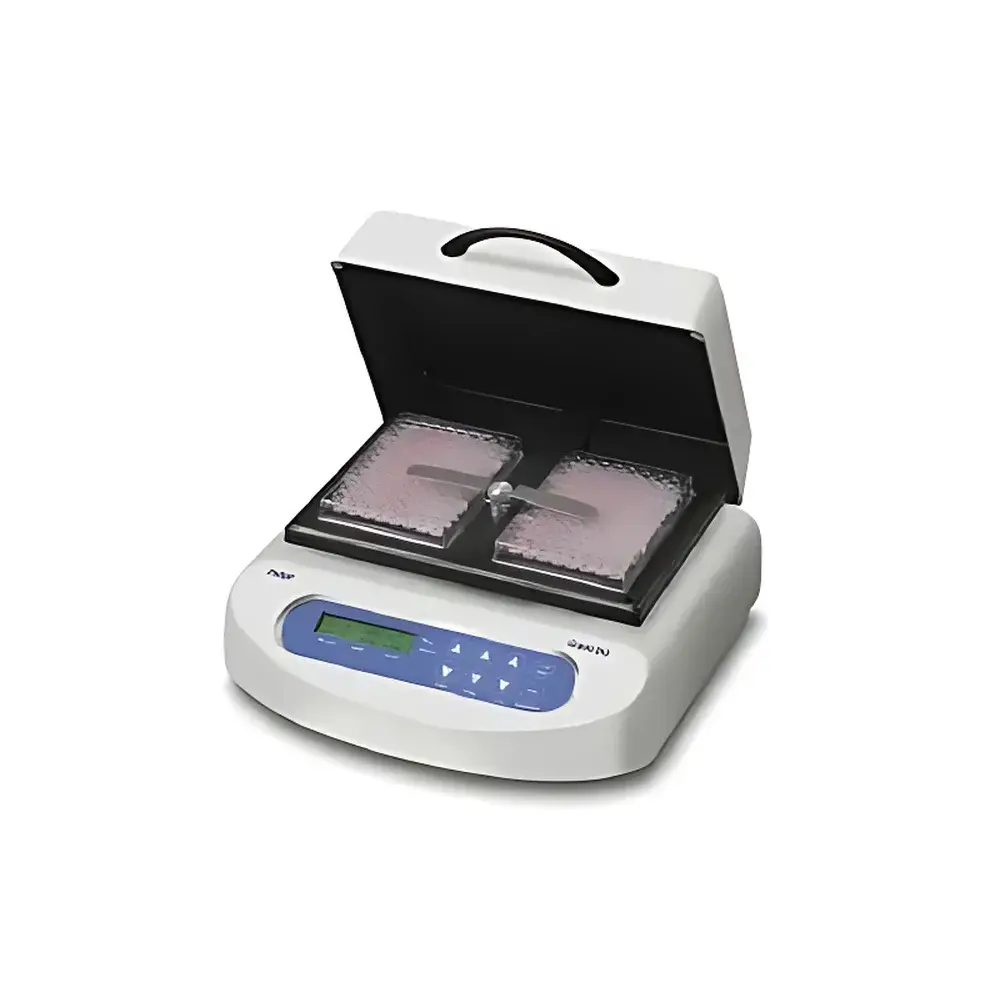
Grant Instruments PHMP Advanced Microplate Incubating Shaker
| Origin | United Kingdom |
|---|---|
| Manufacturer Type | Authorized Distributor |
| Origin Category | Imported |
| Model | PHMP |
| Quotation | Upon Request |
| Temperature Range | Ambient +5 to 60 °C |
| Temperature Stability | ±0.1 °C |
| Temperature Uniformity | ±0.2 °C |
| Oscillation Speed | 250–1200 rpm |
| Speed Resolution | 10 rpm |
| Orbit Diameter | 4 mm (2 mm radius) |
| Timer Range | 1 min to 96 h |
| Time Resolution | 1 min |
| Display | 2-line × 16-character LCD |
| Heating Time (to 37 °C from ambient) | 15–20 min |
| Dimensions (W×D×H) | 265 × 250 × 125 mm |
| Ambient Operating Temperature | 4–45 °C |
| Input Voltage | 12 V DC |
| Input Current | 5 A |
| Plate Compatibility | 96-well and 384-well microplates |
| Configurations | PHMP (2-plate capacity), PHMP-4 (4-plate capacity, optional high-temp variant: 5–100 °C) |
Overview
The Grant Instruments PHMP Advanced Microplate Incubating Shaker is an engineered solution for precise thermal control and homogeneous mixing of microplate-based assays in life science laboratories. Designed around a compact, thermally isolated Peltier-based heating system and a brushless DC motor-driven orbital shaker mechanism, the PHMP delivers tightly regulated temperature environments while maintaining consistent, low-shear agitation across all wells—critical for kinetic enzymatic reactions, cell-based assays, nucleic acid hybridization, and thermal-sensitive protein work. Its architecture integrates dual-zone thermal management: a heated lid actively maintains vapor-phase equilibrium above the plate surface, minimizing condensation and evaporation, while the heated aluminum block ensures rapid thermal equilibration and spatial uniformity across the entire plate footprint. This design conforms to fundamental requirements for reproducible incubation-shaking workflows under GLP-compliant and ISO 17025-aligned laboratory practices.
Key Features
- Orbital shaking with precisely controlled 2 mm radius (4 mm diameter) motion, optimized for minimal well-to-well shear variance and maximal mixing efficiency in standard 96-well and 384-well formats.
- Peltier-based heating system with active lid heating—eliminates cold spots and suppresses condensation, enabling extended incubation without sample desiccation or cross-contamination risk.
- High-resolution digital control: temperature adjustable in 0.1 °C increments, speed in 10 rpm steps, and time in 1-minute intervals—supporting method traceability and SOP adherence.
- Dual operational modes: continuous operation for long-term assays or programmable timer mode with audible alert and automatic shutdown—enhancing safety and unattended reliability.
- Robust mechanical construction with reinforced aluminum housing and vibration-damped base, validated for >10,000 hours of continuous operation under routine QC/QA lab conditions.
- Modular platform design: PHMP accommodates two standard microplates; PHMP-4 supports four plates in parallel—ideal for high-throughput screening (HTS) and comparative assay setups.
Sample Compatibility & Compliance
The PHMP is validated for use with ANSI/SLAS-standard 96-well and 384-well microplates—including PCR plates, cell culture plates, ELISA strips, and deep-well storage plates. It meets mechanical and thermal performance criteria referenced in ASTM E2923-22 (Standard Guide for Performance Verification of Thermal Cyclers and Incubators) and supports compliance with FDA 21 CFR Part 11 when integrated with validated LIMS or electronic lab notebook (ELN) systems. The unit operates within Class II biological safety cabinet-compatible dimensions and adheres to IEC 61010-1 safety standards for laboratory electrical equipment. Optional PHMP-4 high-temperature configuration (5–100 °C) enables compatibility with stringent denaturation protocols per ISO/IEC 17025 clause 5.4.2.
Software & Data Management
While the PHMP operates via standalone front-panel interface, its parameter settings—including temperature setpoint, rpm, duration, and activation timestamp—are retained in non-volatile memory and can be logged externally via RS232 or USB-to-serial adapters (optional). When deployed in regulated environments, users may integrate the device into audit-trail-capable workflows using third-party data acquisition software compliant with ALCOA+ principles (Attributable, Legible, Contemporaneous, Original, Accurate). Firmware updates are available through Grant Instruments’ secure technical support portal, ensuring alignment with evolving regulatory expectations for instrument qualification (IQ/OQ/PQ).
Applications
- Bacterial growth kinetics and antibiotic susceptibility testing (AST) requiring simultaneous incubation and gentle agitation.
- Enzyme-linked immunosorbent assays (ELISA), where uniform washing and substrate incubation depend on consistent orbital motion and thermal homogeneity.
- cDNA synthesis, RT-qPCR setup, and next-generation sequencing (NGS) library preparation involving temperature-sensitive reverse transcriptases and polymerases.
- Protein crystallization screening, ligand-binding assays, and thermal shift assays (TSA) demanding sub-degree temperature stability over multi-hour durations.
- Molecular diagnostics workflows—including isothermal amplification (LAMP, RPA)—where precise thermal control and mixing reduce false-negative rates.
FAQ
What microplate formats are supported?
The PHMP supports ANSI/SLAS-compliant 96-well and 384-well plates, including skirted, semi-skirted, and unskirted variants. Deep-well plates up to 2.2 mL capacity are compatible when used with optional plate clamps.
Is the PHMP suitable for use inside a CO₂ incubator?
No—the PHMP is not rated for humidified or CO₂-enriched atmospheres. It is designed for ambient-air laboratory environments with operating humidity ≤80% RH non-condensing.
Can temperature and shaking parameters be logged for audit purposes?
Yes—when connected to external data loggers or validated acquisition software, all setpoints and runtime events (start/stop, alerts, shutdown) can be captured with timestamps meeting GLP documentation requirements.
Does the PHMP require calibration verification?
Per ISO/IEC 17025 and manufacturer recommendations, annual verification of temperature accuracy (using NIST-traceable probe) and speed consistency (via tachometer) is advised; calibration certificates are available upon request.
What safety protections are built in?
Over-temperature cutoff, motor stall detection, lid-open interlock, and auto-shutdown after timer expiry ensure fail-safe operation in unattended scenarios.



