
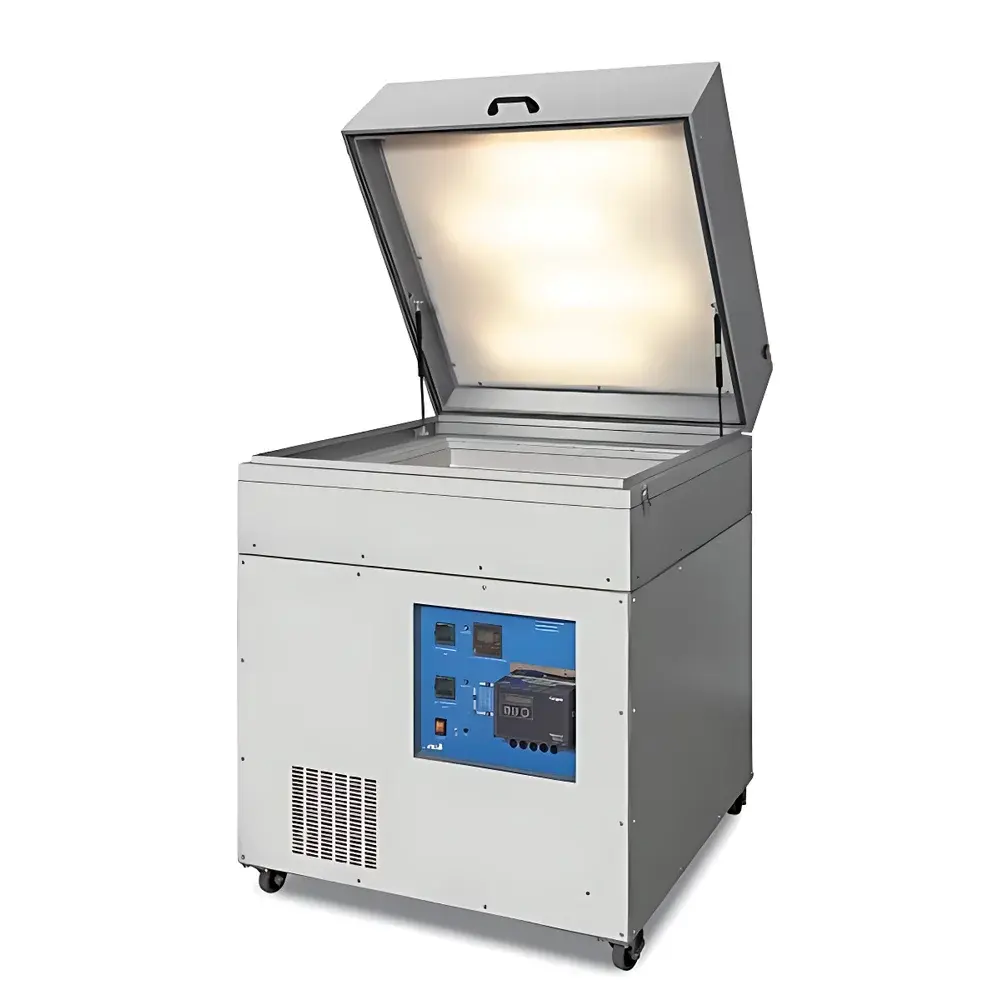

Grant GRD1 Dual-Directional Temperature Gradient Incubator
| Brand | Grant |
|---|---|
| Origin | United Kingdom |
| Model | GRD1 |
| Temperature Range (Cooling Side) | 0–30 °C |
| Temperature Range (Heating Side) | Ambient +5 °C to 45 °C |
| Working Surface | 760 × 760 mm |
| Temperature Stability (per DIN 58966) | ±1 °C |
| Display | Digital |
| Power Supply | 220–240 V, 50/60 Hz |
| Max. Power Consumption | 2050 W |
| EMC Class | A |
| Sample Compartment Layout | 14 × 14 = 196 discrete wells |
| Integrated Data Logger | Squirrel 2020 (5-channel, with sensors at four corners and center) |
| Timer Function | Programmable 24-h dual-phase cycle with 90° orthogonal gradient rotation |
Overview
The Grant GRD1 Dual-Directional Temperature Gradient Incubator is an engineered platform for high-resolution thermal phenotyping in plant science, seed physiology, microbiology, and entomology. Unlike conventional incubators that maintain uniform temperature fields, the GRD1 employs a precisely controlled bidirectional thermal gradient system based on Peltier-driven asymmetric heating and cooling across a solid aluminum plate. This architecture establishes a stable, linear temperature gradient—ranging from 0 °C (cooling side) to up to 45 °C (heating side)—across its 760 × 760 mm working surface. The system’s core innovation lies in its programmable 24-hour thermal cycling protocol: it first applies a unidirectional gradient (e.g., left-to-right) for a defined duration (e.g., 8 h), then automatically rotates the effective gradient orientation by 90° (e.g., top-to-bottom) for the remaining period (e.g., 16 h). This orthogonal cycling enables simultaneous evaluation of 196 independent thermal microenvironments—each corresponding to a unique combination of minimum and maximum temperature exposure over time—thereby generating multidimensional thermal response surfaces without manual intervention.
Key Features
- Bi-directional gradient control via integrated thermoelectric (Peltier) modules with independent heating/cooling zones on a precision-machined aluminum thermal plate
- 14 × 14 grid (196 wells) defined by removable acrylic partitioning plates—each well supports samples up to 30 mm diameter (e.g., Petri dishes, microtiter plates, nematode assay vials)
- DIN 58966-compliant temperature stability of ±1 °C across the entire surface under steady-state conditions
- Programmable 24-hour timer with dual-phase scheduling: user-selectable durations for primary and orthogonal gradient phases
- Built-in Squirrel 2020 data logger with five calibrated Pt100 sensors (four corner-mounted + one central) for continuous time-stamped thermal mapping
- Full-system mobility with locking casters and robust steel frame; designed for long-term operation in GLP-aligned laboratories
- Digital front-panel interface with real-time gradient visualization and setpoint confirmation
Sample Compatibility & Compliance
The GRD1 accommodates a broad spectrum of biological and material specimens requiring controlled thermal heterogeneity: orthodox and recalcitrant seeds (e.g., Striga, Orobanche), germination assays, microbial colonies (E. coli, S. cerevisiae), insect larvae (e.g., Drosophila, Tribolium), nematodes (Heterodera, Meloidogyne), tissue explants, and small-scale biopolymer stability tests. Its thermal architecture supports experimental designs aligned with ISO 20780 (seed testing), ASTM E1823 (thermal analysis terminology), and FAO/IBPGR guidelines for germplasm evaluation. The system meets EMC Directive 2014/30/EU (Class A emissions) and operates within IEC 61000-4 immunity standards. While not FDA 21 CFR Part 11–certified out-of-the-box, raw Squirrel log files (.sqd) are exportable in CSV/Excel formats for integration into validated LIMS or ELN platforms supporting audit-trail requirements.
Software & Data Management
Data acquisition is handled natively by the Squirrel 2020 logger, which records timestamped temperature values from all five sensors at user-defined intervals (1 s to 24 h resolution). Logs are downloaded via USB to Windows-based SquirrelView software, enabling spatial interpolation, gradient slope calculation, and temporal profile overlay. Export options include CSV, PDF reports, and MATLAB-compatible .mat files. For advanced thermal modeling—such as calculating thermal time (degree-days), cardinal temperatures (Tmin, Topt, Tmax), or dormancy-breaking thresholds—the logged matrix data can be imported into R (via grDevices or spatstat) or Python (scipy.interpolate, xarray). No proprietary cloud service or subscription is required; all firmware updates and configuration tools are distributed as offline installers.
Applications
- Seed science: Optimization of pre-germination stratification temperatures (per Kebreab & Murdoch, 1999a); quantification of thermal time to 50% germination (Ellis & Roberts, 1981); dormancy release kinetics under oscillating gradients
- Plant physiology: Mapping thermal optima for photosynthetic efficiency, stomatal conductance, or hypocotyl elongation across orthogonal gradients
- Entomology & nematology: Developmental rate analysis of parasitic nematodes (Ratnasinghe & Hague, 1998); thermal tolerance limits in stored-product pests
- Microbial ecology: Growth rate profiling of psychrotolerant and thermotolerant strains across sub-lethal thermal ranges
- Germplasm conservation: Empirical determination of safe storage temperatures for regional seed banks (e.g., IRRI, Australian Grains Genebank)
- Biofuel feedstock screening: Thermal resilience assessment of algal isolates or lignocellulosic degraders
FAQ
How does the GRD1 achieve orthogonal gradient rotation without moving parts?
The system electronically reconfigures the active heating/cooling zones on the aluminum plate—shifting the thermal axis from horizontal to vertical (or vice versa) by reversing polarity and power distribution across the Peltier array. No mechanical actuators or rotating hardware are involved.
Can the GRD1 operate below 0 °C or above 45 °C?
No. The specified operational range is 0–30 °C on the cooling side and ambient +5 °C to 45 °C on the heating side, constrained by Peltier efficiency and thermal dissipation limits. Sub-zero operation requires external cryogenic coupling, which is unsupported.
Is calibration traceable to NPL or UKAS standards?
Grant Instruments provides factory calibration certificates traceable to NPL reference standards. On-site recalibration using accredited third-party providers (e.g., UKAS Lab No. 1234) is supported via accessible sensor terminals and documented procedures.
What sample containers are compatible with the 196-well layout?
Standard 35 mm, 60 mm, and 90 mm Petri dishes; 12- and 24-well plates; custom-machined aluminum sample holders (available as optional accessories); and cylindrical vials ≤30 mm diameter and ≤50 mm height.
Does the GRD1 support remote monitoring or Ethernet connectivity?
Not natively. It lacks built-in Ethernet, Wi-Fi, or IoT interfaces. Remote access requires external integration via USB-connected PC running SquirrelView with VNC or similar secure remote desktop protocols.



