
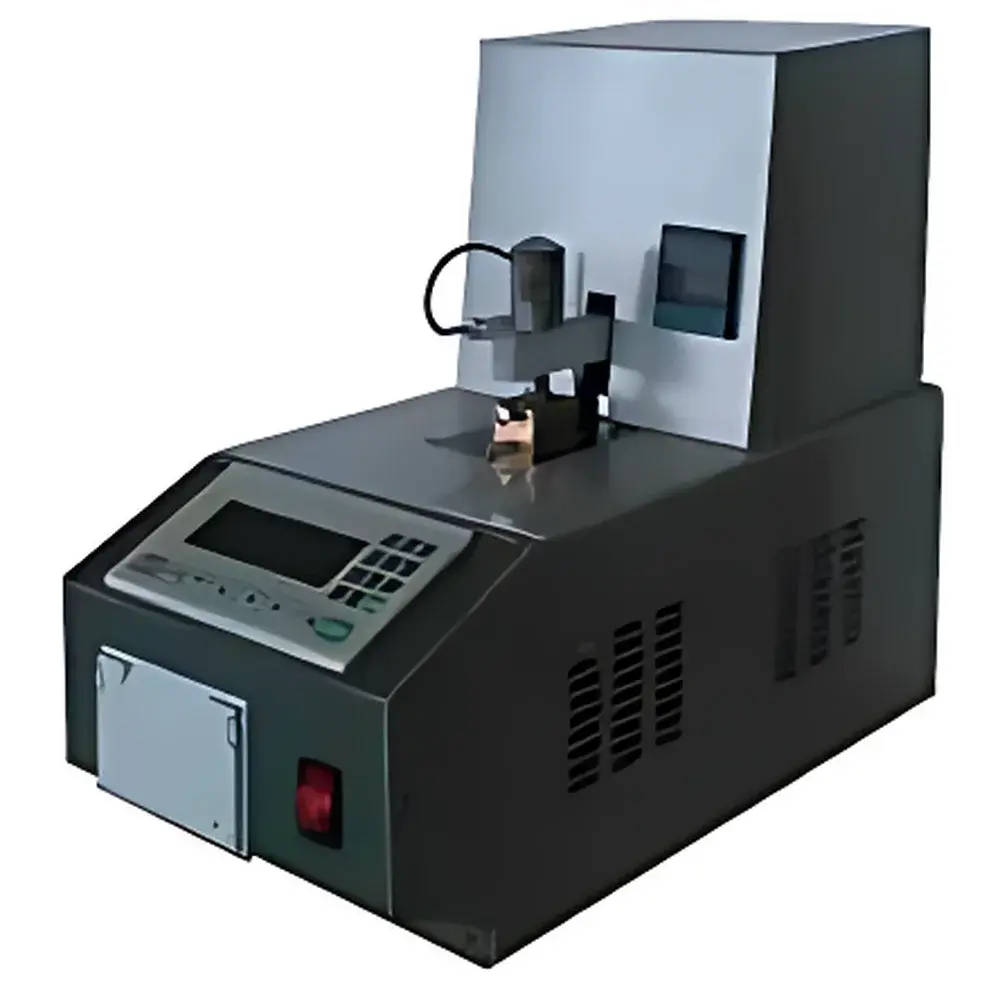
Xufeng XF-0765 High-Frequency Reciprocating Rig (HFRR) Diesel Lubricity Tester
| Brand | Xufeng |
|---|---|
| Origin | Shanghai, China |
| Model | XF-0765 |
| Standards Compliance | SH/T 0765-2005, ASTM D6079, ISO 12156-1, CEC F-06-A-96, IP 450, EN 590 |
| Temperature Range | 20–70 °C (±2 °C control accuracy) |
| Display | Text-based LCD |
| Printer | Integrated dot-matrix printer |
| Power Consumption | 200 W |
| Dimensions (W×D×H) | 230 × 500 × 350 mm |
| Weight | ~20 kg |
| Application | Fuel and lubricant wear performance evaluation under boundary lubrication conditions |
Overview
The Xufeng XF-0765 High-Frequency Reciprocating Rig (HFRR) Diesel Lubricity Tester is a precision-engineered benchtop instrument designed for quantitative assessment of boundary lubrication performance in diesel fuels, biodiesel blends, and light lubricants. It operates on the principle of high-frequency oscillatory motion—where a stationary steel ball is loaded against a rotating flat disc (typically AISI 52100 bearing steel) immersed in the test fluid, subjected to a defined load (e.g., 200 g or 300 g), frequency (50 Hz), amplitude (1 mm), and duration (75 minutes per test). Under controlled temperature (20–70 °C), the resulting wear scar diameter (WSD) on the ball surface is measured optically—typically via calibrated digital microscopy—and serves as the primary metric for lubricity ranking. This method directly correlates with real-world injector wear in modern high-pressure common-rail diesel engines, making HFRR testing indispensable for fuel formulation, quality assurance, and regulatory compliance.
Key Features
- Fully compliant with internationally recognized standards: SH/T 0765-2005, ASTM D6079, ISO 12156-1, CEC F-06-A-96, IP 450, and EN 590—ensuring data interoperability across global refining, trading, and regulatory laboratories.
- Microprocessor-controlled closed-loop thermal regulation with ±2 °C stability across the 20–70 °C operating range, critical for reproducible scar formation kinetics.
- Integrated text-based LCD interface enabling intuitive parameter setup—including test duration, load, temperature setpoint, and cycle count—without external PC dependency.
- Self-diagnostic firmware with real-time error logging and audible/visual alerts for mechanical faults, thermal deviation, or sensor anomalies.
- Onboard dot-matrix printer providing immediate hardcopy output of test parameters, timestamp, ambient conditions, and final WSD measurement—supporting audit-ready documentation per GLP and internal QA protocols.
- Compact stainless-steel chassis (230 × 500 × 350 mm; ~20 kg) optimized for space-constrained QC labs and mobile field-testing units.
- Critical electro-mechanical components—including linear actuators, load transducers, and temperature sensors—sourced from Tier-1 international suppliers to ensure long-term repeatability and minimal drift.
Sample Compatibility & Compliance
The XF-0765 accommodates neat diesel fuels (including ultra-low-sulfur diesel, fatty acid methyl ester blends up to B20), synthetic esters, bio-derived lubricants, and low-viscosity engine oils. Sample volume requirement is ≤2 mL per test, minimizing consumable cost and hazardous waste generation. All test procedures adhere strictly to the sample conditioning, cleaning, and handling protocols specified in ASTM D6079 Annex A1 and ISO 12156-1 Clause 6. The instrument’s mechanical design satisfies CE marking requirements for laboratory equipment (2014/30/EU EMC Directive and 2014/35/EU LVD Directive), and its operational logs meet minimum traceability thresholds for ISO/IEC 17025-accredited testing laboratories.
Software & Data Management
While the XF-0765 operates autonomously via embedded firmware, optional RS-232 or USB-to-serial interface enables integration with laboratory information management systems (LIMS) for automated result ingestion. Raw WSD values, test metadata (operator ID, batch number, calibration date), and environmental logs (chamber temperature, ambient humidity if externally monitored) are exportable in CSV format. For regulated environments, the system supports manual entry of electronic signatures and time-stamped annotations—providing foundational elements for FDA 21 CFR Part 11 alignment when paired with validated third-party data capture software. Calibration records, preventive maintenance logs, and verification reports (e.g., reference oil testing per ISO 12156-2) are retained locally and printable on demand.
Applications
- Quality control of diesel fuel batches prior to distribution, ensuring compliance with regional specifications (e.g., EN 590 Annex D, ASTM D975 Table 1).
- Evaluation of lubricity-enhancing additives (e.g., fatty acids, amides, esters) during formulation development.
- Stability assessment of biodiesel blends under accelerated aging conditions (e.g., EN 14214 oxidation protocols).
- Screening of alternative fuels—including hydrotreated vegetable oil (HVO) and Fischer–Tropsch liquids—for compatibility with legacy injection hardware.
- Root-cause analysis of field-reported injector scuffing or sticking incidents through retrospective fuel archive testing.
- Teaching and method validation in university petroleum engineering and tribology laboratories.
FAQ
What standards does the XF-0765 explicitly support?
It is fully configured to execute SH/T 0765-2005, ASTM D6079, ISO 12156-1, CEC F-06-A-96, IP 450, and EN 590 without hardware or firmware modification.
Is optical wear scar measurement included?
No—the XF-0765 delivers the conditioned test ball; final WSD quantification requires external calibration-grade optical microscopy (e.g., ISO 12156-2 compliant 100× magnification system) or optional add-on digital imaging module (sold separately).
Can the instrument operate unattended overnight?
Yes—once initiated, it completes the full 75-minute test cycle autonomously, including thermal stabilization, motion execution, and printout generation.
What maintenance intervals are recommended?
Daily: Clean test chamber and ball/disc surfaces with analytical-grade hexane; verify zero-load baseline. Quarterly: Re-calibrate temperature sensor and load cell using NIST-traceable references. Annually: Full mechanical inspection and firmware update per Xufeng service bulletin.
Does the system support multi-user access control?
Not natively—the LCD interface lacks password protection or role-based permissions; however, LIMS-integrated deployments can enforce user authentication upstream.




