
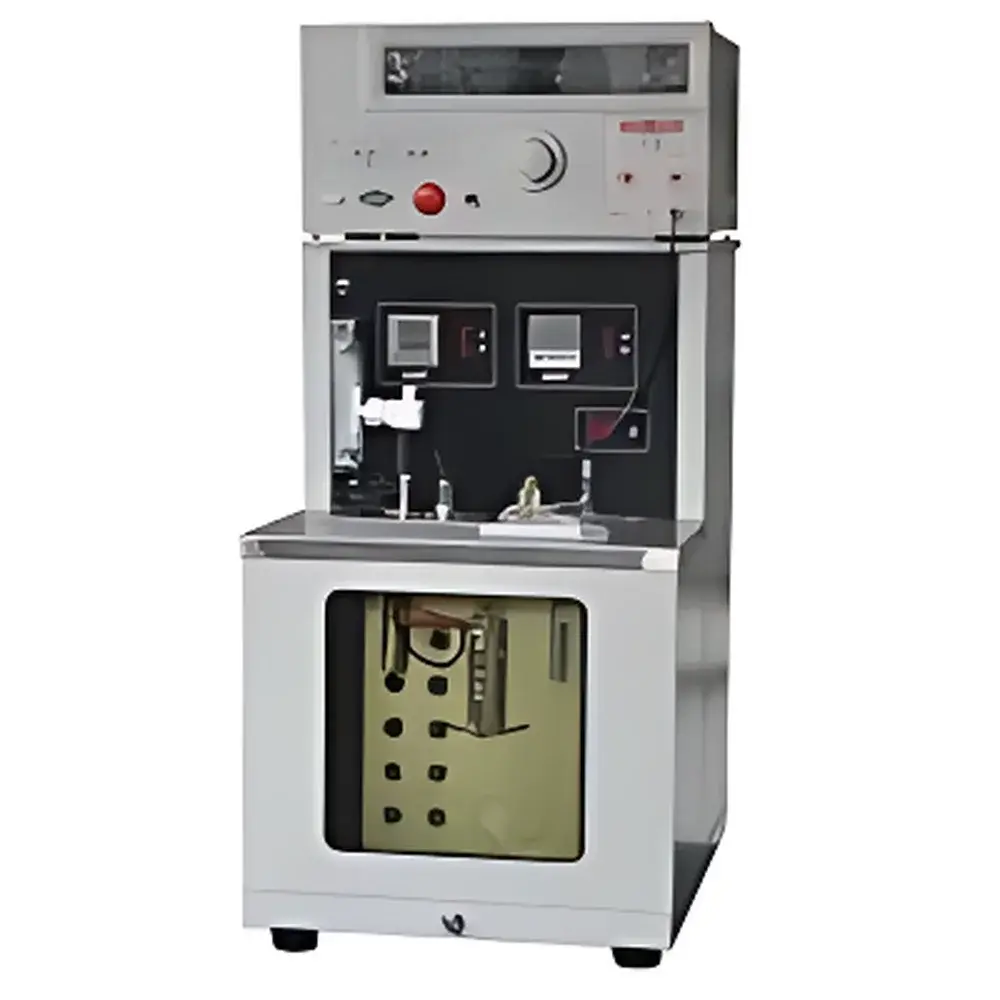
Xufeng XF-11142 Automatic Gassing Tendency Tester for Electrical Insulating Oils
| Brand | Xufeng |
|---|---|
| Origin | Shanghai, China |
| Model | XF-11142 |
| Applicable Standards | GB/T 11142, NB/SH/T 0810, ASTM D2300 |
| Temperature Control Range | Ambient to 80 ± 0.5 °C |
| Test Voltage | 10 kV ± 2% |
| Electrode Type | Hollow Electrode per ASTM D2300 |
| Power Supply | AC 220 V ± 10%, 50 Hz ± 5% |
| Heating Method | Immersed Tubular Heater |
| Temperature Control | PID Microprocessor Controller |
| Timing System | Digital Timer with Audible Alarm |
| Safety Features | Leakage Current Protection, Automatic Power Cut-off |
| Bath Material | Borosilicate Glass |
| Bath Enclosure | Stainless Steel with Tempered Glass Observation Window |
| Surface Finish | Electrostatic Powder Coating, High-Temperature Cured |
Overview
The Xufeng XF-11142 Automatic Gassing Tendency Tester is an engineered laboratory instrument designed to quantitatively evaluate the gassing behavior of electrical insulating liquids—primarily mineral and synthetic transformer oils, capacitor oils, and cable oils—under controlled high-voltage stress and ionization conditions. It implements the Modified Pirelli Method, as standardized in ASTM D2300, and fully complies with GB/T 11142 and NB/SH/T 0810. The instrument operates by subjecting a precisely measured volume of insulating oil to a sustained electric field (10 kV ± 2%) within a geometrically defined gassing cell immersed in a thermally stabilized bath. Gas evolution or absorption at the oil–gas interface is monitored volumetrically after a fixed duration, yielding a net gassing tendency value (mL gas/100 mL oil), which serves as a critical indicator of long-term dielectric stability and oxidation resistance under service conditions.
Key Features
- Integrated high-stability DC high-voltage power supply with regulated output and real-time voltage monitoring—ensures consistent field strength throughout test cycles per ASTM D2300 Section 7.3.
- Hollow electrode assembly fabricated from corrosion-resistant stainless steel, dimensionally conforming to ASTM D2300 specifications for electrode geometry and surface finish.
- PID-controlled borosilicate glass heating bath (ambient to 80 ± 0.5 °C), enabling precise thermal regulation critical for reproducible gas solubility and reaction kinetics.
- Digital microprocessor timer with programmable duration (up to 99 h 59 min) and audible end-of-test alarm—supports unattended operation while maintaining GLP-compliant timing traceability.
- Double-insulated stainless steel enclosure with tempered glass observation window—facilitates real-time visual verification of electrode discharge activity, bubble formation, and meniscus displacement without opening the system.
- Ground-fault leakage protection circuitry that detects ≥30 mA residual current and triggers immediate power disconnection—meets IEC 61000-4-5 surge immunity and local electrical safety requirements (GB 4793.1).
- Modular gassing cell design with calibrated volumetric scale and quick-connect fittings—enables rapid cleaning, validation, and cross-lab method transferability.
Sample Compatibility & Compliance
The XF-11142 is validated for use with non-halogenated hydrocarbon-based insulating liquids, including naphthenic and paraffinic mineral oils, silicone fluids, and polyalphaolefin (PAO)-based synthetics. It excludes chlorinated or highly polar ester-based fluids unless prequalified per NB/SH/T 0810 Annex A. All operational parameters—including temperature ramp rate, voltage application sequence, and gas collection interval—are aligned with the procedural rigor of ASTM D2300 (2023 edition), GB/T 11142–2019, and NB/SH/T 0810–2010. The instrument’s measurement uncertainty budget accounts for bath temperature deviation (±0.5 °C), voltage drift (±2%), and volumetric reading error (±0.1 mL), supporting ISO/IEC 17025-compliant calibration protocols when paired with NIST-traceable reference standards.
Software & Data Management
The XF-11142 operates as a standalone hardware platform without embedded software or network connectivity—intentionally designed to minimize cybersecurity exposure and ensure deterministic real-time control. All test parameters (voltage setpoint, bath temperature, duration) are entered via front-panel membrane keys; results are recorded manually or exported via optional RS-232 interface to external LIMS or ELN systems. Audit trails—including operator ID, date/time stamp, and raw volumetric readings—are maintained in paper-based lab notebooks per 21 CFR Part 11 Annex B guidelines for non-electronic records. For laboratories requiring electronic data capture, third-party compliant data loggers (e.g., Omega OM-DAQPRO-5300) may be integrated using analog voltage outputs (0–10 V) for bath temperature and digital TTL pulses for timer status.
Applications
- Quality assurance of new insulating oils prior to transformer filling (per IEC 60296 and IEEE C57.106).
- Monitoring oxidative degradation in service-aged oils during routine maintenance testing.
- Formulation screening of antioxidant additives (e.g., DBPC, Irganox L series) and their impact on gassing suppression.
- Comparative evaluation of alternative insulating fluids (e.g., natural esters vs. mineral oils) under accelerated electrical stress.
- Root-cause analysis of abnormal gas-in-oil data (DGA) in field units exhibiting H₂ or C₂H₂ anomalies.
FAQ
What safety certifications does the XF-11142 hold?
The instrument complies with GB 4793.1–2019 (Safety Requirements for Electrical Equipment for Measurement, Control, and Laboratory Use) and meets CE-marking essential requirements for low-voltage directive (2014/35/EU) and EMC directive (2014/30/EU) when installed per manufacturer instructions.
Can the instrument be used for silicone-based insulating fluids?
Yes—provided the fluid exhibits no significant volatility below 80 °C and remains chemically inert toward borosilicate glass and stainless steel components. Validation per ASTM D2300 Annex B is recommended before first use.
Is calibration traceable to national standards?
Voltage and temperature transducers are supplied with factory calibration certificates traceable to CNAS-accredited labs (certificate included). End-user periodic verification against NIST SRM 1965 (thermistor calibration standard) and high-voltage divider standards is advised annually.
Does the system support automated gas composition analysis?
No—the XF-11142 measures only net gas volume change. Coupling with GC-TCD or FTIR gas analyzers requires external sampling manifolds and is outside the scope of standard configuration.
What maintenance intervals are recommended?
Bath fluid (distilled water or silicone oil) should be replaced quarterly; electrode surfaces require ultrasonic cleaning with isopropanol after every 10 tests; PID controller calibration verified semiannually using a Class A PT100 probe.





