
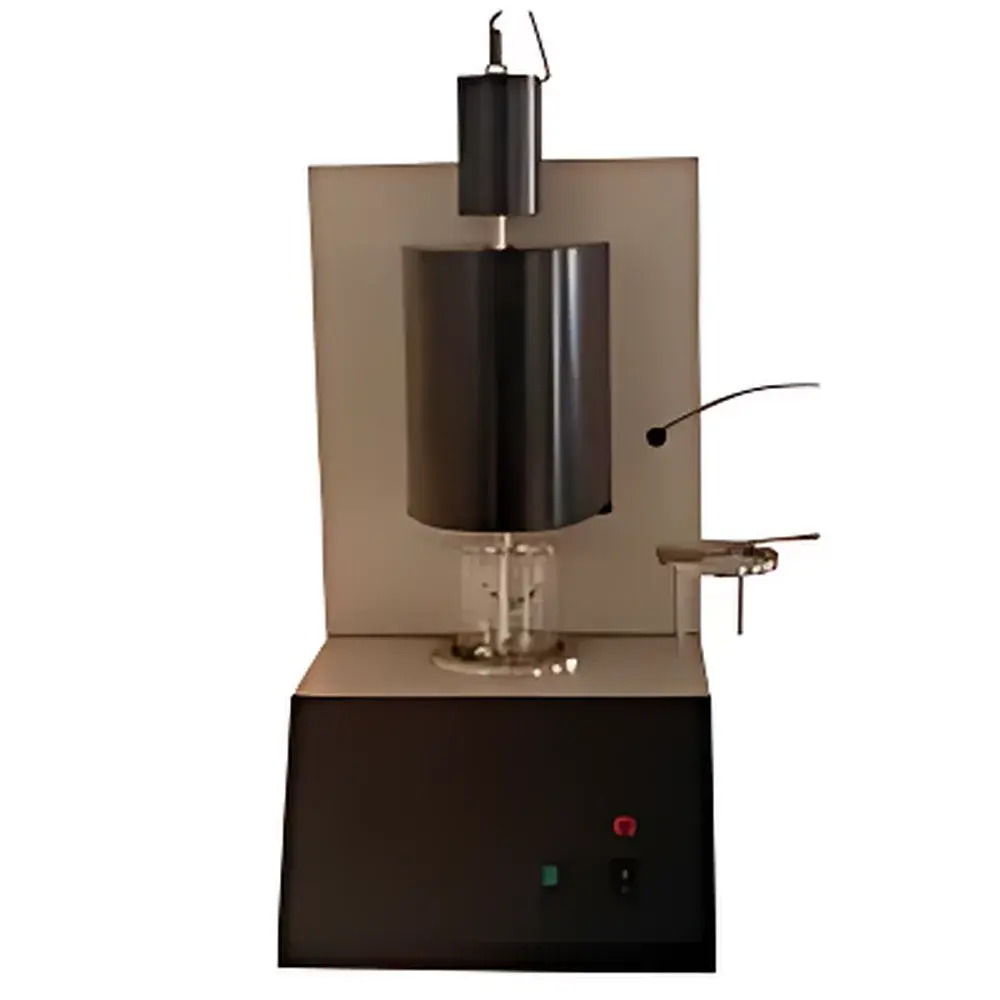
Xufeng XF-3520 Automatic Heat Treatment Oil Cooling Performance Tester
| Brand | Xufeng |
|---|---|
| Origin | Shanghai, China |
| Model | XF-3520 |
| Standards Compliance | SH/T 0220, ASTM D3520 (withdrawn 2008), JIS K 2242 |
| Temperature Control Accuracy | ±2 °C (silver probe at 810 °C |
| Timing Resolution | 0.1 s |
| Data Storage Capacity | 100 test records |
| Power Consumption | 1.6 kW |
| Dimensions (W×D×H) | 300 mm × 450 mm × 650 mm |
| Weight | ~25 kg |
| Interface | RS-232C serial port |
| Construction | Desktop, full stainless-steel chassis |
Overview
The Xufeng XF-3520 Automatic Heat Treatment Oil Cooling Performance Tester is a precision-engineered benchtop instrument designed for quantitative evaluation of quenching behavior in heat treatment oils and other industrial quenchants. It implements the magnetic quenchometer principle—originally standardized in ASTM D3520 (1984–2004)—wherein a calibrated silver probe is heated to a defined austenitizing temperature (810 °C ±2 °C), then immersed into a thermally stabilized oil bath (80–160 °C ±2 °C). The instrument continuously monitors the time-dependent temperature decay of the silver probe, generating high-fidelity cooling curves in real time. From these curves, critical thermal parameters—including characteristic temperatures (e.g., 700 °C, 500 °C, 300 °C), maximum cooling rates, and vapor film duration—are extracted per SH/T 0220 and JIS K 2242 protocols. Unlike manual or analog systems, the XF-3520 replaces legacy X-Y recorders with a Windows-based acquisition and analysis platform, enabling traceable, reproducible, and auditable cooling performance assessment under controlled laboratory conditions.
Key Features
- Fully automated operation: Predefined test parameters (target probe temperature, bath setpoint, data logging interval) are entered via intuitive GUI; initiation requires only a single START command.
- Dual-curve real-time visualization: Simultaneous display of silver probe temperature vs. time and log(time) vs. temperature on a high-resolution Windows interface—supporting immediate verification of vapor phase, boiling, and convection stages.
- Integrated thermal control architecture: Independent PID-regulated heating zones for both the silver probe furnace (810 °C) and sample bath (80–160 °C), each maintaining ±2 °C stability over full operational cycles.
- RS-232C communication port: Enables bidirectional data exchange with centralized QA/QC servers or LIMS environments—facilitating batch-level traceability and automated report generation.
- Robust mechanical design: Compact desktop footprint (300 × 450 × 650 mm) with full stainless-steel housing ensures long-term dimensional stability, chemical resistance, and compatibility with ISO/IEC 17025-accredited lab layouts.
- Built-in diagnostics: Real-time fault detection (e.g., thermocouple open circuit, heater timeout, communication loss) with on-screen alerts and logged event timestamps for root-cause analysis.
Sample Compatibility & Compliance
The XF-3520 supports standard quench media including mineral oils, polymer-based aqueous solutions, molten salts, and fast-cooling synthetic fluids. Sample volume requirements align with SH/T 0220 (≥1.5 L) and JIS K 2242 (≥1.2 L), with integrated bath-level monitoring to prevent dry-run conditions. All thermal calibrations are referenced to NIST-traceable Pt100 sensors. While ASTM D3520 was officially withdrawn in 2008, the method remains widely cited in OEM specifications (e.g., aerospace heat treat suppliers, gear manufacturers) and is explicitly retained in internal quality manuals governed by AS9100 and IATF 16949. The instrument’s data structure—time-stamped raw temperature arrays, calculated cooling rates, and annotated curve inflection points—supports GLP-compliant audit trails when paired with 21 CFR Part 11-enabled software extensions (available as optional configuration).
Software & Data Management
Data acquisition and post-processing are handled by proprietary Windows software compatible with Windows 10/11 (64-bit). Each test generates a structured .CSV file containing timestamped temperature readings at 0.1 s intervals, along with metadata (operator ID, sample ID, ambient conditions, calibration certificate IDs). Up to 100 complete test histories are stored onboard; external export to network drives or USB media is supported. Curve overlay functionality allows comparative analysis across batches or formulations. All reports include embedded compliance statements referencing SH/T 0220 Clause 5.3 (cooling rate calculation algorithm) and JIS K 2242 Annex B (uncertainty estimation guidelines). Audit logs record user login events, parameter modifications, and data deletion actions—meeting baseline requirements for ISO 17025 clause 7.7.2 (data integrity).
Applications
- Qualification of new quench oils prior to production line implementation.
- Batch-to-batch consistency monitoring in lubricant manufacturing.
- Failure analysis of distorted or cracked components linked to suboptimal cooling kinetics.
- Development of low-distortion quenching processes for high-alloy steels (e.g., H13, M2) and titanium alloys.
- Validation of oil degradation due to oxidation, soot loading, or water contamination—via longitudinal tracking of vapor film lifetime and 300 °C cooling rate trends.
- Technical support for heat treat service providers seeking third-party certification under Nadcap AC7102/3.
FAQ
Does the XF-3520 comply with current ASTM standards?
ASTM D3520 was withdrawn in 2008, but the instrument fully satisfies its technical methodology and remains aligned with active national standards SH/T 0220 (China) and JIS K 2242 (Japan), both of which specify identical probe geometry, immersion depth, and data reduction procedures.
Is the silver probe included and certified?
Yes—a calibrated silver probe (99.99% purity, 6.35 mm diameter × 60 mm length) is supplied with NIST-traceable calibration documentation valid for 12 months from shipment.
Can test data be exported for statistical process control (SPC)?
Yes: Raw .CSV outputs contain all required fields for import into JMP, Minitab, or custom SPC dashboards; moving range charts for 500 °C cooling time are routinely generated in customer validation studies.
What maintenance is required for long-term accuracy?
Annual recalibration of furnace and bath temperature controllers using reference thermocouples is recommended; stainless-steel chamber cleaning with acetone every 50 tests prevents carbon buildup on probe surfaces.





