
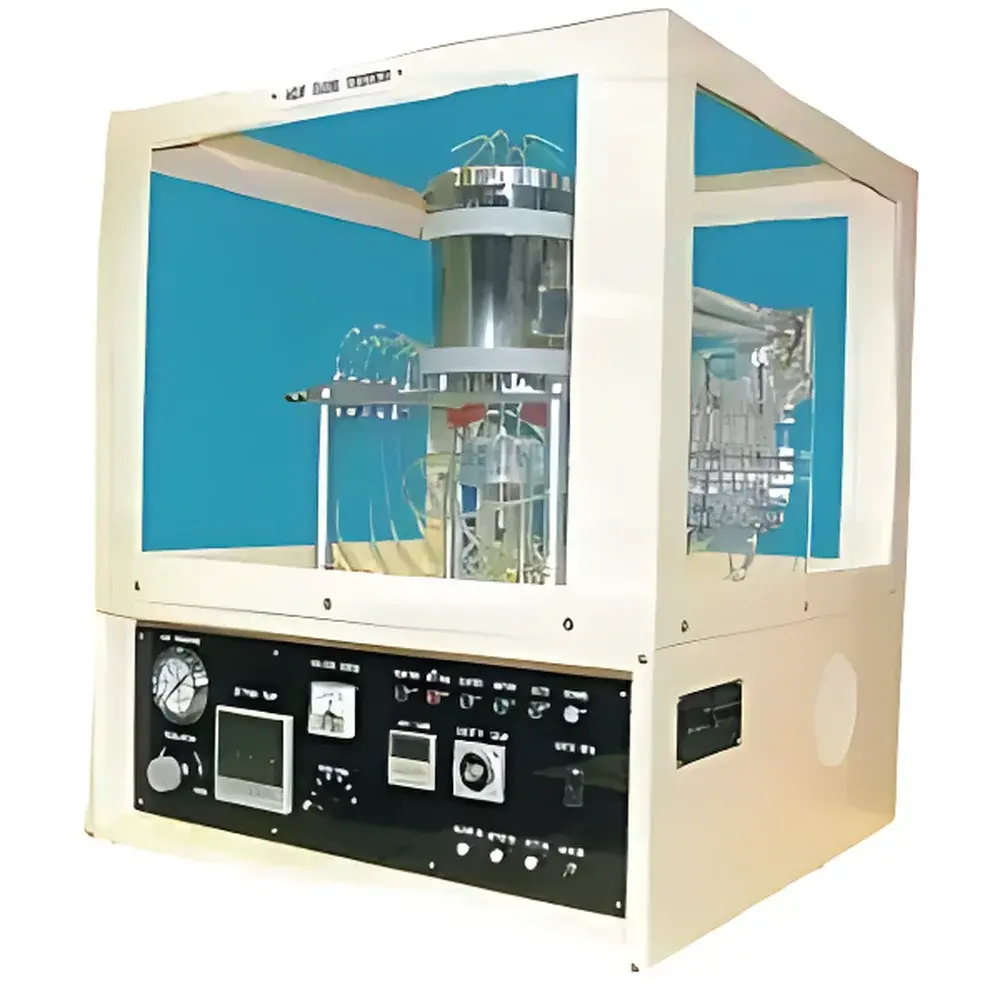
Komatsu HT-201 Hot Tube Tester for Engine Lubricant High-Temperature Deposit Formation Assessment
| Origin | Japan |
|---|---|
| Manufacturer Type | Authorized Distributor |
| Origin Category | Imported |
| Model | HT-201 |
| Price | Upon Request |
Overview
The Komatsu HT-201 Hot Tube Tester is a benchtop thermal deposition assessment instrument engineered to evaluate the high-temperature cleanliness and deposit-forming tendency of engine lubricants—including diesel engine oils, gasoline engine oils, and conventional mineral-based crankcase lubricants. It operates on the principle of controlled thermal stress-induced coking within a precisely dimensioned quartz-glass capillary tube, simulating the localized overheating conditions observed in critical engine zones such as piston ring grooves, valve stems, and turbocharger bearings. Unlike generic oxidation or sludge formation tests, the HT-201 replicates the thermo-oxidative degradation pathway that leads to carbonaceous deposit accumulation under sustained elevated temperatures (200–350 °C), with direct correlation validated against real-world engine fleet trials and standardized engine dynamometer testing. Its design originates from Komatsu’s proprietary KES (Komatsu Engineering Standard) methodology and conforms fully to JIS K 2220 (Testing Methods for Engine Oil Deposit Forming Tendency), providing traceable, reproducible data for formulation development, quality control, and regulatory compliance in OEM and lubricant additive R&D laboratories.
Key Features
- Simultaneous six-sample capacity enables parallel evaluation of multiple formulations or batch samples without operator intervention—reducing labor cost and experimental throughput time by up to 83% versus single-channel alternatives.
- Dual independent temperature regulation system: primary test temperature controller (setpoint range 200–350 °C, ±1 °C stability) and secondary overheat safety limiter (adjustable up to 400 °C), ensuring fail-safe operation during unattended 16-hour test cycles.
- Precision-controlled oil delivery: gravimetrically calibrated micro-pump delivers 0.31 ± 0.01 mL/min per channel, synchronized with regulated compressed air flow (0.3–0.4 kg/cm² at 10 ± 0.5 mL/min per channel) to maintain consistent aerosolization and thermal exposure dynamics inside the capillary.
- Standardized capillary geometry: soft glass tubing (OD 4.0 ± 0.2 mm, ID 2.0 ± 0.1 mm, L 300 mm) ensures uniform heat transfer profile and enables quantitative post-test analysis of deposit mass and chromatic index via gravimetric weighing and digital image-based colorimetry (ASTM D7872-compliant).
- Compact footprint (650 × 600 × 785 mm) and low power demand (AC 100 V, 15 A, 50/60 Hz) facilitate integration into ISO 17025-accredited QC labs without requiring dedicated HVAC or high-capacity electrical infrastructure.
Sample Compatibility & Compliance
The HT-201 is validated for use with liquid hydrocarbon-based engine lubricants meeting API SP, CJ-4, CK-4, and ILSAC GF-6 specifications, including conventional, semi-synthetic, and certain PAO-based formulations. It is not intended for pure ester-based or polyglycol synthetic fluids—those require the higher-temperature HT-202 variant (350–600 °C). All test procedures comply with JIS K 2220 Annex B (Hot Tube Method) and align with the physical principles referenced in ASTM D2272 (Rotating Bomb Oxidation Test) and ASTM D6335 (High-Temperature Deposits in Spark-Ignition Engines), supporting cross-method correlation studies. The system supports GLP-compliant documentation when paired with validated electronic lab notebooks (ELN) and satisfies audit requirements for FDA 21 CFR Part 11 where electronic records are implemented with appropriate access controls and audit trails.
Software & Data Management
The HT-201 operates as a standalone hardware platform with embedded microcontroller-based timing and thermal management—no proprietary software is required for basic operation. However, it interfaces seamlessly with third-party data acquisition systems (e.g., LabVIEW, MATLAB, or custom Python-based logging tools) via RS-232 or optional analog voltage outputs (0–5 V for temperature, status flags). Users may implement automated reporting templates aligned with internal SOPs or external standards such as ISO/IEC 17025 clause 7.8.2 (Reporting of Results). Calibration certificates for temperature sensors (traceable to NMIJ/JCSS) and flow meters (ISO/IEC 17025-accredited) are supplied with each unit. Firmware updates and calibration verification protocols are available through Komatsu-certified service partners under formal maintenance agreements.
Applications
- Formulation screening of detergent/dispersant packages for improved high-temperature deposit control.
- Batch release testing of finished lubricants against OEM-specific cleanliness thresholds (e.g., Komatsu KES 04.1103, Cummins CES 20081).
- Root-cause analysis of field-reported piston deposit issues using accelerated lab-scale replication.
- Supporting ASTM WK76297 (proposed standard for thermal deposit quantification in heavy-duty engine oils).
- Teaching and method validation in university tribology and fuels engineering programs.
FAQ
What distinguishes the HT-201 from other hot tube or coking testers?
The HT-201 uniquely integrates capillary geometry, airflow-oil ratio, and thermal gradient profiles derived from in-engine thermography and deposit mapping—not empirical correlations. Its KES-validated protocol demonstrates >0.92 Pearson correlation with Komatsu SAAE (Single-Cylinder Automotive Engine) test results.
Can the HT-201 be used for bio-based or renewable engine oils?
Yes, provided the base stock exhibits thermal stability within the 200–350 °C range and does not volatilize significantly below 200 °C; pre-screening via TGA is recommended.
Is third-party calibration support available outside Japan?
Yes—authorized Komatsu service centers in North America, Europe, and APAC provide annual calibration services with NIST-traceable documentation and on-site verification of flow rate, temperature uniformity, and timing accuracy.
Does the system meet CE or UKCA marking requirements?
The HT-201 complies with IEC 61010-1:2010 for laboratory electrical equipment and carries EMC Directive 2014/30/EU conformity; CE marking is applied upon regional distributor certification.
How is deposit quantification performed post-test?
Operators weigh the cleaned capillary pre- and post-test using an analytical balance (0.01 mg resolution); deposit mass is calculated as the difference. Optional digital microscopy (20×–100×) enables qualitative grading per JIS K 2220 visual scale (0–5), and image-based hue/saturation analysis supports semi-quantitative trending.





