
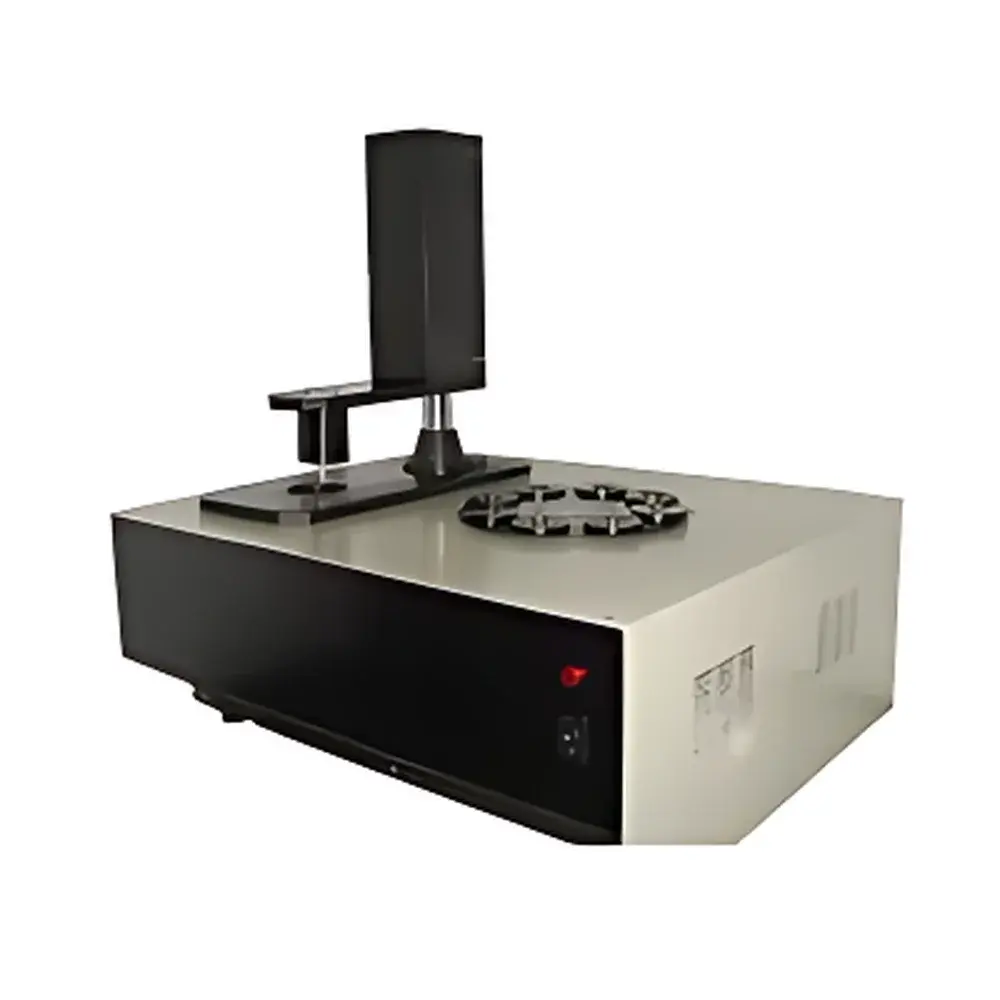
XuFeng XF-97C Automatic Pour Point Tester (Multi-Cup, Air Pressure Detection Method)
| Brand | XuFeng |
|---|---|
| Origin | Shanghai, China |
| Model | XF-97C |
| Temperature Range | –80 °C to +50 °C |
| Cooling System | External cascade compressor chiller |
| Detection Method | Optical fiber–based air pressure displacement sensing |
| Compliance | ASTM D6749, ASTM D97, GB/T 3535 |
| Temperature Resolution | 0.1 °C |
| Sensor Type | Pt100 platinum resistance thermometer |
| Power Supply | AC 220 V, 50/60 Hz, 1500 W |
| Dimensions (Analyzer Unit) | 500 × 300 × 250 mm |
| Weight | ~40 kg |
| Dimensions (Chiller Unit) | 400 × 400 × 750 mm |
| Weight | ~30 kg |
| Sample Volume per Test | 5 mL |
| Interface | RS-232C serial port, Windows-based control software |
| Display | Integrated color LCD touchscreen |
| Output | A4 color inkjet printer (standard), real-time curve logging, automated report generation |
Overview
The XuFeng XF-97C Automatic Pour Point Tester is a benchtop, multi-cup petroleum low-temperature property analyzer engineered for precise, reproducible determination of the pour point of crude oils, lubricants, distillates, and other hydrocarbon-based fluids. It implements the air pressure displacement detection principle defined in ASTM D6749 — a method that monitors the cessation of fluid movement under controlled cooling by detecting minute changes in air pressure within a sealed sample tube as wax crystals form and impede flow. This approach eliminates subjective visual assessment and provides objective, operator-independent endpoint detection. The instrument integrates a dedicated external cascade compressor chiller capable of achieving –80 °C, enabling compliance with demanding specifications for high-wax-content or arctic-grade fuels. Its stainless-steel construction, compact footprint, and embedded microprocessor architecture ensure long-term stability in QC laboratories operating under GLP or ISO/IEC 17025 frameworks.
Key Features
- Multi-cup configuration supports up to six simultaneous tests, significantly improving throughput in high-volume testing environments.
- Optical fiber–coupled air pressure transduction system delivers high-sensitivity detection of flow arrest, minimizing false positives and ensuring repeatability within ±1 °C (per ASTM D6749 repeatability criteria).
- Integrated color LCD touchscreen interface enables full local operation without external PC dependency; optional Windows-based software provides advanced data visualization, curve overlay, and audit-ready reporting.
- PT100 platinum resistance thermometers calibrated traceably to NIST standards provide temperature measurement accuracy of ±0.2 °C across the full –80 °C to +50 °C range.
- Automated fault diagnostics with on-screen error codes and audible alarm facilitate rapid troubleshooting and minimize instrument downtime.
- RS-232C serial interface supports bidirectional communication with LIMS or laboratory network infrastructure, enabling centralized data archiving and remote monitoring.
- Compressor-driven cold trap ensures stable thermal gradients during ramp-down cycles, critical for accurate crystallization profiling per ASTM D97 Annex A1.
- Onboard A4 color inkjet printer produces hardcopy reports containing test parameters, cooling curve, detected pour point, operator ID, timestamp, and instrument calibration status.
Sample Compatibility & Compliance
The XF-97C is validated for use with transparent and opaque petroleum products including diesel fuel, jet fuel (Jet A/A-1), base oils, transformer oils, and residual fuel oils. It conforms fully to ASTM D6749 (Standard Test Method for Pour Point of Petroleum Products — Automatic Air Pressure Method), which supersedes and technically aligns with ASTM D97 (Standard Test Method for Pour Point of Petroleum Products) and GB/T 3535 (Determination of Pour Point of Petroleum Products). All hardware and firmware components meet CE electromagnetic compatibility (EMC) directives and are designed for operation in ambient conditions of 5–35 °C and ≤85% RH (non-condensing). The system supports 21 CFR Part 11–compliant electronic records when deployed with validated software configurations and user access controls.
Software & Data Management
The included Windows-compatible control software offers real-time graphical display of temperature vs. time curves, configurable cooling rate profiles (e.g., 1.5 °C/min per ASTM D6749), and automatic endpoint interpolation. Data files are stored in CSV and PDF formats with embedded metadata (test ID, operator, date/time, calibration certificate ID, environmental logs). Audit trails record all parameter modifications, test starts/stops, and calibration events. Export functionality supports direct integration with enterprise LIMS platforms via ODBC or HL7 interfaces. Software updates are delivered via secure HTTPS channel with SHA-256 signature verification.
Applications
- Quality control of refinery streams prior to blending or shipment
- Specification verification for military and aviation fuel procurement (MIL-DTL-83133, DEF STAN 91-86)
- Research into wax inhibition additive efficacy and cold flow improver performance
- Field support testing at offshore platforms and remote storage terminals using portable chiller configurations
- Regulatory compliance testing for EPA, API, and regional environmental agencies requiring documented low-temperature behavior
- Interlaboratory round-robin studies where inter-operator variability must be minimized
FAQ
What standards does the XF-97C comply with?
ASTM D6749, ASTM D97, and GB/T 3535 — fully supported through hardware design, sensor calibration, and software logic.
Is external refrigeration mandatory for –80 °C operation?
Yes. The XF-97C requires the supplied external cascade compressor chiller to achieve –80 °C; internal Peltier elements alone cannot sustain this range.
Can test data be exported to Excel or LIMS?
Yes. CSV and PDF exports are native; optional LIMS drivers support HL7 and ASTM E1384 message protocols.
Does the system support 21 CFR Part 11 compliance?
When configured with role-based user accounts, electronic signatures, and audit-trail-enabling software, it meets technical requirements for Part 11 adherence.
What is the minimum sample volume required per test?
5 mL — consistent with ASTM D6749 Section 7.2 and optimized for reduced reagent consumption and waste generation.
How is temperature uniformity verified across multiple cups?
Each cup position is independently monitored via dedicated PT100 sensors; software performs real-time variance correction and flags deviations exceeding ±0.3 °C.




