
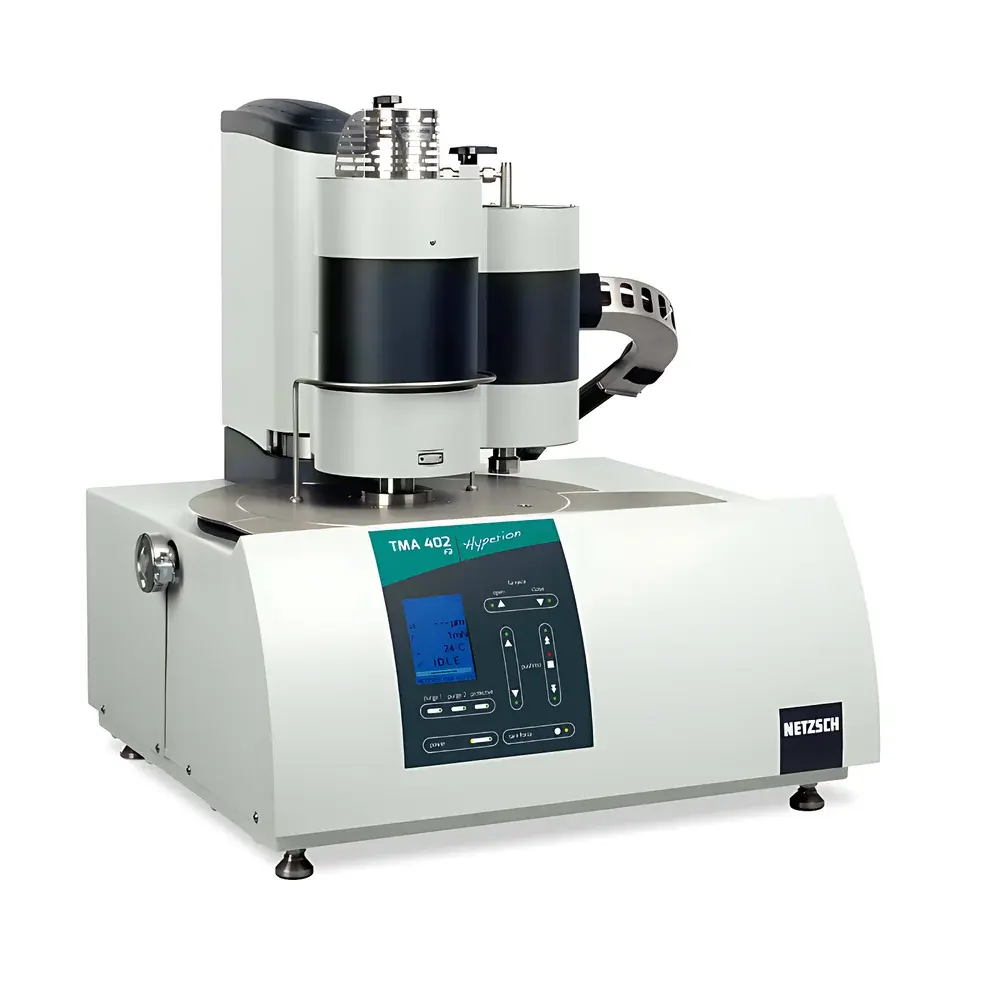
Netzsch TMA 402 F3 Hyperion Thermomechanical Analyzer
| Brand | Netzsch |
|---|---|
| Origin | Germany |
| Model | TMA 402 F3 Hyperion |
| Temperature Range | -150°C to 1550°C |
| Temperature Accuracy | ±0.1°C |
| Force Range | ±3 N |
| Displacement Range | ±2.5 mm |
| Displacement Resolution | 0.125 nm |
| Force Resolution | 0.01 mN |
| Heating Rate | 0–50°C/min |
| Measurement Atmosphere | Oxidizing, Reducing, Inert, Vacuum (down to 10⁻⁴ mbar) |
| Dual-Furnace Capability | Yes |
| Compatible Furnaces | Interchangeable with DSC and STA systems |
| Optional Modes | Dynamic Force, Rate-Controlled Sintering (RCS), Compression/Indentation/Bending/Tension |
Overview
The Netzsch TMA 402 F3 Hyperion is a high-precision thermomechanical analyzer engineered for quantitative measurement of dimensional changes in solid and semi-solid materials under controlled thermal and mechanical conditions. Based on the principle of contact-based dilatometry with active force control, it applies programmable static or dynamic loads while monitoring sample displacement with sub-nanometer resolution across an exceptionally broad temperature range—from cryogenic conditions (-150°C) to ultra-high temperatures (1550°C). This capability enables rigorous characterization of thermally induced expansion, contraction, softening, creep, stress relaxation, and viscoelastic transitions—critical parameters in polymer science, ceramic processing, metallurgy, composites development, and advanced packaging research. Its modular furnace architecture supports application-specific thermal environments without hardware reconfiguration, ensuring experimental flexibility while maintaining metrological integrity per ISO 11359-2 and ASTM E831 standards.
Key Features
- Triple-range furnace system with interchangeable units covering low-, mid-, and high-temperature domains; all furnaces share mechanical and electrical interfaces with Netzsch DSC and STA platforms for cross-technique method transfer.
- Dual-furnace mounting station allows rapid switching between temperature regimes during a single experimental session—eliminating cooldown/reheat cycles and improving throughput in comparative studies.
- Capacitive displacement sensor with 0.125 nm resolution and active drift compensation ensures long-term stability in both static and dynamic measurements, even during extended isothermal holds or slow heating ramps.
- Vacuum-tight furnace housing (10⁻⁴ mbar base pressure) supports coupling with FTIR or QMS for evolved gas analysis (EGA), enabling simultaneous correlation of dimensional change with chemical decomposition events.
- Microprocessor-controlled electromechanical actuator delivers precise force application from 1 µN to 3 N with closed-loop feedback, supporting compression, tension, bending, and penetration modes—including rate-controlled sintering (RCS) for ceramic densification kinetics.
Sample Compatibility & Compliance
The TMA 402 F3 accommodates diverse geometries including rods, fibers, films, powders (in crucibles), coatings, and bulk solids up to 25 mm in length. Standard probe configurations include flat-ended, spherical, and needle tips; custom probes are available for specialized applications such as thin-film adhesion or fiber shrinkage testing. All measurement protocols comply with GLP documentation requirements, and data acquisition includes full audit trails meeting FDA 21 CFR Part 11 criteria when used with Netzsch Proteus® software in validated environments. The instrument satisfies ISO 11359-1 (general principles), ISO 11359-2 (determination of linear expansion coefficient), and ASTM E374 (standard practice for TMA calibration).
Software & Data Management
Controlled exclusively via Netzsch Proteus® software, the system provides integrated instrument operation, real-time visualization, and post-acquisition analysis. Proteus supports multi-step temperature programs with conditional triggers (e.g., hold upon reaching a defined expansion rate), automatic baseline correction using reference curves, and derivative analysis for inflection point detection (e.g., Tg, Ts). Raw data files (.par) are stored in vendor-neutral ASCII format with embedded metadata (time stamps, calibration IDs, operator notes), facilitating import into third-party statistical or modeling tools. Optional modules include compliance reporting templates for ISO/IEC 17025 laboratories and automated report generation aligned with internal QA workflows.
Applications
- Determination of coefficient of linear thermal expansion (CTE) and volumetric expansion in metals, ceramics, and composite laminates.
- Identification of glass transition (Tg), softening (Ts), and crystallization onset temperatures in thermoplastics, elastomers, and amorphous pharmaceuticals.
- Quantification of residual stress relaxation in injection-molded parts and multilayer electronic substrates.
- High-temperature modulus tracking (via dynamic force mode) for refractory materials and aerospace alloys during thermal cycling.
- Characterization of curing kinetics and network formation in thermosets using constrained expansion or forced deflection methods.
- Shrinkage behavior analysis of green ceramic bodies during binder burnout and sintering—enabled by Rate-Controlled Sintering (RCS) functionality.
FAQ
What temperature calibration standards are supported?
Certified indium, zinc, tin, aluminum, and graphite standards are recommended for routine verification; calibration certificates traceable to PTB or NIST are available upon request.
Can the TMA 402 F3 operate under inert gas flow without vacuum?
Yes—gas-tight purge connections support continuous flow rates from 20 to 200 mL/min with optional mass flow controllers for precise atmosphere management.
Is remote monitoring or unattended operation possible?
Proteus software supports scheduled runs, email alerts upon completion or error, and secure remote desktop access via IT-approved protocols—subject to local network policy.
How is force accuracy maintained across the full range?
Each force transducer undergoes individual factory calibration against dead-weight standards; auto-zero and span-check routines are executed before every measurement sequence.
Are there limitations on sample geometry for tensile mode?
Tensile fixtures require specimens with uniform cross-sections (minimum width 1 mm, thickness ≤ 0.5 mm); dog-bone geometries are not required but improve stress distribution uniformity.



