
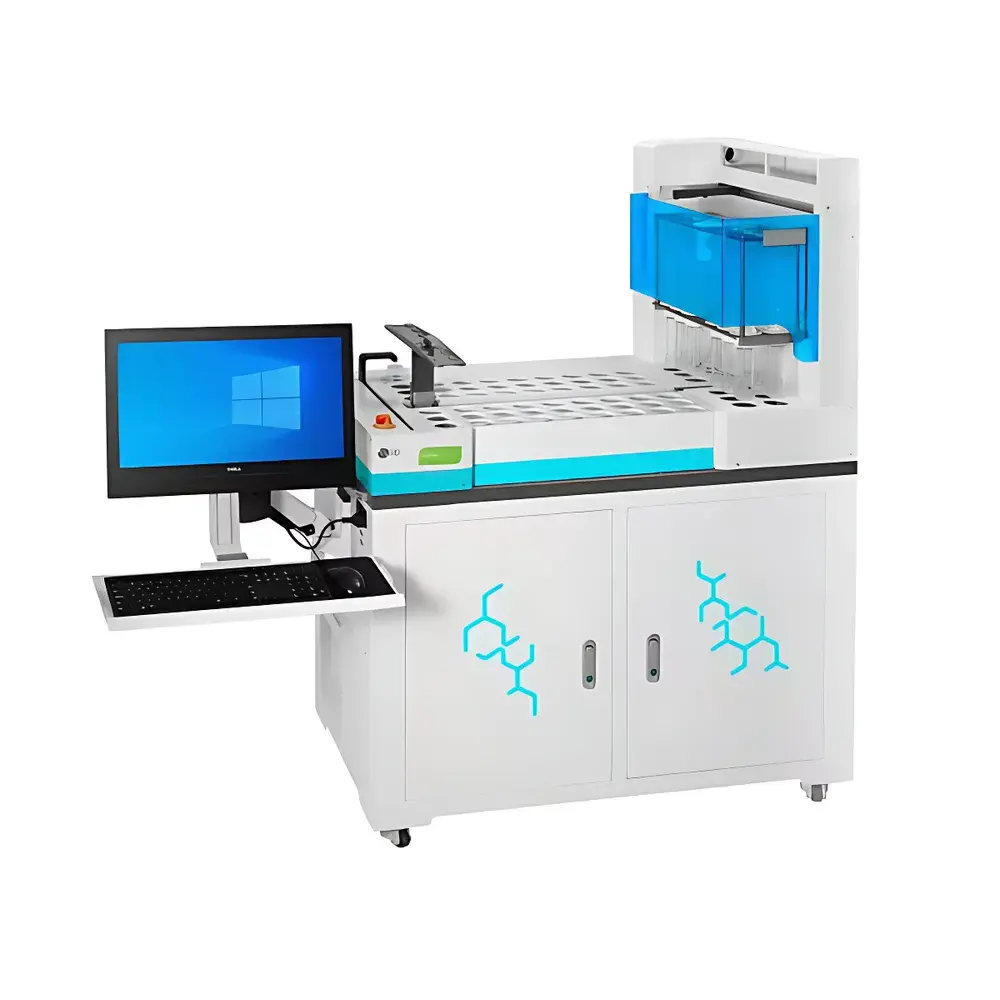
SENTE ST600D Fully Automated CODCr Analyzer Workstation
| Brand | SENTE |
|---|---|
| Origin | Shandong, China |
| Manufacturer Type | Direct Manufacturer |
| Regional Classification | Domestic (China) |
| Model | ST600D |
| Instrument Type | Laboratory Benchtop System |
| Measurement Principle | 2-Hour Reflux Digestion (Dichromate Oxidation Method) |
| Detection Wavelength | 500 nm |
| Measurement Range | 16–700 mg/L COD |
| Accuracy | ≤ ±8% |
| Repeatability | ≤ ±5% |
| Limit of Detection (LOD) | 4 mg/L |
| Cycle Time per Batch | ~10 minutes |
| Throughput | 48 samples per batch |
| Cooling System | Integrated Compressor-Based Closed-Loop Circulation |
| Compliance | GB 11914–1989 & HJ 828–2017 |
Overview
The SENTE ST600D Fully Automated CODCr Analyzer Workstation is an integrated laboratory system engineered for precise, high-throughput determination of Chemical Oxygen Demand (COD) in water and wastewater samples using the standardized dichromate oxidation method. It implements the core principles of closed-reflux digestion followed by spectrophotometric quantification at 500 nm—fully aligned with GB 11914–1989 and HJ 828–2017 regulatory protocols. Unlike conventional manual or semi-automated approaches, the ST600D eliminates human intervention across all critical analytical steps: reagent dispensing, reflux heating under controlled micro-boiling conditions, active cooling, post-digestion rinsing, potentiometric or visual endpoint titration, and result calculation. Its architecture is purpose-built to address reproducibility gaps inherent in manual COD analysis—particularly variability introduced by inconsistent reflux duration, temperature gradients, or subjective endpoint judgment—thereby supporting GLP-compliant environmental testing workflows.
Key Features
- Fully automated batch processing of up to 48 water samples per run, minimizing labor input and cross-contamination risk.
- Modular parallel processing design: six independent sample channels operate simultaneously through reagent addition, digestion, and titration zones—enabling heterogeneous sample matrices (e.g., low- and high-COD samples) to be processed without interference or carryover.
- Integrated compressor-driven closed-loop cooling system eliminates dependency on external tap water or chiller units—ensuring stable condensation performance and reducing infrastructure requirements.
- Precision-engineered reflux assembly featuring sealed condenser tubes with motorized vertical actuation: automatic elevation during reagent injection and post-digestion rinse cycles ensures complete tube clearance and prevents residue accumulation.
- Visual endpoint detection module employing high-sensitivity CCD-based colorimetric sensing—calibrated to recognize the characteristic orange-to-green transition of the dichromate reduction endpoint with sub-second response time and no electrode drift.
- Onboard calibration verification routines and built-in QC checks—including blank correction, standard recovery validation, and system wash validation—traceable to NIST-traceable potassium hydrogen phthalate (KHP) reference standards.
Sample Compatibility & Compliance
The ST600D accommodates a broad range of aqueous matrices including surface water, domestic sewage, industrial effluents, and pretreated leachate. Sample volume requirements are standardized at 20 mL per test, compatible with common 50-mL polypropylene vials. The system supports both unfiltered and filtered samples (per HJ 828–2017 Section 7.2), with optional onboard filtration integration available via accessory module. All operational parameters—including digestion temperature (150 ± 2 °C), reflux duration (120 ± 1 min), and titrant concentration (0.025 mol/L ferrous ammonium sulfate)—are programmatically locked to match national method specifications. Audit trails, user access logs, and electronic signatures comply with basic data integrity expectations for ISO/IEC 17025-accredited laboratories; optional 21 CFR Part 11-compliant software upgrade supports full ALCOA+ (Attributable, Legible, Contemporaneous, Original, Accurate) documentation.
Software & Data Management
The workstation runs on SENTE Analytical Suite v3.2—a Windows-based control platform with dual-mode operation (guided wizard and advanced protocol editor). Real-time monitoring includes thermal profiles, reagent consumption tracking, titration curves, and endpoint confidence scoring. All raw absorbance values, calculated COD concentrations, and QC metrics are exported in CSV and PDF formats with embedded metadata (operator ID, timestamp, instrument serial number, method version). Data storage adheres to local retention policies; encrypted database backups support disaster recovery. Remote diagnostics and firmware updates are enabled via secure TLS-encrypted connection—requiring no open firewall ports.
Applications
- Regulatory compliance monitoring for municipal wastewater treatment plants (WWTPs) under discharge permit requirements.
- Environmental impact assessment (EIA) studies requiring rapid screening of influent/effluent streams across multiple sampling points.
- Industrial process water quality control in chemical, pharmaceutical, food & beverage, and pulp & paper manufacturing facilities.
- Research applications involving kinetic COD profiling, biodegradability index estimation (BOD5/COD), and inhibitor toxicity screening.
- Proficiency testing and inter-laboratory comparison programs administered by provincial environmental monitoring centers.
FAQ
Does the ST600D support alternative digestion methods such as the 15-minute rapid digestion protocol?
No—the ST600D is validated exclusively for the 2-hour reflux method per GB 11914–1989 and HJ 828–2017. Rapid digestion variants require different thermal profiles and are not supported.
Can the system handle highly turbid or suspended-solid-rich samples without pre-filtration?
Yes, provided total suspended solids (TSS) remain below 100 mg/L. Samples exceeding this threshold must undergo centrifugation or membrane filtration prior to loading, as specified in HJ 828–2017 Annex A.
Is method validation documentation provided with the instrument?
Yes—each unit ships with a Factory Performance Qualification (PQ) report, including linearity (R² ≥ 0.999), LOD/LOQ verification, spike recovery data (85–115%), and inter-day precision (RSD ≤ 4.2%).
What maintenance intervals are recommended for the optical sensor and digestion modules?
The visual endpoint sensor requires quarterly cleaning with ethanol-moistened lint-free swabs; digestion blocks are rated for ≥10,000 cycles and inspected annually for thermal uniformity per IEC 61000-4-30.
Are consumables proprietary, and is third-party reagent compatibility verified?
Reagents must meet ASTM D1252–2022 purity specifications. While SENTE-certified kits are optimized for system performance, third-party high-purity K2Cr2O7, Ag2SO4, and H2SO4 are accepted upon successful qualification testing.
Related Products







