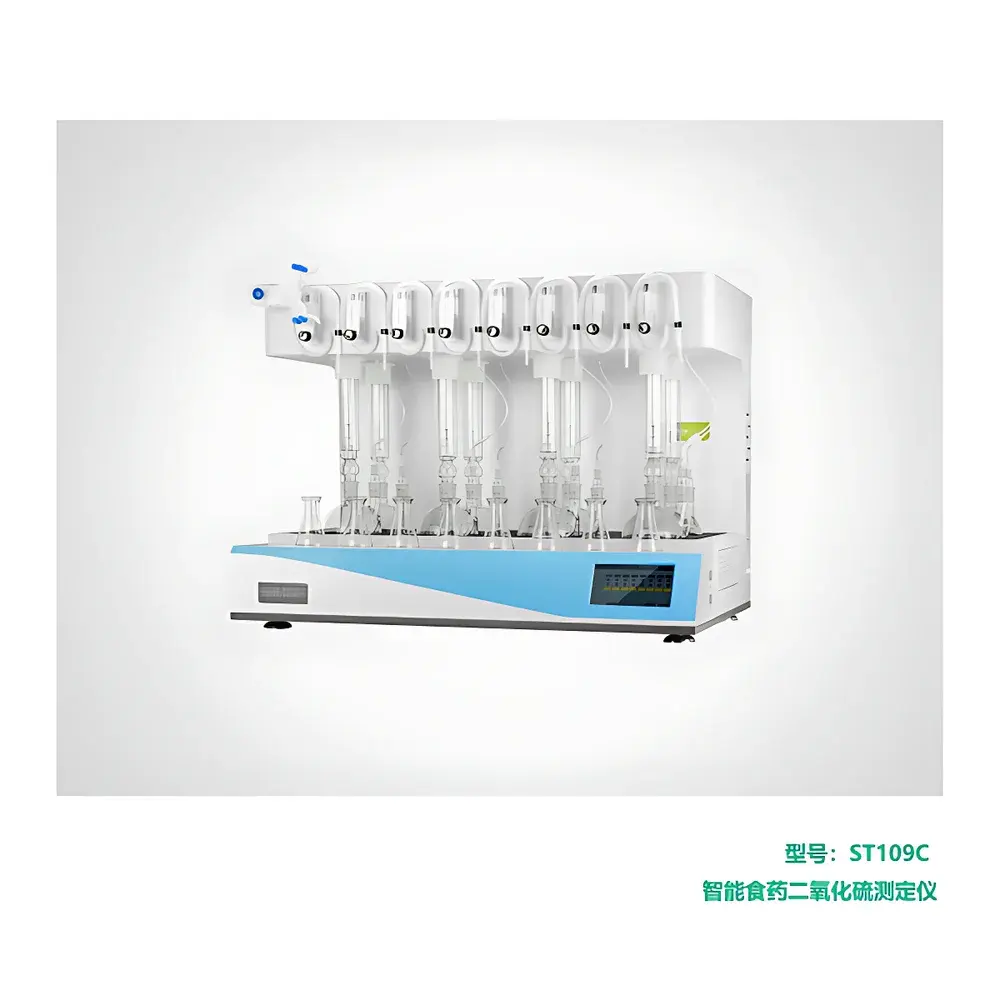
Shengtai ST109C Food & Herbal Medicine Sulfur Dioxide (SO₂) Determination System
| Brand | Shengtai (SENTE) |
|---|---|
| Origin | Shandong, China |
| Manufacturer | Yes |
| Country of Origin | China |
| Model | ST109C |
| Price Range | USD 7,000 – 14,000 |
Overview
The Shengtai ST109C Food & Herbal Medicine Sulfur Dioxide (SO₂) Determination System is a fully automated, benchtop analytical platform engineered for compliance with mandatory Chinese regulatory methodologies — specifically GB 5009.34–2022 “Determination of Sulfur Dioxide in Foods” and the 2015/2020 editions of the Chinese Pharmacopoeia (ChP). It implements the official acid-base titration method — the legally prescribed primary procedure for SO₂ quantification in food matrices, crude herbs, herbal slices, and traditional Chinese medicine (TCM) preparations. Unlike high-cost instrumental alternatives (e.g., GC or IC), the ST109C delivers rigorous method fidelity through integrated process control: automated acid addition, timed reflux, nitrogen purging, condensation, distillation, and receiving-phase magnetic stirring — all within a single, unified architecture. Its design eliminates manual assembly of disparate glassware and auxiliary equipment (e.g., separate hotplates, gas flowmeters, stirrers, cooling units), thereby removing critical sources of inter-laboratory variability including inconsistent heating profiles, unstable N₂ flow, vapor leakage, bumping, and temperature-dependent condenser efficiency.
Key Features
- 8-position parallel processing with independent per-channel control of heating power, nitrogen flow (200–2000 mL/min), and magnetic stirring speed
- Integrated far-infrared ceramic heating modules — chemically inert, splash-resistant, corrosion-resistant, and energy-efficient compared to conventional electric heating mantles or coils
- Pre-programmed, touch-screen–driven workflow: pre-acid nitrogen purge → automatic HCl addition → reflux initiation → timed distillation → post-distillation N₂ blow-down
- ChP-compliant condenser geometry — precisely replicating the reflux configuration specified in the 2020 Chinese Pharmacopoeia illustrations
- Embedded magnetic stirrers in each receiver flask — enabling homogeneous titration endpoint detection without external stir plates
- Modular compatibility with the Shengtai ST15L nitrogen generator (membrane separation technology; N₂ purity ≥99.9%, output 0–15 L/min at 0.5 MPa)
- Self-contained system architecture — no external water-cooling circuits, standalone gas regulators, or third-party hotplate controllers required
Sample Compatibility & Compliance
The ST109C accommodates solid, semi-solid, and liquid samples across food safety and TCM quality control domains: dried fruits, preserved vegetables, wine, sugar, starch-based products, raw herbal materials (e.g., Gastrodia elata, Paeonia lactiflora), processed slices, decoction pieces, and granule formulations. All operational parameters adhere strictly to the procedural constraints defined in GB 5009.34–2022 and ChP 2020 Volume IV General Chapters 2331 (SO₂ Residue Testing). The system supports full auditability under GLP and GMP-aligned laboratory practices, with timestamped method execution logs, user-accessible parameter records, and non-editable run history — facilitating traceability during regulatory inspections or internal QA audits.
Software & Data Management
Operation is managed via an embedded industrial-grade LCD touchscreen interface with intuitive icon-driven navigation. Each run generates a digital log containing: start/stop timestamps, sample ID entries, setpoints (heating power per position, N₂ flow rate, reflux duration), and operator ID. Logs are exportable via USB to CSV format for integration into LIMS environments. While the ST109C does not include network connectivity or remote monitoring, its deterministic, non-proprietary workflow logic ensures full reproducibility across instruments and laboratories — a prerequisite for multi-site validation studies or collaborative pharmacopoeial method transfer.
Applications
- Routine SO₂ residue screening in food manufacturing QC labs (e.g., fruit processors, beverage producers, confectionery facilities)
- Compliance testing for herbal medicine manufacturers subject to ChP 2020 SO₂ limits (e.g., ≤150 mg/kg for most crude herbs)
- Method validation and verification studies supporting ISO/IEC 17025 accreditation
- Training platforms for pharmacognosy and food chemistry curricula requiring hands-on exposure to pharmacopoeial titrimetric procedures
- Reference laboratories performing inter-laboratory comparison trials under CNAS or WHO prequalification frameworks
FAQ
Does the ST109C comply with international pharmacopoeias such as USP or EP?
The ST109C is explicitly designed for GB 5009.34–2022 and ChP 2020. While USP and Ph. Eur. 2.2.58 also permit acid-base titration for SO₂, users must verify alignment of reagent volumes, reflux times, and endpoint criteria against local regulatory expectations prior to adoption.
Can the system be used with alternative titration methods (e.g., iodometric titration)?
Yes — the platform’s modular receiver design and programmable N₂ flow allow adaptation to iodine-based redox titration protocols, provided the user validates recovery, precision, and linearity per ICH Q2(R2) guidelines.
Is the ST15L nitrogen generator required for operation?
No — the ST109C accepts external compressed N₂ supply (0.3–0.6 MPa); however, the ST15L eliminates dependency on cylinder logistics and ensures consistent, oil-free, low-moisture N₂ delivery essential for stable titration baselines.
What maintenance is required for long-term reliability?
Routine cleaning of condensers and receivers with dilute nitric acid; annual calibration of N₂ flow sensors and temperature sensors using NIST-traceable references; inspection of ceramic heater integrity and sealing gaskets every 6 months.
How is method robustness demonstrated for regulatory submissions?
Shengtai provides a comprehensive validation package including system suitability test data, intermediate precision studies (n=6 across 3 days, 2 operators), spike recovery across matrix types (80–120%), and documented evidence of conformity to ChP 2020 apparatus specifications.