
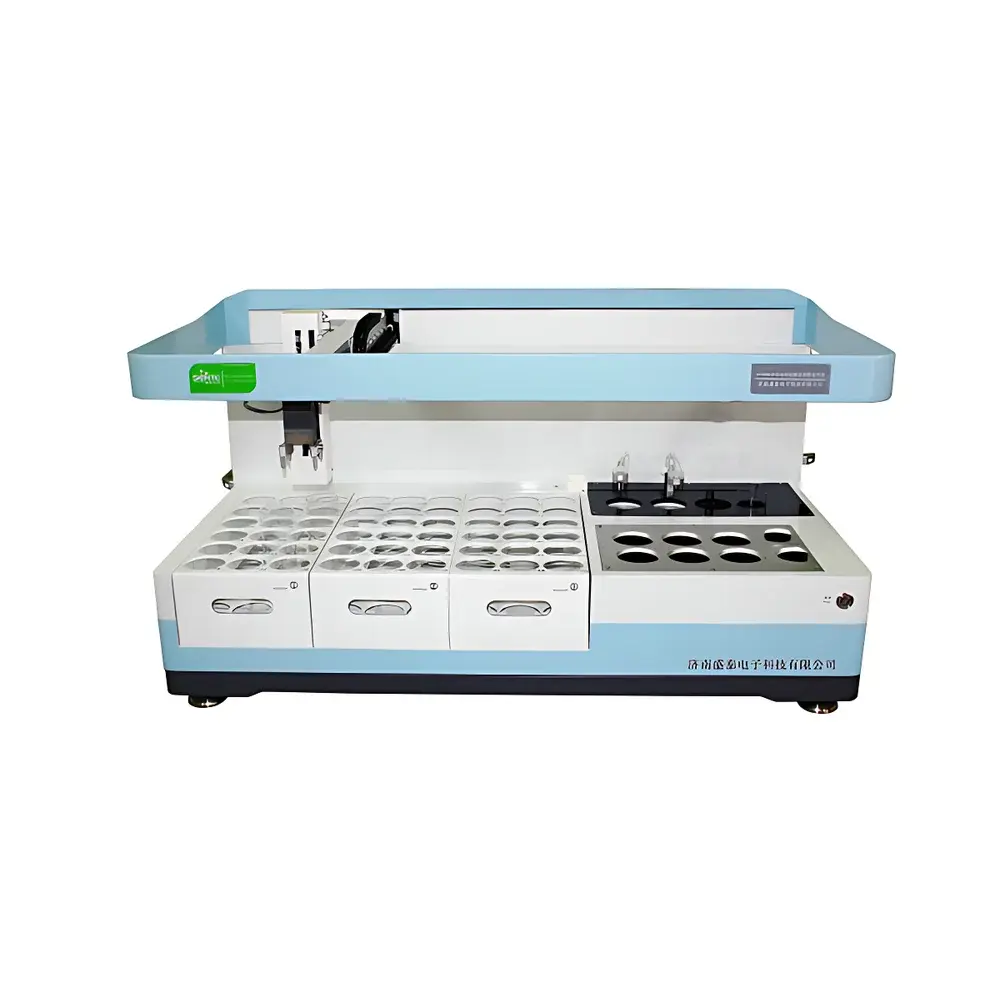
SENTE ST108M1 Series High-Precision Fully Automated Permanganate Index Analyzer
| Brand | SENTE |
|---|---|
| Origin | Shandong, China |
| Manufacturer Type | Direct Manufacturer |
| Instrument Type | Laboratory Benchtop Analyzer |
| Model | ST108M1 |
| Measurement Principle | Potassium Permanganate Oxidation with ORP Endpoint Detection |
| Range | 0.05–5.0 mg/L |
| Repeatability | ±3% RSD |
| Accuracy | ±2% of true value |
| LOD | 0.01 mg/L |
| Resolution | 0.01 mg/L |
| Single-Test Duration | 5 minutes |
Overview
The SENTE ST108M1 Series is a fully automated benchtop permanganate index (CODMn) analyzer engineered for precision, regulatory compliance, and unattended operation in environmental testing laboratories. It implements the standardized potassium permanganate oxidation method—where MnO4− serves as the oxidant under acidic or neutral conditions—and employs real-time oxidation-reduction potential (ORP) monitoring to determine the stoichiometric endpoint. This principle aligns directly with ISO 8467:1986, GB 11892–1989, and GB/T 5750.7, ensuring method equivalence across national and international water quality assessment frameworks. Unlike manual titration or semi-automated systems, the ST108M1 integrates sample quantification, reagent dispensing, controlled water-bath digestion (60–80 °C), back-titration with sodium oxalate, and endpoint recognition into a single closed-loop sequence—eliminating operator bias, minimizing carryover, and delivering traceable, auditable results.
Key Features
- Fully integrated 54-position autosampler with gravimetric-free volumetric sampling: eliminates manual pipetting and supports continuous batch processing without intervention.
- Dual independent high-precision syringe pumps (±0.5‰ volumetric accuracy) enable simultaneous reagent addition and back-titration—reducing cycle time by up to 40% versus sequential systems.
- Multi-spectral colorimetric endpoint detection using a calibrated full-color CMOS vision sensor, validated for turbid, colored, or suspended-solid-laden samples (e.g., raw surface water, reservoir intake water).
- Onboard environmental compensation module continuously monitors ambient pressure, temperature, and humidity—dynamically adjusting digestion temperature setpoints and reaction timing to maintain method fidelity at elevations up to 4,500 m ASL.
- PLC-based control architecture with industrial-grade I/O isolation ensures long-term operational stability, electromagnetic interference resistance, and deterministic response timing—critical for GLP-compliant routine analysis.
- Intelligent reagent management system with optical level sensing and low-volume alerts; all reagent reservoirs are sealed, ventilated, and temperature-stabilized to prevent evaporation or crystallization.
- Boiling-water-bath digestion module featuring auto-refill function, submerged-sample verification, and thermal uniformity control (±0.3 °C across bath volume) per GB 11892 requirements.
Sample Compatibility & Compliance
The ST108M1 is validated for direct analysis of drinking water, source water, and surface water matrices within the 0.05–5.0 mg/L permanganate index range. For highly contaminated samples (e.g., wastewater influent or polluted river water), the onboard dilution module performs programmable 1:2 to 1:100 serial dilutions using certified Class A glassware-equivalent fluid paths. All wetted components—including PTFE-coated tubing, ceramic valves, and borosilicate glass digestion vials—are chemically inert to concentrated H2SO4, KMnO4, and Na2C2O4. The system complies with ISO/IEC 17025 documentation requirements for method validation, and its audit trail functionality satisfies FDA 21 CFR Part 11 data integrity criteria—including electronic signatures, immutable event logs, and version-controlled method files.
Software & Data Management
The embedded Windows IoT platform runs SENTE Analytical Suite v4.2—a validated application supporting IQ/OQ/PQ protocols, multi-user role-based access control (RBAC), and configurable report templates (PDF/CSV/XLSX). Raw sensor data—including real-time ORP curves, RGB channel intensity traces, and pump actuation timestamps—is stored locally with SHA-256 hashing for forensic traceability. Data export supports LIMS integration via ASTM E1384-compliant HL7 messaging or secure SFTP push. All calibration records, maintenance logs, and QC run summaries are retained for ≥36 months and searchable by sample ID, analyst, date range, or instrument event code.
Applications
- Routine compliance monitoring for municipal water utilities under China’s GB 5749–2022 and EU Drinking Water Directive (2020/2184).
- Source water vulnerability assessment in watershed management programs.
- Validation of advanced oxidation process (AOP) efficiency in pilot-scale treatment studies.
- Interlaboratory comparison exercises organized by CNAS-accredited reference labs.
- Long-term trend analysis of organic load in lakes and reservoirs under national ecological monitoring networks.
FAQ
Does the ST108M1 support method customization beyond GB 11892 and ISO 8467?
Yes—users may define custom digestion temperatures, durations, reagent concentrations, and endpoint thresholds via password-protected method editor; all modifications are logged with user ID and timestamp.
How is carryover prevented between high- and low-concentration samples?
The system executes a three-stage post-run cleaning protocol: pressurized air purge, 5% HNO3 rinse, and deionized water flush—validated to reduce residual MnO4− carryover to <0.002 mg/L.
Is remote diagnostics and firmware updates supported?
Yes—via encrypted TLS 1.3 connection to SENTE’s Secure Remote Access Gateway (SRAG), enabling authorized service engineers to perform health checks, parameter tuning, and zero-downtime updates.
What is the recommended calibration frequency for routine operation?
Daily verification using certified 1.00 mg/L KHP standard; full 3-point calibration (0.1, 2.0, 4.5 mg/L) required weekly or after maintenance.
Can the instrument be integrated into an existing laboratory automation framework?
Yes—it provides Modbus TCP and OPC UA server interfaces for seamless coordination with robotic arms, sample tracking systems, and central MES platforms.
Related Products







