
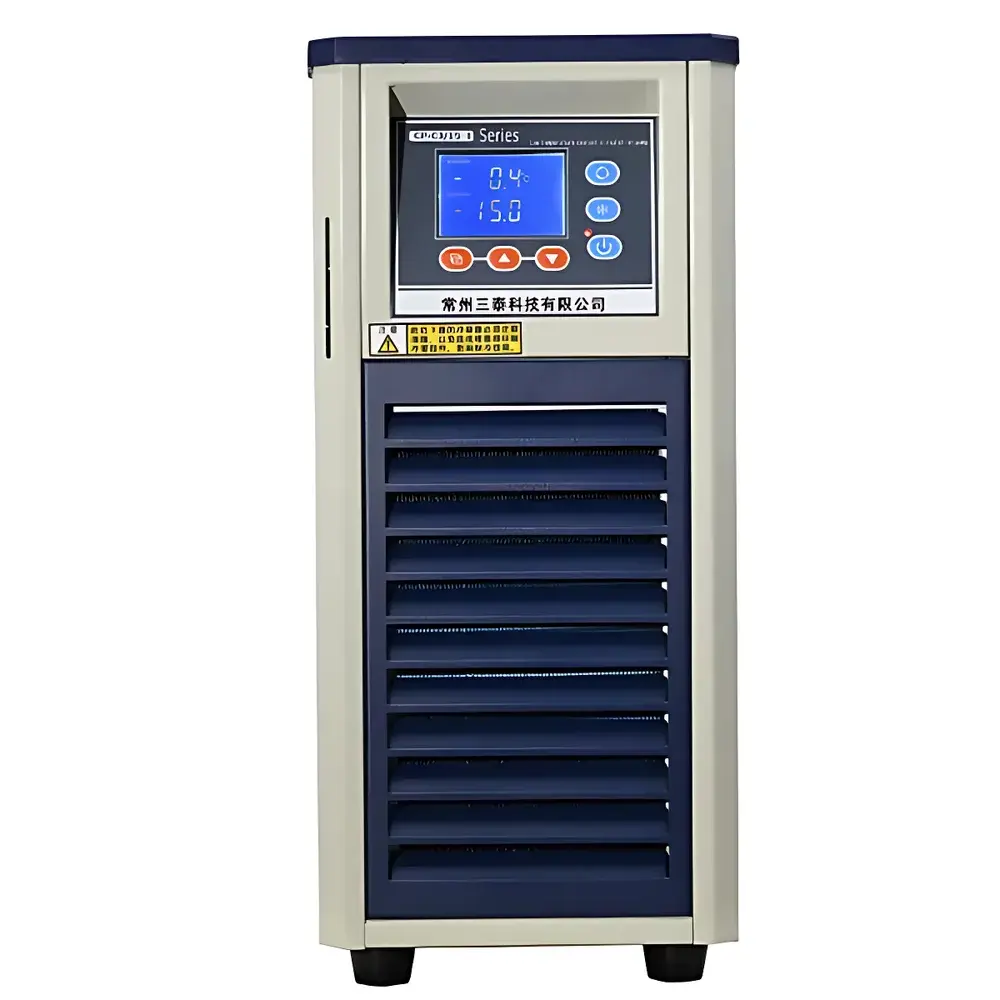
Santai CP-C3/15I Low-Temperature Circulating Chiller
| Brand | Santai |
|---|---|
| Model | CP-C3/15I |
| Origin | Jiangsu, China |
| Manufacturer Type | Direct Manufacturer |
| Equipment Type | Refrigerated/Heating Circulating Chiller |
| Cooling Medium | Internal Circulation Only |
| Temperature Range | −15 °C to Ambient |
| Temperature Stability | ±2 °C |
| Power Supply | 220 V AC, 50 Hz |
| Reservoir Volume | 3 L |
| Minimum No-Load Temperature | −15 °C |
| Refrigerant | R290 |
| Compressor Power | 610 W |
| Circulating Pump Power | 50 W |
| Flow Rate | 12 L/min |
| Max. Head | 7 m |
| Display | LCD |
| Temperature Sensor | Pt100 |
| Control Accuracy | ±2 °C |
| Safety Protections | Delay Start, Overcurrent, Overheat |
| Construction Material | 1Cr18Ni9Ti (equivalent to ASTM A240 304 stainless steel) |
| External Port | 1/2″ NPT female, 304 SS |
Overview
The Santai CP-C3/15I Low-Temperature Circulating Chiller is an engineered thermal management system designed for precise, stable, and continuous cooling in laboratory-scale rotary evaporation, condenser jacketing, and reaction temperature control applications. It operates on a closed-loop vapor-compression refrigeration cycle using environmentally compliant hydrocarbon refrigerant R290 (propane), delivering reliable sub-ambient cooling down to −15 °C with no-load conditions. Unlike open-bath systems, the CP-C3/15I integrates a sealed 3 L stainless-steel reservoir, a corrosion-resistant circulation loop, and a high-efficiency scroll compressor—enabling consistent heat extraction from external equipment such as condenser coils or jacketed reactors. Its dual-mode capability (refrigeration + heating via optional auxiliary heater) supports dynamic temperature ramping within the operational range of −15 °C to ambient (typically 20–25 °C), making it suitable for solvent recovery workflows requiring strict thermal control during distillation.
Key Features
- Stainless-steel fluid path (1Cr18Ni9Ti, equivalent to AISI 304) ensures long-term compatibility with water, ethanol, methanol, and other common low-viscosity cooling media—resisting pitting and galvanic corrosion under continuous recirculation.
- Intelligent PID temperature control with Pt100 platinum resistance thermometer (Class B, IEC 60751) provides ±2 °C stability across the full setpoint range; digital LCD interface enables direct parameter entry, real-time monitoring, and user-defined ramp/soak profiles.
- Dual safety architecture includes compressor delay protection (to prevent short-cycling), overcurrent cutoff, and thermally monitored high-limit shutoff—meeting IEC 61010-1 requirements for laboratory electrical equipment.
- Low-noise, brushless DC circulating pump (50 W) delivers up to 12 L/min flow at variable head (2.2–7 m), supporting both internal recirculation and external closed-loop distribution via standardized 1/2″ NPT ports.
- Energy-optimized design: R290 refrigerant offers 3.3× higher volumetric cooling capacity than R134a at equivalent pressures, reducing compressor runtime and electrical load without sacrificing thermal output.
Sample Compatibility & Compliance
The CP-C3/15I is validated for use with standard laboratory glassware including 2 L rotary evaporators, vertical condensers, and jacketed flasks. Its non-pressurized reservoir and gravity-fed outlet configuration comply with ISO 13485-aligned manufacturing controls for Class I medical device support equipment. While not certified for GMP production environments, its traceable calibration points (via Pt100 sensor), audit-ready parameter logging (when paired with optional RS485/Modbus interface), and mechanical interlocks satisfy GLP documentation prerequisites for method validation in QC labs. The unit conforms to EMC Directive 2014/30/EU and Low Voltage Directive 2014/35/EU, with CE marking applied per harmonized standards EN 61326-1 and EN 61000-6-3.
Software & Data Management
The CP-C3/15I operates as a standalone instrument with embedded firmware—no host PC required for basic operation. For integrated lab data systems, optional RS485 communication (Modbus RTU protocol) enables bidirectional parameter exchange with LIMS or SCADA platforms. Logged variables include setpoint, actual bath temperature, compressor status, and fault codes—retained in non-volatile memory for ≥30 days. When deployed in regulated environments, users may configure password-protected parameter locking (preventing unauthorized setpoint changes), aligning with FDA 21 CFR Part 11 principles for electronic record integrity. Firmware updates are performed via USB port using signed binaries verified by SHA-256 checksum.
Applications
- Routine rotary evaporation: Maintains condenser jacket temperature at −10 °C to −15 °C for efficient recovery of low-boiling solvents (e.g., diethyl ether, pentane, dichloromethane) under reduced pressure.
- Cryogenic reaction control: Stabilizes exothermic Grignard or lithiation reactions in jacketed reactors by circulating chilled ethanol/water mixtures.
- Instrument cooling: Supplies temperature-regulated coolant to HPLC column ovens, FTIR detector housings, or mass spectrometer ion sources requiring thermal drift suppression.
- Calibration support: Provides traceable cold-point reference for thermometer verification against NIST-traceable standards (e.g., ASTM E74, ISO/IEC 17025).
FAQ
What cooling media are compatible with the CP-C3/15I?
Deionized water, 30–50% aqueous ethanol, and inhibited glycol-water mixtures (pH 6.5–8.5) are recommended. Avoid chlorinated solvents, strong acids/bases, or particulate-laden fluids.
Can this chiller supply external equipment requiring >12 L/min flow?
No—the maximum rated flow is 12 L/min at ≤7 m head. For higher demand, consider the CP-C5/20I (20 L/min) or consult engineering support for parallel-pump configurations.
Is remote monitoring supported out-of-the-box?
Basic local display only. RS485 Modbus interface is optional and requires separate ordering (accessory code: COM-RS485-01).
Does the unit meet UL or CSA certification requirements?
It carries CE marking per EU directives. UL/cUL listing is not included but can be pursued via third-party certification for North American deployment.
How often does the R290 refrigerant require servicing?
Under normal operation and leak-free installation, the sealed refrigeration circuit requires no periodic recharge—typical service interval exceeds 10 years per ISO 5149 maintenance guidelines.



