
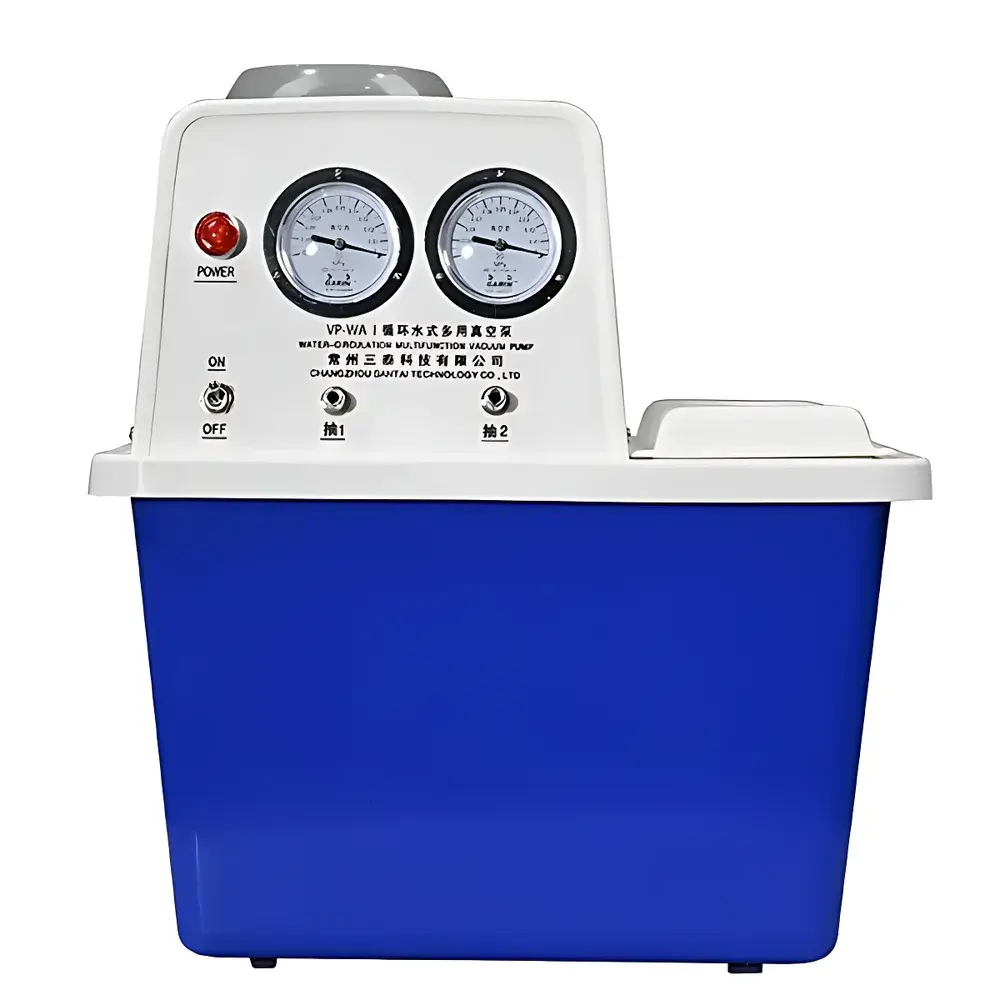
Santai VP-WAⅠ Circulating Water Multi-Function Vacuum Pump
| Brand | Santai |
|---|---|
| Origin | Jiangsu, China |
| Manufacturer Type | Direct Manufacturer |
| Country of Origin | Domestic (China) |
| Model | VP-WAⅠ |
| Instrument Category | Circulating Water Vacuum Pump |
| Circulation Mode | Internal Circulation |
| Input Power | 180 W |
| Power Supply | 220 V AC, 50 Hz |
| Flow Rate | 80 L/min |
| Maximum Vacuum | −0.098 MPa (absolute) |
| Dual-Port Airflow Capacity | 10 L/min per port |
| Lift Height | 10 m |
| Water Tank Volume | 15 L |
| Housing Material | 304 Stainless Steel |
| Water Tank Material | Polypropylene (PP) |
| Dimensions (L×W×H) | 385 × 280 × 420 mm |
| Net Weight | 11 kg |
| Safety Features | Integrated Check Valve to Prevent Backflow |
Overview
The Santai VP-WAⅠ Circulating Water Multi-Function Vacuum Pump is an engineered solution for reliable, low-maintenance vacuum generation in academic, industrial, and quality control laboratories. Unlike traditional oil-sealed or diaphragm vacuum pumps, this unit operates on the principle of water-ring vacuum generation—where rotating impeller action creates a partial vacuum by displacing water within a sealed chamber. The pump integrates a closed-loop internal circulation system that continuously recirculates deaerated water from its integrated 15 L polypropylene reservoir, eliminating dependence on continuous tap water flow while maintaining stable vacuum pressure up to −0.098 MPa (equivalent to ~25 Torr). Designed for compatibility with rotary evaporators, vacuum filtration setups, vacuum drying ovens, and solvent recovery systems, the VP-WAⅠ delivers consistent performance under sustained operation—validated for uninterrupted duty cycles exceeding 8 hours at ambient temperatures ≤35 °C.
Key Features
- Dual independent vacuum ports with analog vacuum gauges (0–0.1 MPa range), enabling simultaneous operation of two vacuum-dependent instruments without cross-pressure interference.
- Integrated non-return check valves on both suction lines to prevent backflow of water or process fluids into connected apparatus—critical for protecting sensitive glassware and preventing contamination during power interruption or shutdown.
- Corrosion-resistant construction: 304 stainless steel pump head and housing ensure long-term durability against acidic, alkaline, or organic vapors commonly encountered in chemistry and pharmaceutical labs.
- Optimized hydraulic design delivers 80 L/min total volumetric flow rate with 10 m maximum lift height—sufficient for multi-stage vacuum applications including parallel filtration manifolds and cascade condenser systems.
- Compact footprint (385 × 280 × 420 mm) and lightweight chassis (11 kg) facilitate benchtop deployment, mobile cart integration, or shared-lab repositioning without structural reinforcement.
- Energy-efficient 180 W induction motor operating at 220 V / 50 Hz meets IEC 60034 efficiency standards and complies with CE-conformant electrical safety requirements for laboratory equipment.
Sample Compatibility & Compliance
The VP-WAⅠ is compatible with standard ground-glass jointed vacuum apparatus (e.g., B-14, B-19, B-24 taper sizes), Buchner funnels, Hirsch funnels, and common rotary evaporator condensers. Its PP water tank and 304 SS wetted surfaces resist degradation from methanol, ethanol, acetone, ethyl acetate, and dilute aqueous acids/bases—making it suitable for routine QC testing per USP , ISO 17025-accredited environments, and GLP-compliant sample preparation workflows. While not certified to ISO 8573 for compressed air purity, the pump’s oil-free, water-sealed operation inherently avoids hydrocarbon contamination—a key requirement for trace-level analytical sample handling. No regulatory certification (e.g., UL, CSA) is claimed; users are advised to verify local electrical code compliance prior to installation.
Software & Data Management
This is a manually operated, analog-control vacuum pump with no embedded microprocessor, digital interface, or data logging capability. Vacuum level monitoring is performed visually via dual analog gauges calibrated to MPa scale. For integration into automated workflows, optional external pressure transducers (e.g., Validyne DP15 or Omega PX409 series) may be installed downstream with analog 4–20 mA or 0–10 V output signals routed to SCADA or LIMS platforms. Audit trails, calibration records, and preventive maintenance logs must be maintained manually per ISO/IEC 17025 Clause 6.4.10 and FDA 21 CFR Part 11 guidance for non-electronic records.
Applications
- Vacuum-assisted rotary evaporation of heat-sensitive compounds in synthetic organic chemistry and natural product isolation.
- Gravity and pressure-driven filtration of particulate suspensions in environmental water analysis (EPA Method 160.1) and pharmaceutical suspension testing.
- Deaeration of solvents prior to HPLC mobile phase preparation or Karl Fischer titration.
- Supporting vacuum desiccation in stability chambers per ICH Q1A(R2) guidelines for accelerated aging studies.
- Providing negative pressure for fume hood auxiliary exhaust systems where low-flow, high-reliability vacuum is required.
FAQ
Can the VP-WAⅠ be used with corrosive solvents such as concentrated HCl or nitric acid?
No. While the 304 stainless steel and PP components resist mild organics and dilute acids, prolonged exposure to concentrated mineral acids will degrade the impeller seal and tank integrity. Use only with solvents listed in the material compatibility chart supplied with the manual.
Is tap water required for operation?
No. The internal 15 L PP reservoir supports fully closed-loop operation. Tap water connection is optional and intended only for initial fill or periodic top-up after evaporation loss.
What is the recommended maintenance interval?
Inspect water level and clarity daily; replace reservoir water every 72 operational hours in high-vapor-load conditions. Clean impeller chamber and check valves quarterly using deionized water and soft brush—no lubrication required.
Does the pump meet noise emission limits for ISO 15710 compliance?
Measured sound pressure level is 52 dB(A) at 1 m distance under full load—within typical laboratory ambient thresholds but not formally tested to ISO 15710 Annex A protocols.
Can vacuum level be regulated digitally?
No. Vacuum regulation is achieved passively via manual needle valves on each port. For programmable control, integrate external vacuum regulators (e.g., VAT Type 11.1) downstream.



