
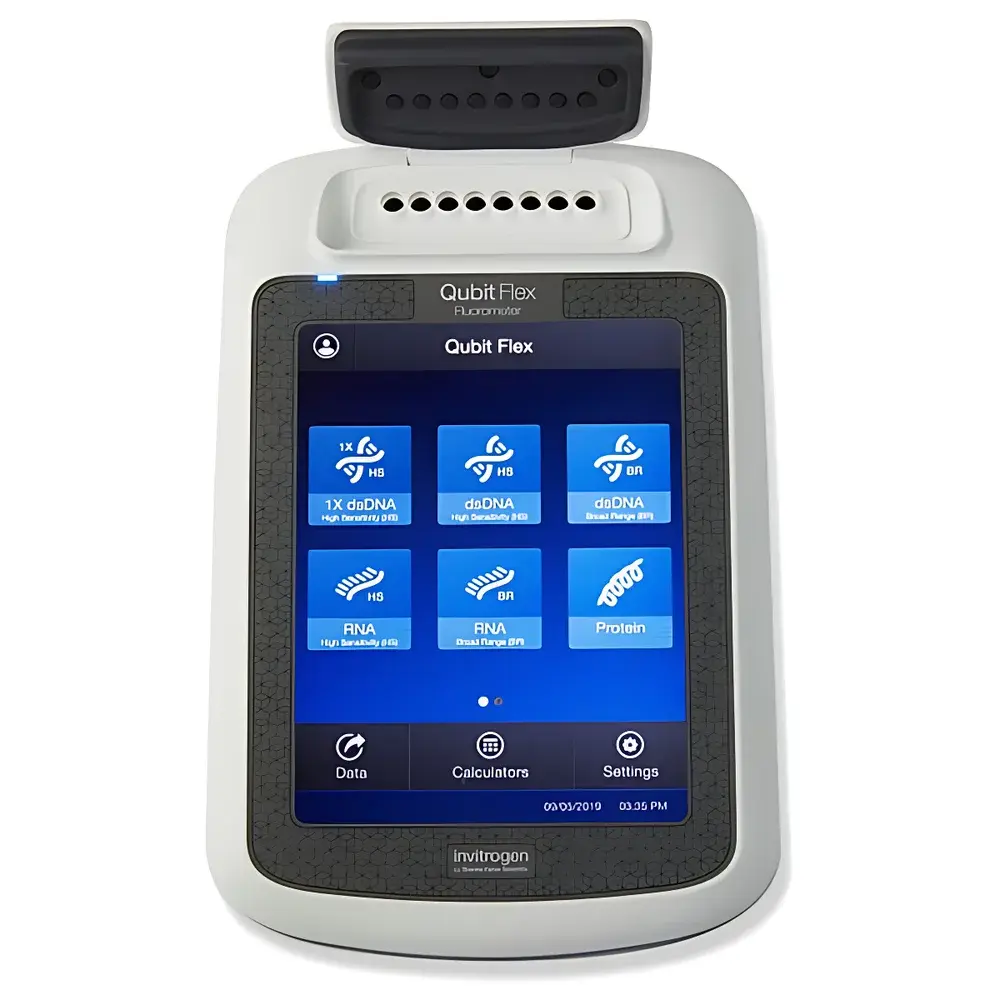
Invitrogen Qubit Flex 8-Channel Fluorometer for Nucleic Acid and Protein Quantitation
| Brand | Invitrogen |
|---|---|
| Origin | Singapore |
| Manufacturer Type | Original Equipment Manufacturer (OEM) |
| Origin Category | Imported |
| Model | Qubit Flex |
| Detection Time | ≤3 s |
| Wavelength Accuracy | ≤±1 nm |
| BSA Detection Range | 12.5 µg/mL – 5 mg/mL |
| DNA Detection Limit | 0.01 ng/µL |
| Sample Types | dsDNA, ssDNA, RNA, microRNA, Protein |
| Sample Volume Requirement | 1–20 µL |
Overview
The Invitrogen Qubit Flex 8-Channel Fluorometer is an engineered solution for high-fidelity, fluorescence-based quantitation of nucleic acids and proteins in life science laboratories. Unlike absorbance-based methods (e.g., UV-260 nm spectrophotometry), the Qubit Flex employs dye-binding fluorescence detection—leveraging proprietary, target-specific dyes that exhibit minimal background signal and high quantum yield upon selective binding to dsDNA, ssDNA, RNA, microRNA, or protein. This principle delivers exceptional selectivity: it discriminates intact nucleic acid molecules from free nucleotides, degraded fragments, salts, or chaotropic agents commonly present in purification eluates. As a result, the instrument achieves sub-nanogram sensitivity (0.01 ng/µL for dsDNA) and robust linearity across five orders of magnitude, making it suitable for critical pre-analytical workflows where sample integrity and concentration accuracy directly impact downstream success—including next-generation sequencing (NGS) library normalization, qRT-PCR input standardization, CRISPR guide RNA titration, and recombinant protein expression monitoring.
Key Features
- Parallel 8-channel detection: Simultaneously measures up to eight samples in ≤3 seconds per run—reducing hands-on time by >50% compared to single-channel fluorometers and eliminating inter-run calibration drift.
- Target-specific assay compatibility: Supports validated, kit-based assays for dsDNA (HS/BR), ssDNA, RNA (HS/BR/IQ), microRNA, and total protein—each with independently optimized excitation/emission profiles and calibration curves.
- Minimal sample consumption: Requires only 1–20 µL of undiluted sample—preserving precious clinical isolates, single-cell lysates, or low-yield enzymatic reactions.
- Integrated calculation suite: Four embedded calculators—Reagent Preparation, Dynamic Range Estimation, Molar Concentration Conversion (based on sequence length), and Normalization (for molarity- or mass-based NGS library pooling)—reduce manual error and accelerate experimental design.
- Robust data governance architecture: Local storage capacity for ≥10,000 sample records with timestamped metadata; export via Wi-Fi, USB 2.0, or Ethernet (10/100BASE-T); supports CSV and PDF report generation compliant with GLP documentation requirements.
- Digital SmartStart™ 3D tutorial system: On-device interactive walkthroughs for setup, assay execution, maintenance, and troubleshooting—designed for rapid user onboarding without reliance on printed manuals or remote support.
Sample Compatibility & Compliance
The Qubit Flex is validated for use with purified nucleic acid and protein preparations across diverse extraction chemistries (e.g., silica-membrane columns, magnetic beads, phenol-chloroform). It meets key performance criteria outlined in ISO/IEC 17025:2017 for testing and calibration laboratories and aligns with analytical method validation principles described in ICH Q2(R2). While not a regulated medical device, its assay kits are manufactured under ISO 13485-certified quality systems. Data audit trails—including operator ID, date/time stamps, assay lot numbers, and raw fluorescence values—are retained locally and exportable to support FDA 21 CFR Part 11-compliant environments when integrated with validated LIMS or ELN platforms.
Software & Data Management
The instrument operates standalone with a 7-inch capacitive touchscreen interface running a real-time Linux-based OS. All firmware, assay definitions, and calibration data are stored internally and updated via encrypted USB drives or secure OTA (over-the-air) packages. Exported datasets include full traceability: sample ID, assay type, dilution factor, measured RFU, calculated concentration (with units), coefficient of variation (CV%), and pass/fail flags against user-defined acceptance criteria. Raw data files conform to MIAME-compliant metadata standards and can be ingested into Thermo Fisher Connect or third-party analysis pipelines via standardized CSV schema.
Applications
- NGS library quantification and molarity-based pooling prior to cluster generation
- qPCR and digital PCR template normalization to minimize amplification bias
- Quality control of in vitro transcription (IVT) RNA, CRISPR gRNA, and antisense oligonucleotides
- Monitoring transfection efficiency via plasmid DNA recovery post-lipofection
- Quantitation of low-abundance microRNA from biofluid-derived exosomes
- Verification of recombinant protein yield in E. coli or mammalian expression systems
- Validation of nucleic acid fragmentation protocols (e.g., sonication, enzymatic shearing)
FAQ
Is the Qubit Flex compatible with third-party fluorescent dyes?
No—the instrument is calibrated exclusively for use with Invitrogen Qubit assay kits. Non-proprietary dyes lack validated excitation/emission profiles and calibration algorithms, compromising accuracy and reproducibility.
Can the Qubit Flex perform kinetic measurements or temperature-controlled assays?
No—it is a fixed-temperature endpoint fluorometer (ambient operation only) and does not support time-resolved or thermal ramping protocols.
What is the recommended maintenance schedule?
Routine cleaning of the optical path and sample port with lint-free wipes and 70% ethanol is advised after each use; annual factory recalibration is recommended for labs operating under ISO/IEC 17025 or GxP frameworks.
How does the Qubit Flex handle sample carryover or cross-contamination?
The system uses disposable, optically matched 8-well strips (Q33252) with individual light-tight wells—no fluidics or shared cuvettes—eliminating physical carryover risk between samples.
Does the Qubit Flex support multi-user access control or role-based permissions?
Not natively—the device lacks built-in user authentication; however, exported data files retain operator identifiers, enabling integration with external identity management systems in networked lab environments.




