
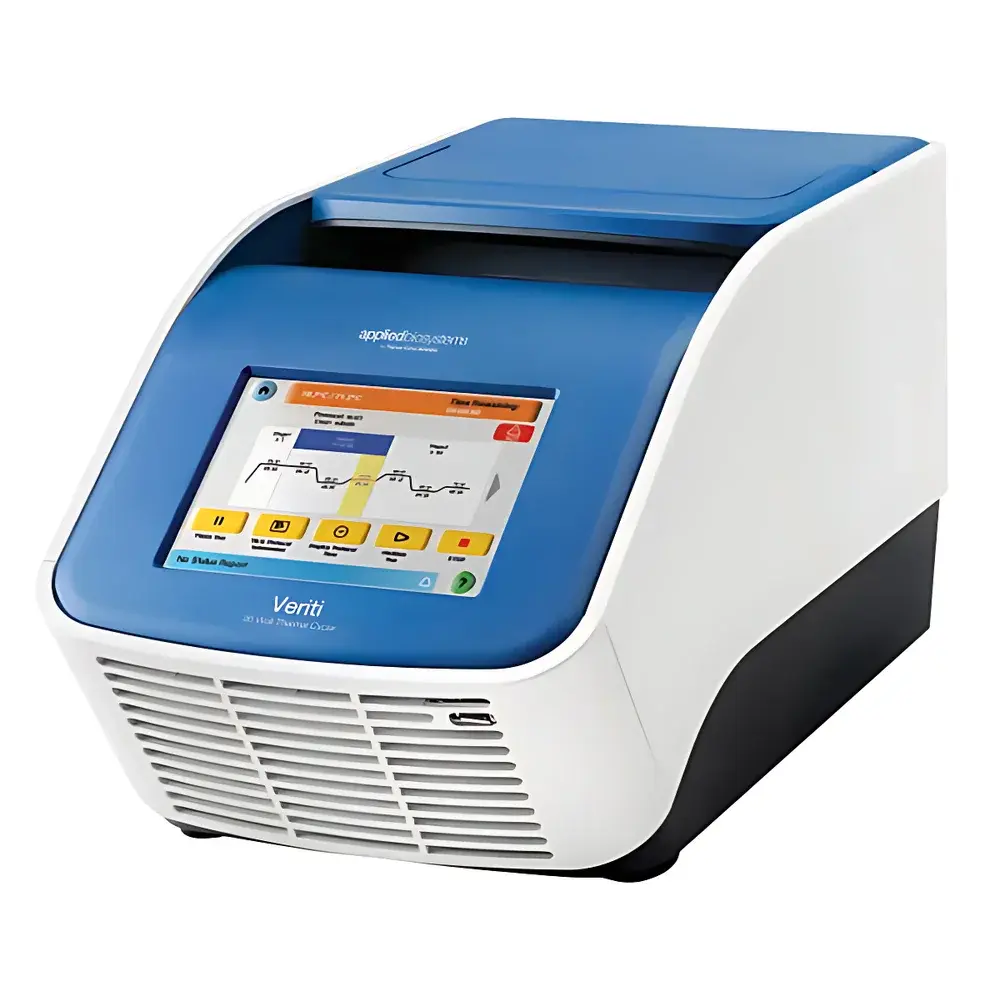
Applied Biosystems Veriti Thermal Cycler
| Origin | Singapore |
|---|---|
| Manufacturer Type | Authorized Distributor |
| Origin Category | Imported Instrument |
| Model | Veriti |
| Instrument Type | Standard Thermal Cycler |
| Sample Capacity | 96-well, 384-well, 60-well, and Fast 86-well formats |
| Ramp Rate | 5.00 °C/sec |
| Temperature Accuracy | ±0.25 °C (35–99 °C) |
| Well-to-Well Uniformity | <0.5 °C (measured 20 sec after reaching 95 °C) |
Overview
The Applied Biosystems Veriti Thermal Cycler is a high-performance, modular thermal cycler engineered for robust and reproducible polymerase chain reaction (PCR) amplification across diverse life science applications. Based on Peltier-based solid-state heating and cooling technology, the Veriti system delivers precise, rapid, and uniform temperature transitions across multiple independent thermal blocks—enabling parallel optimization of PCR conditions without hardware reconfiguration. Designed for routine molecular biology workflows—including genotyping, cloning, mutagenesis, and endpoint PCR—the instrument supports standard and fast cycling protocols while maintaining strict adherence to thermal performance specifications defined by ISO/IEC 17025-compliant calibration practices. Its architecture reflects over two decades of Applied Biosystems’ engineering heritage in nucleic acid amplification instrumentation, with field-proven stability under continuous laboratory operation.
Key Features
- Six independently controlled thermal blocks—each programmable with distinct ramp rates, hold times, and temperature profiles—to facilitate simultaneous optimization of primer annealing, extension, or touchdown protocols.
- 6.5-inch VGA color touchscreen interface with intuitive icon-driven navigation; no stylus or external input device required for method creation, editing, or execution.
- High-speed thermal ramping at 5.00 °C/sec ensures reduced cycle times without compromising enzyme fidelity or amplicon yield.
- Temperature accuracy of ±0.25 °C across the full operational range (35–99 °C), verified per ASTM E2875-18 standards for thermal performance validation in laboratory equipment.
- Well-to-well temperature uniformity <0.5 °C (measured 20 seconds post-reach at 95 °C), critical for minimizing inter-well variability in multiplex or low-template reactions.
- Support for multiple plate formats: standard 96-well, 384-well, 60-well, and Fast 86-well configurations—compatible with commercially available PCR plates and tubes meeting ANSI/SBS dimensional standards.
Sample Compatibility & Compliance
The Veriti Thermal Cycler accommodates a broad range of consumables certified for thermal sealing integrity and optical clarity, including skirted and semi-skirted 96-well plates, low-profile 384-well plates, and single-tube strips. All supported formats comply with ANSI/SLAS microplate standards, ensuring mechanical compatibility with automated liquid handlers and plate readers. The instrument meets IEC 61010-1 safety requirements for laboratory electrical equipment and operates within Class II biological safety cabinet-compatible ambient conditions (15–30 °C, 20–80% RH non-condensing). It is validated for use in GLP environments where traceable thermal calibration records and audit-ready log files are maintained per internal SOPs aligned with FDA 21 CFR Part 11 data integrity principles.
Software & Data Management
Veriti instruments operate natively via onboard firmware with embedded method storage (up to 1,000 user-defined protocols). Methods may be saved directly to internal memory or exported/imported using USB flash drives formatted as FAT32. Optional remote management software—Veriti Connect—enables secure network integration via Ethernet or Wi-Fi, supporting real-time status monitoring, email alerts upon run completion or error events, and centralized protocol deployment across multi-instrument labs. All run logs include timestamped thermal profiles, block ID, operator ID (if configured), and environmental metadata, facilitating retrospective analysis and compliance reporting. Exported data conforms to CSV and XML schemas compatible with LIMS platforms and statistical analysis tools such as JMP or GraphPad Prism.
Applications
- Standard endpoint PCR for gene expression screening, pathogen detection, and transgenic verification.
- PCR optimization studies leveraging multi-block gradient capability for empirical determination of optimal annealing temperatures.
- High-throughput pre-amplification prior to qPCR, NGS library preparation, or Sanger sequencing.
- Education and core facility settings requiring intuitive operation, minimal training overhead, and consistent inter-user reproducibility.
- Regulated QC testing where documented thermal performance and electronic record retention support ISO 13485 or CLIA-certified workflows.
FAQ
Is the Veriti Thermal Cycler compatible with third-party PCR plates and tubes?
Yes—provided they conform to ANSI/SBS dimensional specifications and demonstrate thermal stability up to 105 °C. Recommended consumables include ABgene, Thermo Fisher Scientific, and Eppendorf certified products.
Does the Veriti support gradient PCR functionality?
Yes—each of the six independent blocks can be configured with a linear temperature gradient spanning up to 25 °C, enabling efficient empirical optimization of annealing conditions across a single plate.
Can run data be exported in a format suitable for regulatory submission?
Yes—CSV and XML exports include full thermal trace metadata, user attribution, and timestamping, supporting ALCOA+ data integrity principles required for FDA, EMA, or PMDA submissions.
What maintenance is required to sustain thermal accuracy over time?
Annual calibration verification using NIST-traceable thermocouples is recommended; no routine user-serviceable parts require replacement under normal operating conditions.
Is the Veriti validated for use in GMP environments?
While the instrument itself is not pre-validated, its firmware architecture, audit trail logging, and electronic signature support enable qualification per IQ/OQ/PQ protocols aligned with Annex 11 and 21 CFR Part 11 requirements.
Related Products




