
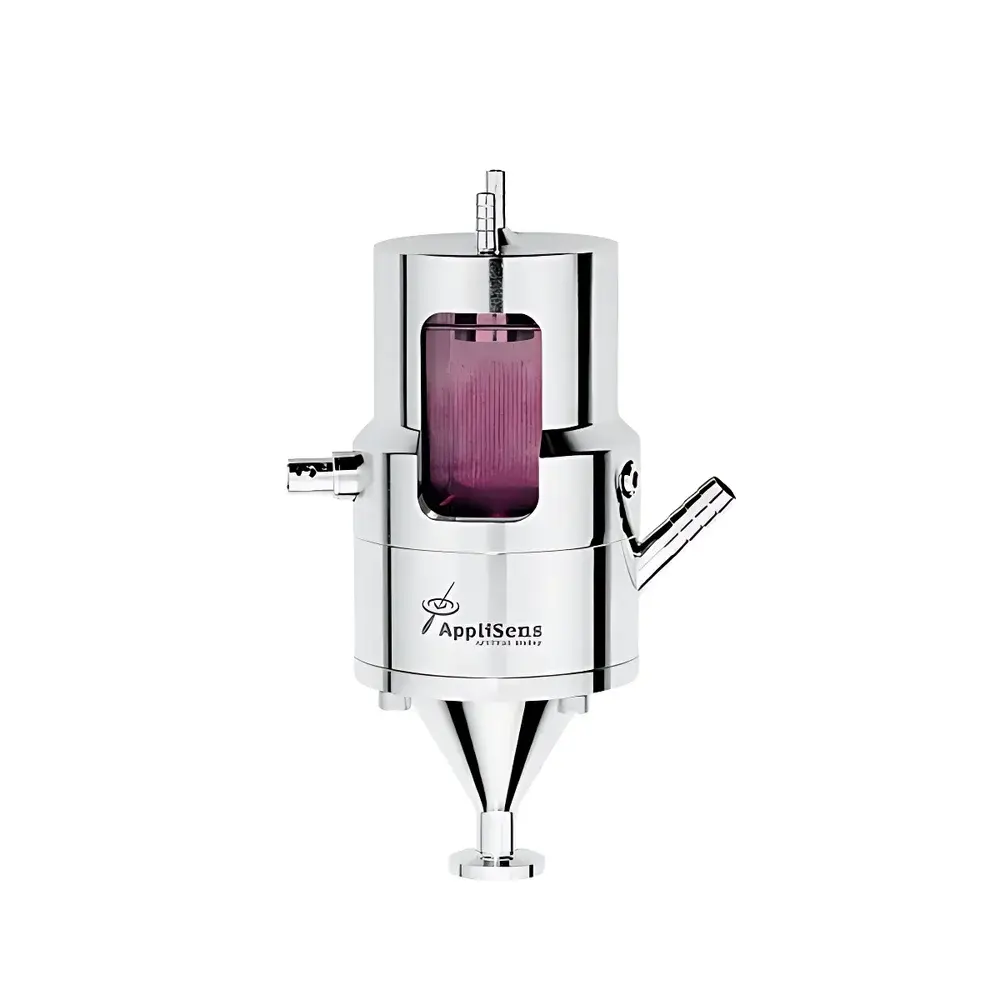
Applikon BioSep System
| Brand | Getinge |
|---|---|
| Origin | Sweden |
| Model | BioSep System, BioSep Controller |
| Type | Scalable Perfusion Cell Retention Device |
Overview
The Applikon BioSep System is a scalable, ultrasonically actuated cell retention device engineered for continuous perfusion bioprocessing in mammalian cell culture applications. Unlike traditional tangential flow filtration (TFF) or centrifugal separation methods, the BioSep leverages high-frequency resonant ultrasound to induce gentle yet effective acoustic streaming and standing wave forces within the bioreactor effluent stream. This physical separation mechanism enables selective retention of viable cells—including CHO, HEK293, and hybridoma lines—while allowing spent medium, metabolites (e.g., lactate, ammonium), and submicron debris to pass through. The system operates without membranes, filters, or moving mechanical parts in contact with the cell suspension, thereby eliminating fouling, shear-induced viability loss, and batch-to-batch variability associated with membrane-based retention. Designed for integration with Applikon’s ADI100–ADI500 bioreactor platforms and compatible with third-party vessels via standardized 1/4″–3/8″ tubing interfaces, the BioSep supports process intensification from lab-scale (0.5–5 L) to pilot-scale (up to 50 L working volume) under controlled, closed-system conditions.
Key Features
- Ultrasonic Cell Retention: Utilizes resonant frequency-driven acoustic radiation forces (typically 1–3 MHz range) to form stable cell aggregates at pressure nodes—enabling >95% viable cell retention efficiency across extended perfusion runs (≥60 days demonstrated).
- Membrane-Free Architecture: Eliminates filter clogging, replacement costs, and validation burden associated with TFF; reduces risk of adventitious agent ingress and simplifies cleaning-in-place (CIP) procedures.
- Integrated Control Logic: BioSep Controller synchronizes real-time perfusion rate modulation with bioreactor pH, DO, and viable cell density (VCD) feedback—supporting automated harvest-and-replace strategies based on metabolic setpoints.
- Scalable Fluidic Design: Modular pump modules (peristaltic and diaphragm), flow sensors (±1% FS accuracy), and temperature-compensated conductivity probes ensure consistent performance across scales without re-optimization.
- GMP-Ready Construction: Wetted parts compliant with USP Class VI and FDA 21 CFR Part 11 requirements; controller firmware supports electronic audit trails, user access levels, and data export in CSV/Excel formats.
Sample Compatibility & Compliance
The BioSep System is validated for use with adherent and suspension-adapted mammalian cell lines cultured in serum-free, chemically defined media. It accommodates typical bioprocess streams containing proteins up to 10 mg/mL, viscosity up to 15 cP, and suspended solids ≤1.2 × 10⁶ cells/mL. Regulatory alignment includes adherence to ISO 13485:2016 for medical device quality management systems and compatibility with ICH Q5A–Q5D guidelines for cell line characterization and product consistency. Process data generated meets ALCOA+ principles (Attributable, Legible, Contemporaneous, Original, Accurate, Complete, Consistent, Enduring, Available) for GLP/GMP audits.
Software & Data Management
The BioSep Controller runs on embedded Linux OS with a web-based HMI accessible via Ethernet or Wi-Fi. All operational parameters—including ultrasonic amplitude (%), feed/perfusion flow rates (mL/min), cumulative medium volume exchanged (L), and real-time cell retention efficiency estimates—are logged at user-configurable intervals (1 sec–5 min). Data export supports time-synchronized alignment with AppliControl™ bioreactor software or third-party SCADA systems (OPC UA v1.04 compliant). Audit trail functionality records operator actions, parameter changes, and system alarms with timestamps and user IDs—fully traceable for FDA 21 CFR Part 11 compliance when paired with digital signature-enabled authentication.
Applications
- High-titer monoclonal antibody (mAb) production in intensified perfusion processes
- Continuous manufacturing of viral vectors (AAV, lentivirus) requiring prolonged producer cell viability
- Stem cell expansion under low-shear, high-density conditions
- Process development studies comparing perfusion vs. fed-batch kinetics and product quality attributes (e.g., glycosylation profiles, aggregate formation)
- Bioreactor scale-down modeling for tech transfer and regulatory filing (QbD-aligned design space exploration)
FAQ
Does the BioSep require calibration against cell counting methods?
Yes—initial setup requires correlation between ultrasonic signal amplitude and offline VCD measurements (e.g., Vi-CELL XR or Cedex Bio HT); subsequent runs maintain accuracy via drift-compensated sensor fusion algorithms.
Can the BioSep be retrofitted to existing bioreactors?
Yes—provided the vessel has sterile sampling ports and compatible tubing connections (1/4″ or 3/8″ ID); engineering support includes piping schematics and CIP/SIP integration protocols.
What maintenance is required for long-term operation?
Annual verification of ultrasonic transducer resonance frequency and power output; quarterly inspection of fluid path seals and tubing fatigue; no consumables beyond standard peristaltic pump tubing.
Is the system suitable for GMP clinical manufacturing?
Yes—validated installation qualification (IQ), operational qualification (OQ), and performance qualification (PQ) documentation packages are available upon request; system design conforms to Annex 1 (2022) requirements for aseptic processing.



