
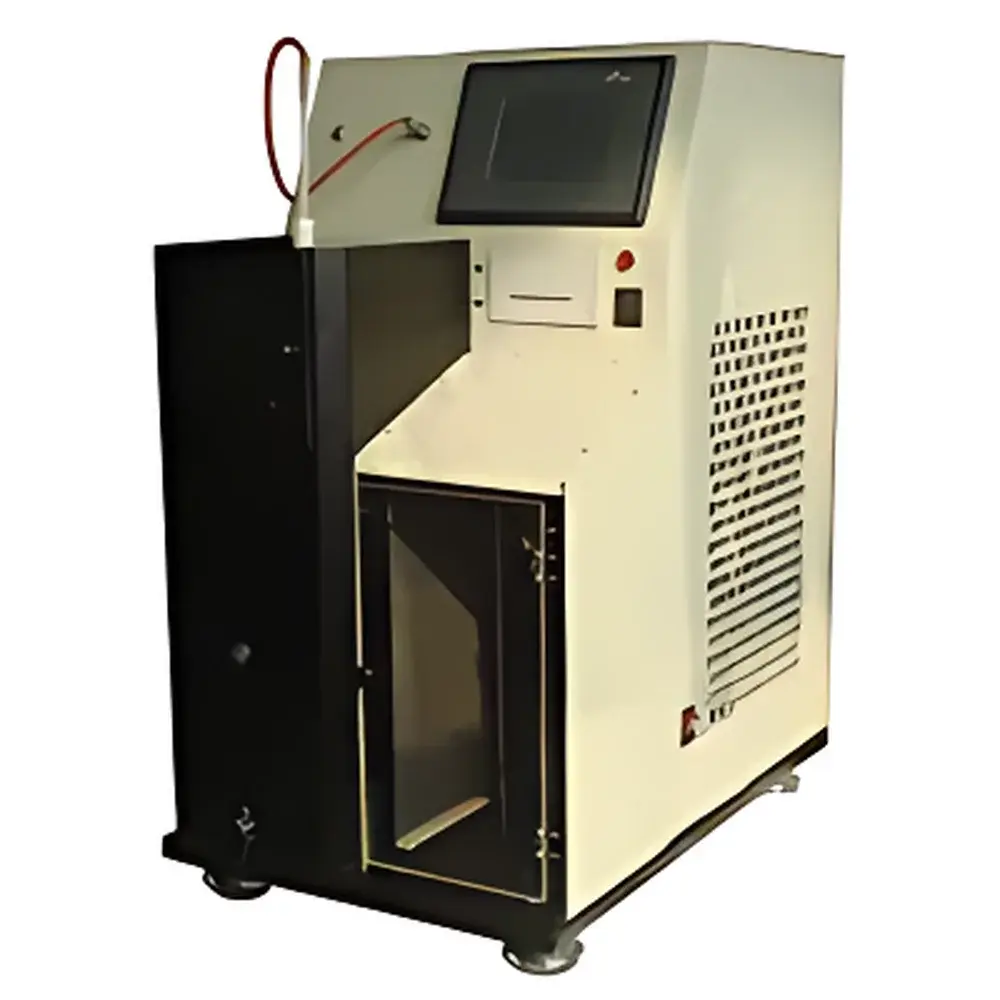
Xufeng XF-6536A Single-Channel Automated Petroleum Distillation Apparatus
| Brand | Xufeng |
|---|---|
| Origin | Shanghai, China |
| Model | XF-6536A |
| Standards Compliance | GB/T 6536, ASTM D86, ASTM D850, ASTM D1078, ASTM D2892, ISO 3405, IP 123, JIS K2254 |
| Temperature Range | 10°C to 400°C (display resolution: 0.1°C) |
| Distillate Rate Control | 2–9 mL/min (adjustable in 0.5 mL/min increments) |
| Condenser Temperature Control | 0–80°C (Peltier + electric heating) |
| Receiver Bath Temperature Control | 0°C/4°C to ambient |
| Detection Systems | Photometric meniscus tracking, CRC thermocouple dry-point sensor, Pt100 temperature sensor |
| Heating Source | Ni-Cr tubular heater (220 V, 1 kW) with forced-air cooling |
| Control Interface | Full-color LCD touchscreen with Windows-based GUI |
| Data Output | RS-232C serial port compliant with laboratory network integration |
| Calibration Functions | Automated multi-parameter correction (temperature, bath, ambient, pressure, volume, time) |
| Power Supply | AC 220 V, 50/60 Hz, 1500 W |
| Dimensions & Weight | 400 × 580 × 700 mm (W×D×H), ~40 kg |
Overview
The Xufeng XF-6536A Single-Channel Automated Petroleum Distillation Apparatus is a precision-engineered instrument designed for standardized distillation analysis of petroleum products in accordance with internationally recognized test methods. It implements the classical batch distillation principle—based on controlled heating, vaporization, condensation, and volumetric collection—to determine key volatility characteristics including initial boiling point (IBP), final boiling point (FBP), dry point (DP), and percent recovered at specified temperatures. The apparatus operates under strict adherence to ASTM D86 (for light to medium distillates), ASTM D850 and D1078 (for low-boiling solvents such as benzene and ethanol), ASTM D2892 (for crude oil characterization), and corresponding national standards including GB/T 6536 and ISO 3405. Its architecture integrates real-time thermal regulation, high-fidelity meniscus detection, and closed-loop PID control of distillate rate—ensuring reproducible results across diverse sample matrices while minimizing operator intervention.
Key Features
- Full-color capacitive touchscreen interface with intuitive Windows-style navigation and graphical real-time display of distillation curves and dynamic parameter readouts.
- Integrated Peltier semiconductor cooling combined with electric heating for independent, precise temperature control of both condenser (0–80°C) and receiver bath (0°C/4°C to ambient).
- High-accuracy photometric meniscus tracking system for automatic volumetric measurement of distillate, eliminating parallax error and manual reading variability.
- Dry-point detection via dedicated CRC thermocouple sensor, enabling unambiguous identification of the final vaporization event without user interpretation.
- Multi-stage temperature compensation architecture—including ambient, atmospheric pressure, cold-bath, and sensor-specific corrections—implemented through firmware-based calibration routines.
- Programmable distillation rate control (2–9 mL/min in 0.5 mL/min steps) using adaptive PID algorithms to maintain compliance with standard-specified collection rates.
- Automated end-of-test logic with four configurable termination conditions: endpoint temperature, dry point, target recovery volume, or maximum temperature limit.
- RS-232C serial interface supporting bidirectional communication with LIMS or laboratory data management systems for audit-ready traceability.
- Comprehensive self-diagnostic suite with audible alarm and on-screen fault code display for rapid troubleshooting and system integrity verification.
Sample Compatibility & Compliance
The XF-6536A is validated for testing Category 1–4 petroleum fractions per GB/T 6536 and ASTM D86, including gasoline, naphtha, kerosene, diesel, and jet fuel. It also supports specialized applications defined in ASTM D850 (low-boiling aromatic hydrocarbons), ASTM D1078 (volatile organic liquids), and ASTM D2892 (true boiling point analysis of crude oils). All operational parameters—including heating ramp profiles, condenser setpoints, and receiver temperature zones—are programmatically aligned with method requirements. The instrument meets essential regulatory expectations for analytical instrumentation used in quality control laboratories operating under GLP or refinery QA/QC frameworks. While not inherently 21 CFR Part 11-compliant out-of-the-box, its RS-232C output and timestamped data logs support integration into validated electronic record systems when paired with appropriate software infrastructure.
Software & Data Management
The embedded microprocessor executes preloaded distillation protocols aligned with 20 selectable test templates. Each run generates a timestamped dataset containing temperature vs. volume, IBP/FBP/DP markers, recovery percentages, and environmental metadata (e.g., ambient temperature, barometric pressure if external sensor is connected). Data export is supported via built-in thermal printer (with optional A4 color inkjet compatibility) and RS-232C serial transmission. Raw ASCII-formatted output includes header fields identifying instrument ID, operator, date/time, method reference, and calibration status—facilitating automated parsing into spreadsheet or LIMS environments. Firmware supports field-upgradable calibration coefficients and method updates without hardware modification.
Applications
This apparatus serves critical roles in petroleum refining QC labs, independent testing facilities, and research institutions conducting volatility profiling for formulation development, regulatory compliance reporting, and process optimization. Typical use cases include: verifying gasoline volatility specifications (RVP, T50, T90) against EPA or EN standards; assessing solvent purity and composition in chemical manufacturing; characterizing crude assay cuts for distillation modeling; validating reformulated fuel blends for seasonal volatility adjustments; and supporting ASTM D2892 true boiling point (TBP) curve generation for simulation input. Its dual-mode capability—handling both narrow-range solvent distillations and wide-range crude cuts—enhances lab throughput without compromising method fidelity.
FAQ
Does the XF-6536A support ASTM D2892 crude oil distillation?
Yes—it is explicitly configured for ASTM D2892 testing, including vacuum-assisted operation (when integrated with compatible vacuum controllers) and extended temperature range up to 400°C.
Can the instrument perform automatic atmospheric pressure correction?
It supports both manual entry and optional external barometric sensor input for real-time pressure compensation during test execution.
What level of temperature accuracy is achieved after calibration?
When fully calibrated using certified reference thermometers and traceable procedures, the system maintains ±0.3°C accuracy across the full 10–400°C operating range per ASTM E77 validation guidelines.
Is the meniscus detection system compatible with dark or opaque distillates?
The photometric sensor is optimized for clear to moderately colored samples; for highly opaque or particulate-laden distillates, visual verification or alternative volumetric methods may be required per method exceptions.
How does the system ensure consistent initial boiling point determination?
By decoupling initial heating rate from final heating profile and applying software-based baseline drift compensation, the instrument delivers repeatable IBP detection independent of heater aging or ambient thermal fluctuations.






