
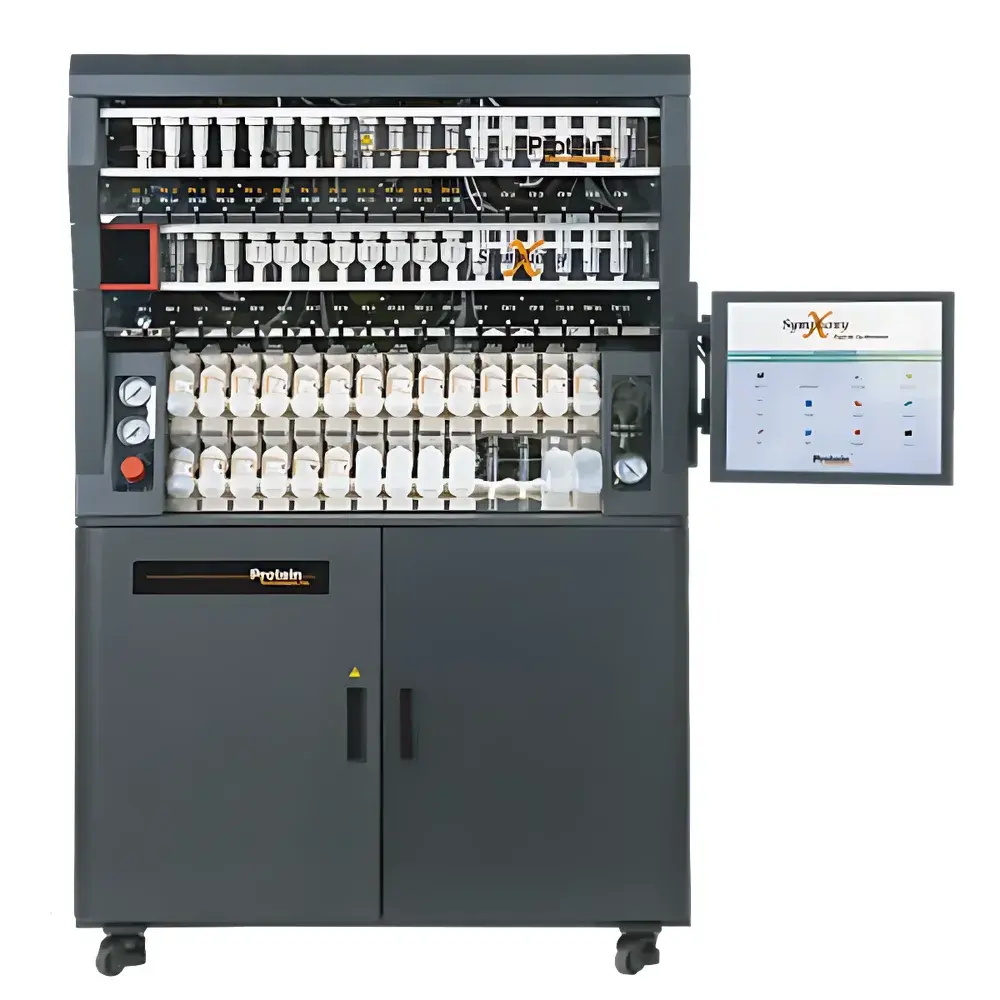
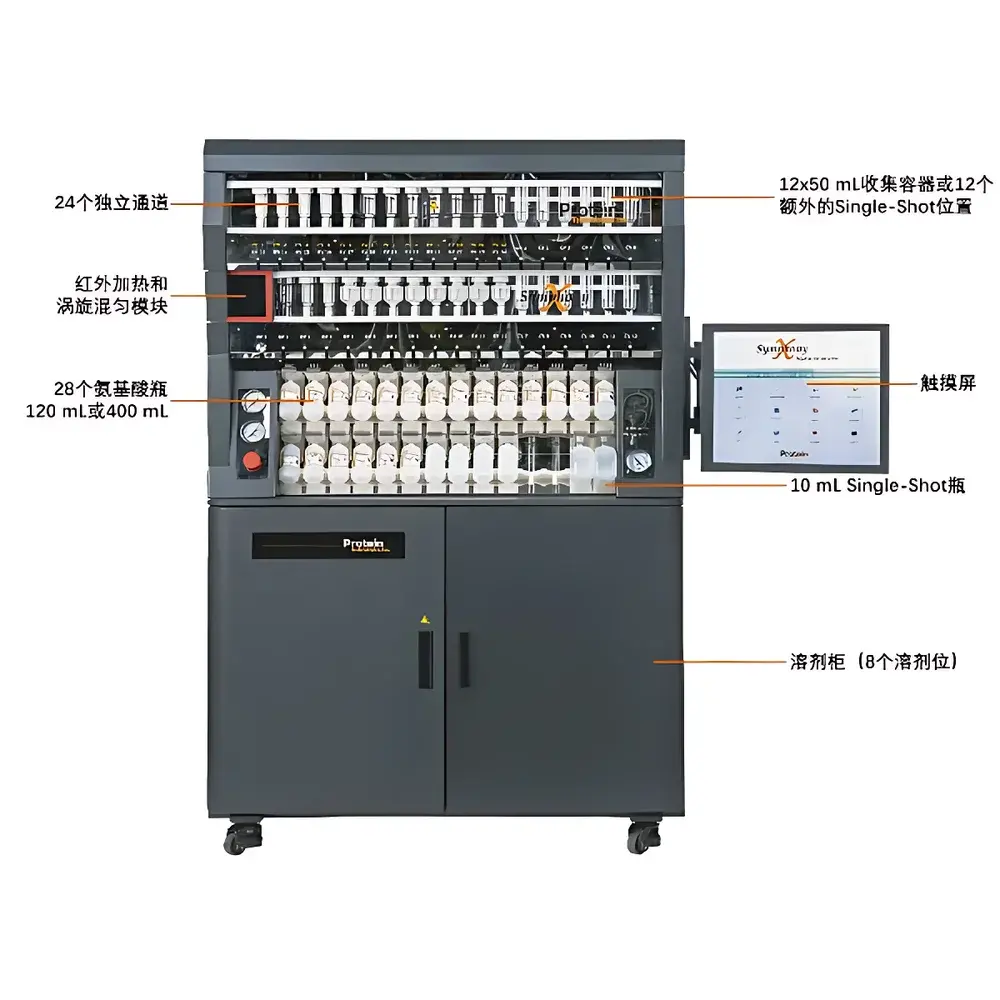
Protein Technologies Symphony® X Automated Peptide Synthesizer
| Brand | Protein Technologies |
|---|---|
| Origin | USA |
| Manufacturer Type | Original Equipment Manufacturer (OEM) |
| Product Category | Imported |
| Model | Symphony® X |
| Amino Acid Delivery | Fully Automated |
| Reagent Delivery | Fully Automated |
| Synthesis Scale | 0.005–24 mmol per reactor (up to ~2 g resin per RV) |
| Single-Shot Dispense Volume | ≥0.5 mL or ≥1 mL per delivery |
| Reactor Count | 24 independent reactors (12 with optional pre-activation capability) |
| Reactor Vessel Capacity | Disposable polypropylene: 10 mL, 45 mL |
| Borosilicate glass | 10 mL, 40 mL |
Overview
The Protein Technologies Symphony® X is a high-performance, 24-channel automated solid-phase peptide synthesizer engineered for research, process development, and cGMP-compliant manufacturing environments. It implements Fmoc- and Boc-based solid-phase synthesis using precise fluidic control, real-time reaction monitoring, and thermally regulated reaction vessels. Unlike conventional parallel synthesizers that share reagent manifolds or rely on generic solenoid valves, the Symphony® X employs an integrated Ultra PurePep® Pathway — a proprietary microfluidic matrix valve architecture delivering zero-dead-volume, chemically inert, and optically verified fluid routing to each reactor. This architecture eliminates cross-contamination risks inherent in systems using off-the-shelf pneumatic valves prone to chemical degradation, leakage, or carryover. The instrument supports scalable synthesis from micromolar research quantities (5 µmol) to preparative-scale batches (24 mmol), enabling seamless transition from sequence screening to clinical-grade material production.
Key Features
- 24 Independent Reaction Channels: Each reactor operates autonomously — with independent temperature control, mixing, reagent delivery, and UV monitoring — allowing concurrent synthesis of distinct sequences, scales, and coupling chemistries without interference.
- Ultra PurePep® Pathway: A dedicated microfluidic valve block per reactor ensures complete isolation of fluid paths; all reagents and solvents are delivered under nitrogen pressure or vacuum, validated in real time via optical flow sensors to confirm accurate dispense volume and timing.
- Controlled Induction Heating: Integrated induction heaters achieve rapid, uniform thermal ramping across the full 0–90 °C range; compatible with vortex mixing to maintain homogeneous reaction conditions — critical for sterically hindered couplings and difficult sequences.
- Intellisynth Real-Time UV Monitoring: Measures absorbance directly in the reaction mixture (not effluent), enabling dynamic endpoint detection of Fmoc deprotection. This allows adaptive cycle termination — reducing over-deprotection, minimizing side reactions, and conserving expensive reagents.
- Parallel Pre-Activation Capability: Up to 12 reactors can be pre-activated simultaneously using DIC/HOBt or alternative activators — essential for coupling N-methylated, D-amino acid, or β-branched residues with high fidelity.
- Single-Shot Special Reagent Delivery: Delivers exact volumes (≥0.5 mL or ≥1 mL) of costly coupling agents or additives directly into individual reactors without priming, flushing, or manual intervention — eliminating waste and contamination risk.
- Automated Cleavage & Collection: Fully programmable cleavage protocol (on-the-fly, post-synthesis, or scheduled); cleaved peptides collected directly into standard 50 mL conical tubes. All wetted materials are TFA-resistant (e.g., PTFE, Hastelloy, borosilicate glass), validated for repeated exposure to harsh cleavage cocktails.
Sample Compatibility & Compliance
The Symphony® X accommodates a broad range of resin types (Wang, Rink, Sieber, PAL, ChemMatrix®), amino acid derivatives (Fmoc- and Boc-protected, including phospho-, glyco-, and fluorescently labeled variants), and activation chemistries (HBTU/DIPEA, DIC/Oxyma, PyBOP, etc.). Its fluidic architecture is compatible with DMF, DCM, NMP, THF, and acetonitrile-based solvents. For regulated environments, the system supports IQ/OQ documentation packages aligned with ASTM E2500, ISO 9001, and FDA 21 CFR Part 11 requirements. Audit trails, electronic signatures, and user-access controls are implemented through the Synthesis Control Software (SCS) to meet GLP and cGMP validation standards. All hardware components undergo material compatibility testing per USP and ISO 10993-5 for biocompatibility where applicable.
Software & Data Management
The Synthesis Control Software (SCS) provides intuitive method authoring, real-time status visualization, and comprehensive data logging. Each synthesis run generates a timestamped, immutable record containing reactor-specific parameters: temperature profiles, UV absorbance curves, reagent dispense volumes/timing, mixing cycles, and cleavage event logs. Data exports comply with ASTM E2872 (Standard Guide for Electronic Records and Signatures in Laboratory Settings) and support CSV, PDF, and XML formats. SCS integrates with LIMS platforms via RESTful API and supports role-based access control (RBAC) with password policies, session timeouts, and activity audit trails. Full electronic records are retained for ≥25 years per internal retention policy — consistent with ICH M4Q(R2) and EU Annex 11 expectations for long-term traceability.
Applications
- High-throughput peptide library generation for epitope mapping, SAR studies, and vaccine candidate screening
- Process development and optimization of coupling/deprotection kinetics under controlled thermal and stoichiometric conditions
- cGMP synthesis of therapeutic peptides (e.g., GLP-1 analogs, antimicrobial peptides, constrained macrocycles)
- Production of heavy-isotope-labeled peptides for quantitative proteomics (SILAC, AQUA)
- Synthesis of modified peptides bearing post-translational modifications (phosphorylation, acetylation, ubiquitination mimics)
- Method transfer between research-scale and manufacturing-scale synthesis platforms
FAQ
Does the Symphony® X support both Fmoc and Boc chemistry?
Yes — the system is fully configurable for either Fmoc- or Boc-based solid-phase synthesis, including orthogonal protection schemes and acid-labile linkers.
Can I upgrade a 12-reactor Symphony® X to 24 channels?
No — reactor count is hardware-defined at time of manufacture; 24-channel configuration requires full system purchase.
Is the Ultra PurePep® Pathway serviceable in the field?
Yes — the microfluidic valve blocks are modular and replaceable by certified field service engineers; mean time between failures exceeds 10,000 cycles per channel.
What validation documentation is included with IQ/OQ support?
A complete IQ/OQ package includes equipment specification checklist, installation verification report, operational test protocols (OTP), calibration certificates for temperature/UV sensors, and a summary compliance statement signed by a GPT-certified engineer.
How does Single-Shot dispensing prevent reagent waste during small-scale synthesis?
By eliminating manifold priming and line flushing, Single-Shot delivers only the precise volume required per coupling step — reducing typical reagent consumption by 30–50% compared to traditional batch-fed systems.




