
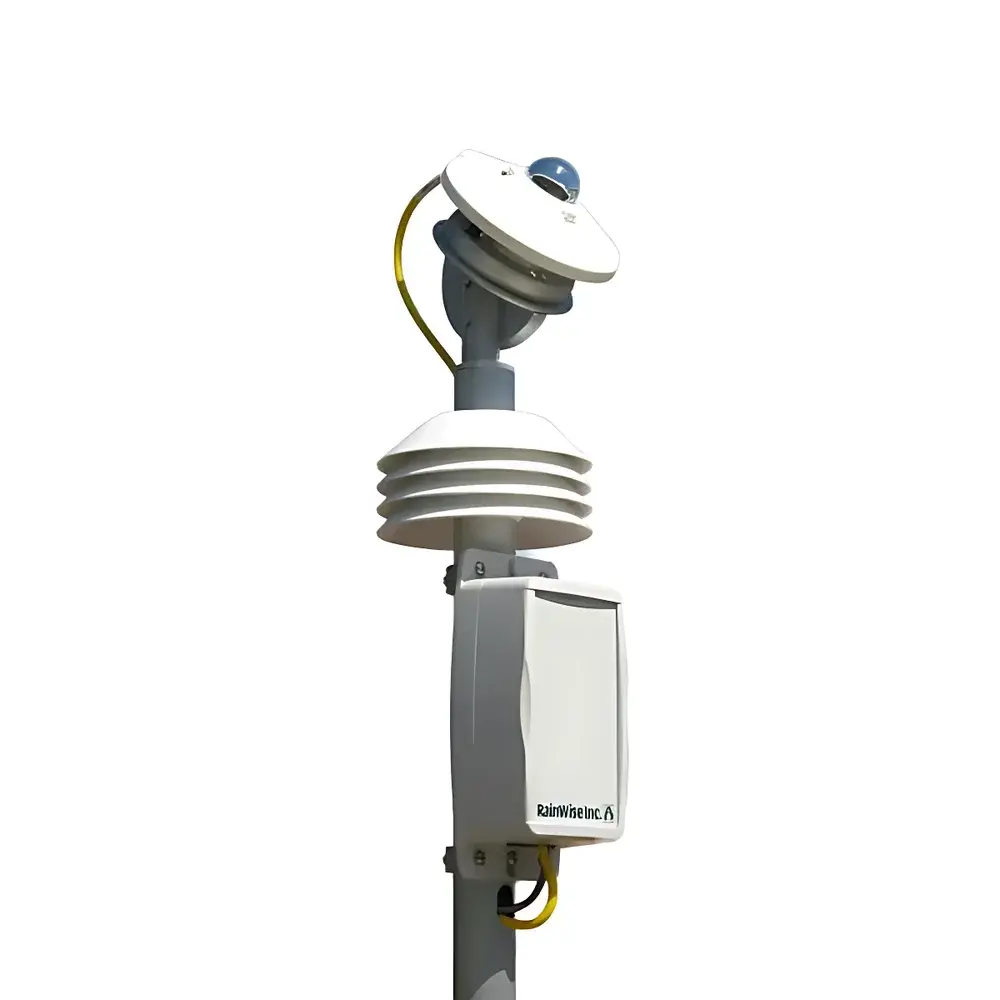
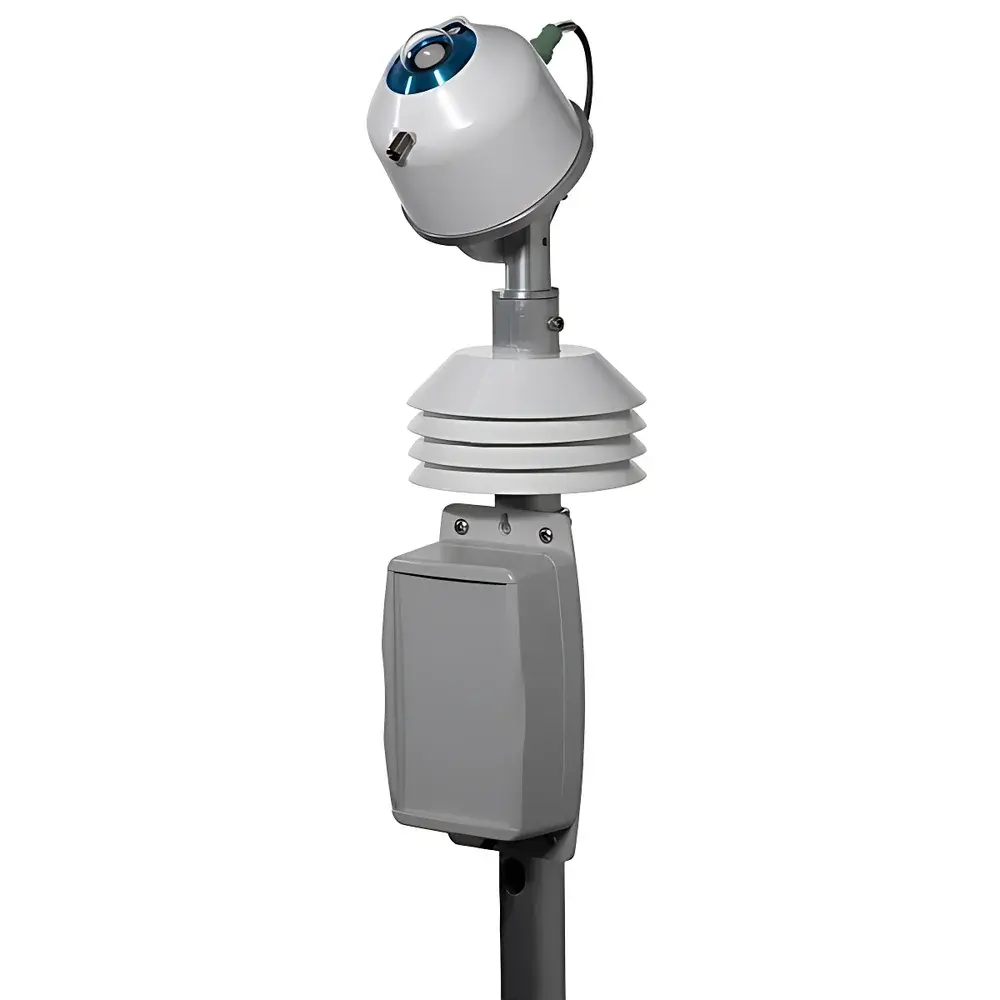
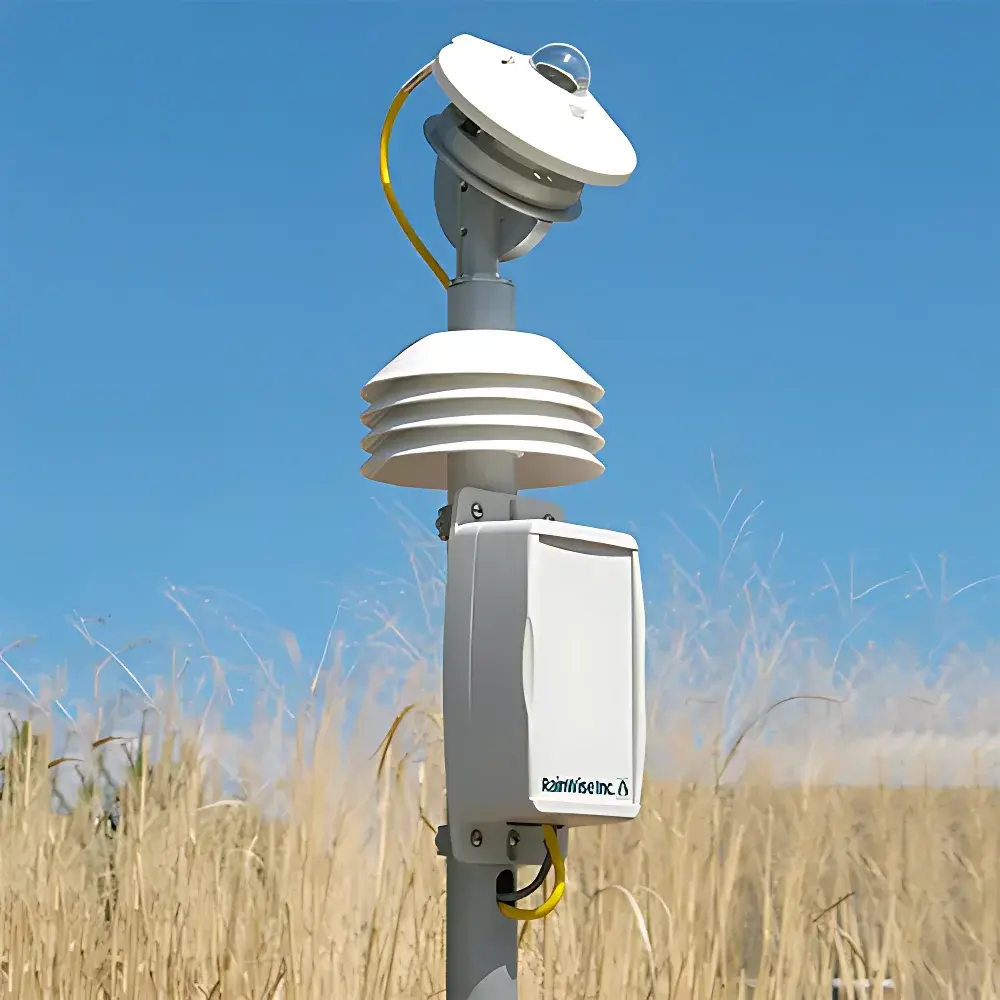
RainWise PVmet 150 Photovoltaic Monitoring Weather Station
| Brand | RainWise |
|---|---|
| Origin | USA |
| Model | PVmet 150 |
| Radiation Measurement Range | 0–2000 W/m² |
| Accuracy (Irradiance) | ±5% |
| Spectral Range | 285–2800 nm |
| Response Time (95%) | <18 s |
| Cosine Response Error (45°) | ±1% |
| Cosine Response Error (75°) | ±5% |
| Air Temperature Range | −40 to +80 °C |
| Air Temperature Accuracy | ±0.3 °C |
| Backsheet Temperature Range | −40 to +80 °C |
| Backsheet Temperature Accuracy | ±0.3 °C |
| Resolution (Temperature) | 0.1 °C |
| Operating Ambient | −40 to +80 °C, 0–100% RH |
| Power Supply | 10–30 VDC, 50 mA |
| Communication Interface | RS-485/RS-422 Modbus RTU (2-wire half-duplex) |
| Baud Rate | up to 9600 |
| Terminal Impedance | 120 Ω |
| Cable Length | 7.62 m |
| Enclosure Materials | PVC, ABS, Anodized Aluminum, Stainless Steel, Polycarbonate (LEXAN®, Makrolon® 2658) |
Overview
The RainWise PVmet 150 Photovoltaic Monitoring Weather Station is an engineered solution for high-fidelity solar resource assessment and performance monitoring in utility-scale, commercial, and industrial photovoltaic (PV) power plants. Designed specifically for the operational and financial requirements of modern solar asset management, the PVmet 150 implements a secondary-standard pyranometer compliant with ISO 9060:1990 (Class II) and aligned with World Meteorological Organization (WMO) Second-Class and First-Class reference instrument specifications. Its measurement architecture centers on spectral response (285–2800 nm), cosine-corrected irradiance capture, and thermally stable temperature sensing—enabling traceable, reproducible data essential for Performance Ratio (PR) calculations, yield modeling, and IEC 61724-1 compliance reporting. Mounted on a tilt-adjustable bracket, the unit delivers plane-of-array (POA) irradiance measurements critical for accurate DC yield estimation and degradation analysis.
Key Features
- ISO 9060:1990 Class II secondary-standard pyranometer with <±5% uncertainty under natural outdoor conditions, validated per ASTM E892 and IEC 61724-1 Annex A protocols
- Dual-point thermal sensing: high-accuracy air temperature sensor (±0.3 °C) and up to two PV backsheet temperature sensors (±0.3 °C), supporting thermal derating and module temperature coefficient validation
- Modbus RTU over RS-485/RS-422 (2-wire half-duplex) as standard; optional Modbus TCP via Ethernet interface for integration into SCADA, EMS, or cloud-based O&M platforms
- SunSpec certified (SunSpec Modbus Profile 103 & 203), ensuring interoperability with inverters, string monitors, and third-party analytics software
- Robust environmental enclosure constructed from UV-stabilized polycarbonate (LEXAN® and Makrolon® 2658), anodized aluminum, stainless steel hardware, and RoHS-compliant non-lead electronics
- Low-power design (10–30 VDC, 50 mA typical) suitable for remote deployment with battery/solar-charged systems or integration into existing site power infrastructure
Sample Compatibility & Compliance
The PVmet 150 is designed for continuous, unattended operation in outdoor environments ranging from −40 °C to +80 °C and 0–100% relative humidity. Its mechanical and electrical design conforms to IEC 60529 IP65 ingress protection, UL 61010-1 safety standards, and EN 50121-3-2 for electromagnetic compatibility in industrial settings. The pyranometer’s calibration traceability follows NIST-traceable procedures, and its spectral response meets the requirements for Class II instruments defined in ISO 9060:1990 and referenced in IEC 61724-1:2021 for PV system monitoring. All firmware and communication protocols comply with SunSpec Alliance certification requirements, facilitating audit-ready data exchange in GMP-aligned solar asset management workflows.
Software & Data Management
Data acquisition is performed via industry-standard Modbus RTU registers mapped to physical parameters including global horizontal irradiance (GHI), plane-of-array irradiance (POA), ambient air temperature, and PV backsheet temperature. Register mapping supports both single- and dual-backsheet configurations, enabling flexible deployment across mono-facial and bifacial array architectures. When integrated with compatible SCADA systems or data loggers (e.g., Campbell Scientific CR1000X, Siemens Desigo CC, or Schneider EcoStruxure), the PVmet 150 provides timestamped, linearized values with built-in diagnostic flags for sensor health monitoring. Firmware updates are delivered via serial command set, and configuration parameters—including tilt angle, sensor ID, and baud rate—are programmable without hardware modification. Audit trails and change logs are maintained in accordance with GLP/GMP-aligned data integrity principles where required.
Applications
- Performance Ratio (PR) and Yield Assessment per IEC 61724-1 Tier A/B/C monitoring tiers
- Site suitability studies and pre-construction solar resource validation
- Operational performance benchmarking against P50/P90 energy yield models
- Thermal loss quantification using simultaneous POA irradiance and backsheet temperature inputs
- Commissioning verification and long-term degradation trending (LID, LeTID, PID)
- Regulatory reporting for feed-in tariff (FIT) or power purchase agreement (PPA) compliance
FAQ
Is the PVmet 150 calibrated prior to shipment?
Yes. Each unit ships with a NIST-traceable calibration certificate valid for 12 months from date of manufacture, covering pyranometer sensitivity and temperature sensor offsets.
Can the PVmet 150 be used for bifacial energy yield modeling?
Yes. With optional rear-side irradiance sensors and dual backsheet temperature inputs, it supports albedo-derived bifacial gain calculation when deployed with appropriate mounting geometry.
Does the device support time-synchronized data logging?
The PVmet 150 does not include an internal real-time clock; synchronization is managed externally by the host data logger or SCADA system via Modbus register reads and timestamp assignment.
What is the recommended recalibration interval?
RainWise recommends recalibration every 12–24 months depending on exposure conditions, consistent with IEC 61724-1 guidance for Class II reference stations.
Is the RS-485 interface isolated?
No. The RS-485 transceiver is non-isolated; external galvanic isolation is advised for installations spanning multiple grounding domains or in high-noise industrial environments.
Related Products







