
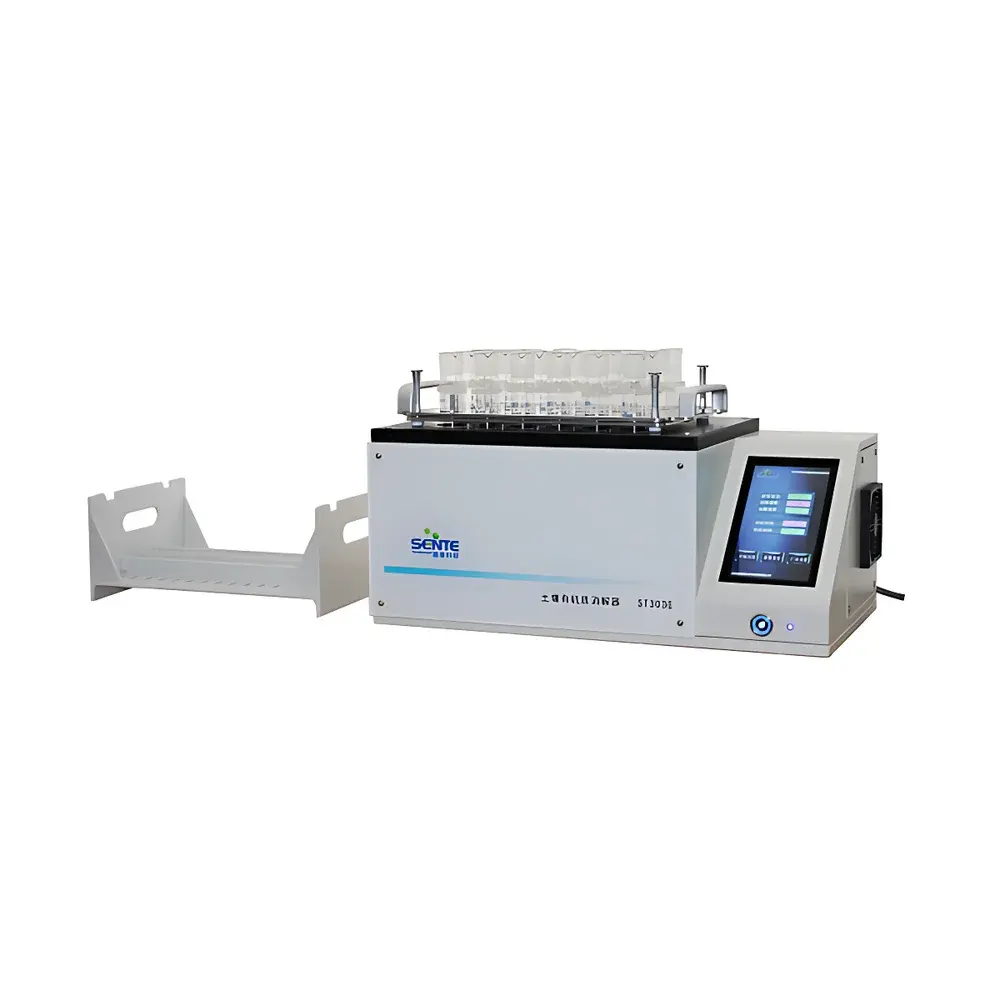
SENTE ST303G Automated Soil Organic Matter Digestion System
| [Brand | SENTE |
|---|---|
| Origin | Shandong, China |
| Manufacturer Type | Direct Manufacturer |
| Instrument Type | Electric Heating Digestion System |
| Automation Level | Fully Automatic |
| Digestion Positions | 24 |
| Temperature Range | 0–230 °C (extendable to 300 °C) |
| Temperature Control Accuracy | ±1 °C |
| Heating Principle | Infrared Radiant Heating |
| Reagent Channels | 4 |
| Rated Power | 2300 W |
| Rated Voltage | 220 V, 50 Hz |
| Dimensions (W×D×H) | 355 × 338 × 228 mm |
| Digestion Tube Size | Ø28 × 250 mm |
| Max. Tube Capacity | 100 mL |
| Digestion Time Range | 0–240 min] |
Overview
The SENTE ST303G Automated Soil Organic Matter Digestion System is a purpose-built, fully automated digestion platform engineered for precise, reproducible, and compliant sample preparation in soil fertility analysis, agricultural research, environmental monitoring, and regulatory testing laboratories. It implements the classical wet-oxidation method standardized in ISO 14235:1998, ASTM D5072–19, and Chinese national standard NY/T 85–2017 for quantifying soil organic carbon (SOC), which is then converted to soil organic matter (SOM) content using the empirically validated conversion factor of 1.724. The system operates on infrared radiant heating—providing rapid thermal response, uniform energy distribution, and minimal thermal lag—enabling strict adherence to the critical 175 °C ±5 °C oxidation temperature and 5.0 ±0.5 min reaction time specified in the dichromate-sulfuric acid oxidation protocol. Its 24-position configuration supports high-throughput batch processing while maintaining per-vial temperature consistency (±1 °C inter-position deviation), essential for minimizing analytical variance across replicate samples.
Key Features
- Fully automated digestion cycle with programmable temperature (0–300 °C) and time (0–240 min) parameters, including automatic heating termination, audible/visual end-of-cycle alerts, and real-time thermal profiling.
- 24 independent infrared-heated aluminum alloy digestion modules arranged in a concentric ring architecture—ensuring rapid, uniform heat transfer and <±1.5 °C inter-well temperature deviation at 175 °C.
- Integrated 4-channel reagent dispensing system compatible with K2Cr2O7-H2SO4 oxidant solution, blank reagents, and titrant stock—reducing manual handling and cross-contamination risk.
- Patented insulated, corrosion-resistant cavity housing with non-exposed thermal insulation materials; surface-treated with epoxy-polyester anti-acid coating for long-term exposure to aggressive fumes and condensates.
- 24-tube carrier assembly enabling simultaneous insertion/removal of all digestion tubes—facilitating rapid post-digestion cooling and seamless transition to titration workflows.
- 5-inch color TFT-LCD touchscreen with 60° ergonomic tilt angle, supporting intuitive parameter entry, live temperature/time graphs, event logging, and user-accessible calibration menus.
Sample Compatibility & Compliance
The ST303G accommodates standard 28 mm × 250 mm borosilicate glass digestion tubes (max. 100 mL capacity), compatible with soils containing ≤15% organic matter, as well as food matrices, pharmaceutical excipients, and plant tissues requiring oxidative digestion prior to carbon quantification. All thermal and timing parameters are configurable to align with method-specific validation requirements under GLP and ISO/IEC 17025 frameworks. While the instrument itself does not perform titration, its digestion output meets the sample conditioning specifications required for subsequent volumetric analysis per USP , EPA Method 9060A, and AOAC Official Method 973.17. The system’s deterministic heating profile and closed-cavity design support audit-ready traceability when paired with external LIMS or electronic lab notebook (ELN) integration via RS-232 or USB export.
Software & Data Management
The embedded firmware records timestamped thermal profiles, setpoint deviations, cycle completion status, and operator ID (via optional password-protected login). Raw logs are exportable in CSV format for offline review or import into laboratory information management systems (LIMS). Though the ST303G does not include built-in titration control or CFR Part 11-compliant electronic signatures, its operational data—including start/end times, actual vs. target temperatures, and duration compliance—can be archived alongside analytical results to satisfy FDA 21 CFR Part 11 documentation requirements when used within a validated workflow. Calibration verification routines (e.g., NIST-traceable thermocouple checks) are accessible through service mode and documented in the user manual.
Applications
- Quantitative determination of soil organic carbon (SOC) and derived organic matter (SOM) in agronomic soil surveys and land-use change studies.
- Preparation of digests for total carbon analysis in compost, manure, biochar, and municipal solid waste amendments.
- Oxidative digestion of food products (e.g., cereals, legumes, dairy powders) prior to carbon/nitrogen ratio assessment.
- Regulatory compliance testing for organic content in pharmaceutical raw materials per ICH Q5C guidelines.
- Method development and validation in environmental chemistry labs seeking robust, low-variance alternatives to open-flame or block-heater digestion.
FAQ
Does the ST303G include integrated titration capability?
No—the ST303G performs only the controlled digestion step. Titration must be conducted separately using a calibrated burette or autotitrator.
Is the system compatible with ISO 14235:1998 validation requirements?
Yes—its programmable temperature stability (±1 °C), precise timing control (±10 s), and uniform inter-position heating meet the instrumental performance criteria outlined in Annex B of ISO 14235 for method equivalence verification.
Can digestion tubes be replaced with quartz or PTFE variants?
Only borosilicate glass tubes meeting ASTM E438 Type I, Class A specifications are validated for use; alternative materials may compromise thermal response or chemical resistance.
What maintenance is required for long-term accuracy?
Biannual verification of temperature sensors using a NIST-traceable reference thermometer and visual inspection of cavity insulation integrity are recommended per the maintenance schedule in Section 7.2 of the operator manual.



