
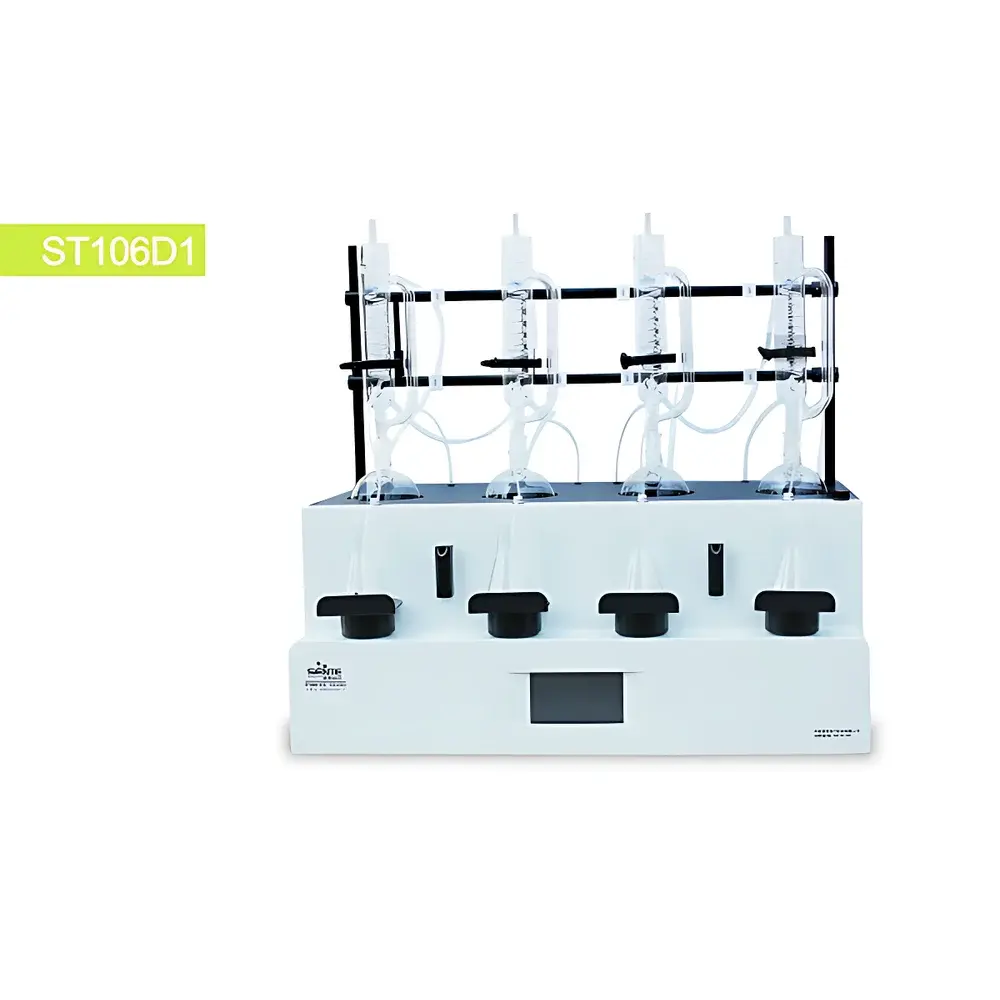
SENTE ST106D1 Intelligent Integrated Distillation Apparatus
| Brand | SENTE |
|---|---|
| Origin | Shandong, China |
| Manufacturer Type | Direct Manufacturer |
| Country of Origin | China |
| Model | ST106D1 (also designated STPW204) |
| Instrument Type | Standard Quartz Glass Distillation System |
| Heating Method | Far-Infrared Ceramic Heating Module |
| Cooling Method | Built-in Compressor-Based Closed-Loop Cooling System |
| Distillation Rate | 2–8 mL/min |
| Heating Ramp Time | ≤8 min |
| Distillate Volume Range | 1–1000 mL |
| Heating Positions | 6 independent channels |
| Rated Power | 3500 W |
| Dimensions (L×W×H) | 960 × 575 × 410 mm |
| Timer Range | 0–200 min |
| Standard Configuration Includes | 4 × 1000 mL dual-neck quartz flasks, 4 × 500 mL receiving flasks, 4 × coiled condensers, flask support rack, condenser mounting bracket, 4 × distillate auto-lock collection units, and integrated compressor cooling unit |
Overview
The SENTE ST106D1 Intelligent Integrated Distillation Apparatus is a fully automated, six-channel benchtop distillation system engineered for reproducible, operator-independent volatile compound isolation in environmental, food safety, pharmaceutical, and regulatory testing laboratories. It operates on classical batch distillation principles—applying controlled far-infrared ceramic heating to sample solutions within quartz glass flasks, followed by efficient vapor condensation via precision-engineered coiled condensers and active thermal management through an internal compressor-driven closed-loop coolant circulation system. Unlike conventional water-cooled systems requiring municipal tap supply or external chillers, the ST106D1 eliminates dependency on auxiliary infrastructure while maintaining stable condenser surface temperatures across all channels. Its design prioritizes method robustness, endpoint accuracy, and hands-free operation—particularly critical for applications governed by standardized protocols such as EPA Method 524.2, ISO 6439, or AOAC 971.23.
Key Features
- Six independently controllable heating stations with far-infrared ceramic modules ensure uniform thermal distribution and rapid ramp-up (≤8 min to operational temperature), minimizing thermal lag and enhancing inter-run consistency.
- Integrated compressor-based cooling system delivers continuous, temperature-stabilized coolant flow to all four condensers without external plumbing—eliminating risks of pressure fluctuations, ambient temperature drift, or municipal water quality variability.
- Programmable distillate volume endpoint control (1–1000 mL per channel) enables precise method adherence for analyte recovery quantification, supporting both fixed-volume and gravimetric endpoint strategies.
- Patented coiled condenser geometry—fabricated from high-purity quartz glass—optimizes surface area-to-volume ratio and minimizes vapor re-entrainment, preventing carryover and ensuring high-fidelity separation of low-boiling volatiles.
- Large-format capacitive touchscreen interface provides intuitive navigation, real-time parameter monitoring (temperature, elapsed time, collected volume), and secure user-level access control compatible with GLP-compliant workflow documentation.
- Dedicated distillate ejection and waste segregation mechanism ensures automatic discharge of excess or post-endpoint liquid into a dedicated reservoir—reducing manual handling and cross-contamination risk during high-throughput runs.
Sample Compatibility & Compliance
The ST106D1 accommodates aqueous, acidic, alkaline, and moderately organic matrices—including wastewater, soil extracts, dairy products, alcoholic beverages, and herbal infusions—within standard 1000 mL dual-neck quartz flasks. Its quartz construction resists corrosion from HCl, HNO₃, and NaOH solutions commonly used in digestion pretreatment steps. The system supports method validation under ISO/IEC 17025 requirements and aligns with key regulatory frameworks including US EPA SW-846, FDA Bacteriological Analytical Manual (BAM), and EU Commission Regulation (EC) No 882/2004. All electronic controls and data logging functions are architected to support audit-ready records compliant with 21 CFR Part 11 when paired with validated LIMS integration.
Software & Data Management
The embedded firmware enables full method storage (up to 50 protocols), timestamped run logs with digital signature fields, and exportable CSV reports containing start/stop times, setpoints, actual temperatures, and final collected volumes. Optional USB or Ethernet connectivity allows synchronization with laboratory information management systems (LIMS) for automated result ingestion. Audit trails capture user ID, parameter changes, and system events—retained for ≥180 days without overwrite. Firmware updates are performed via authenticated firmware packages signed by SENTE’s certificate authority to maintain integrity throughout the instrument lifecycle.
Applications
- Volatile organic compound (VOC) analysis in drinking water and groundwater per EPA Method 502.2 and 524.2
- Ammonia-nitrogen determination in wastewater using distillation–titration workflows (ISO 5664, APHA 4500-NH₃)
- Kjeldahl nitrogen recovery in food and feed samples (AOAC 984.13, ISO 5983-1)
- Free cyanide and phenol extraction prior to colorimetric or GC detection (ISO 6439, ISO 6438)
- Essential oil isolation and purity assessment in botanical QA/QC environments
- Distillative cleanup of complex biological digests prior to ICP-MS or AAS analysis
FAQ
Does the ST106D1 require connection to tap water or an external chiller?
No—the system incorporates a self-contained compressor-based cooling loop with proprietary heat exchange architecture, enabling uninterrupted operation without external utilities.
Can individual channels be operated independently?
Yes—each of the six heating positions features independent temperature and timing control, allowing heterogeneous sample sets to be processed simultaneously under distinct protocols.
What materials contact the sample during distillation?
Only high-purity quartz glass (flasks, condensers) and PTFE-sealed joints; no metal components are exposed to vapors or liquids.
Is the system compatible with GLP or GMP documentation requirements?
Yes—full electronic record generation, user authentication, and immutable audit trail functionality meet core ALCOA+ data integrity criteria for regulated environments.
What maintenance intervals are recommended for the compressor cooling system?
Compressor performance verification and refrigerant pressure calibration are advised annually; no routine oil changes or filter replacements are required due to sealed-system design.



