
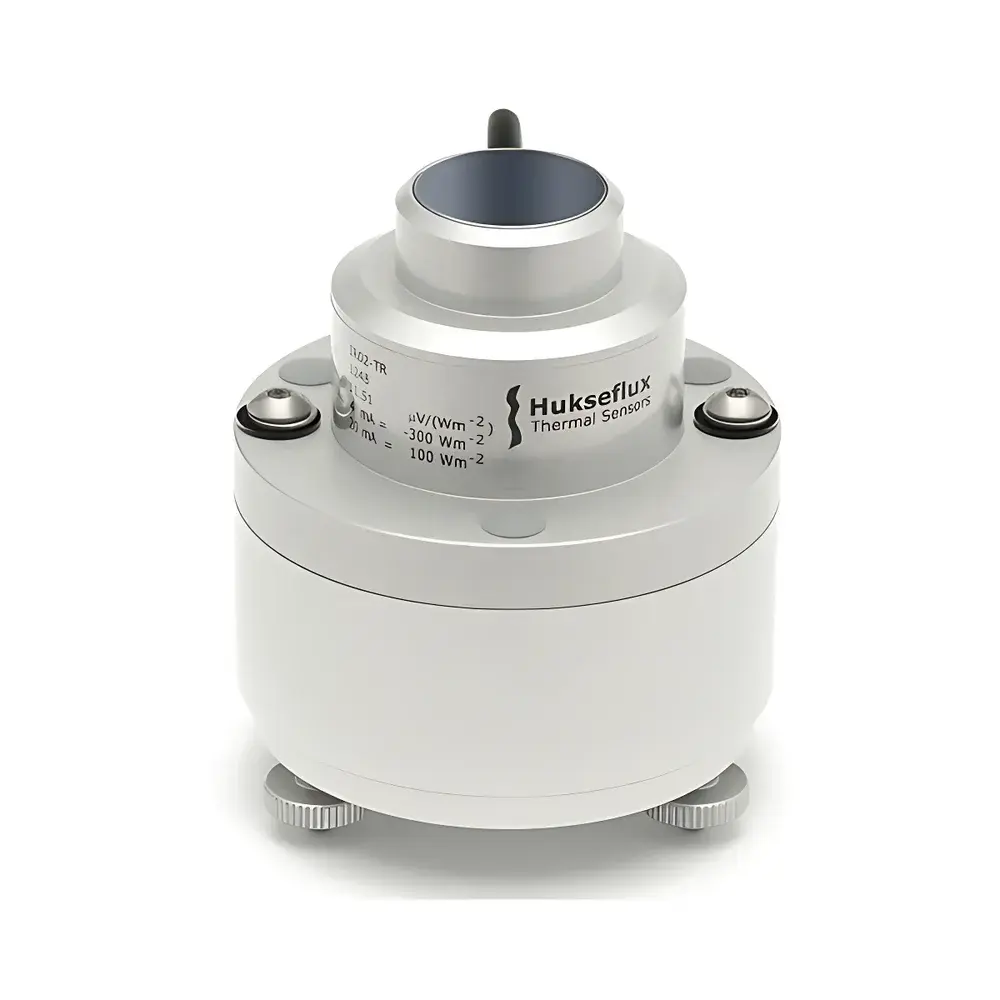
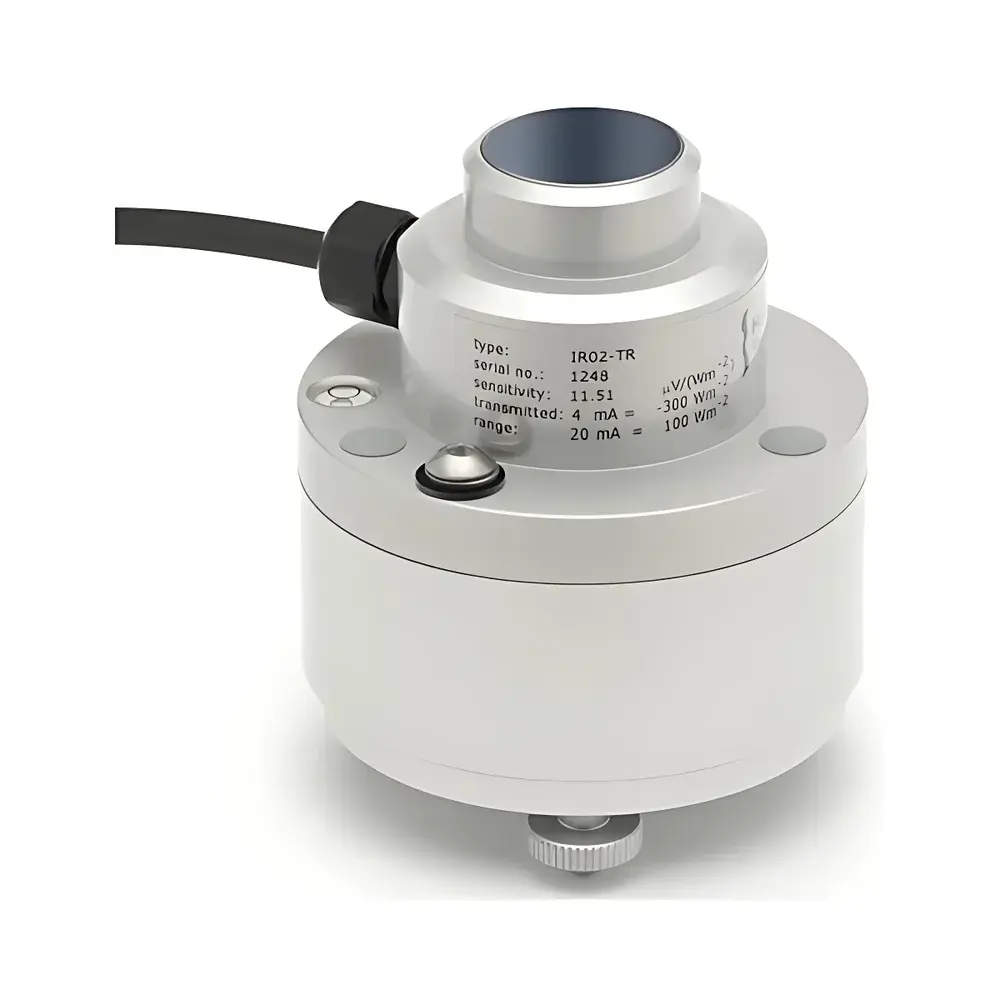
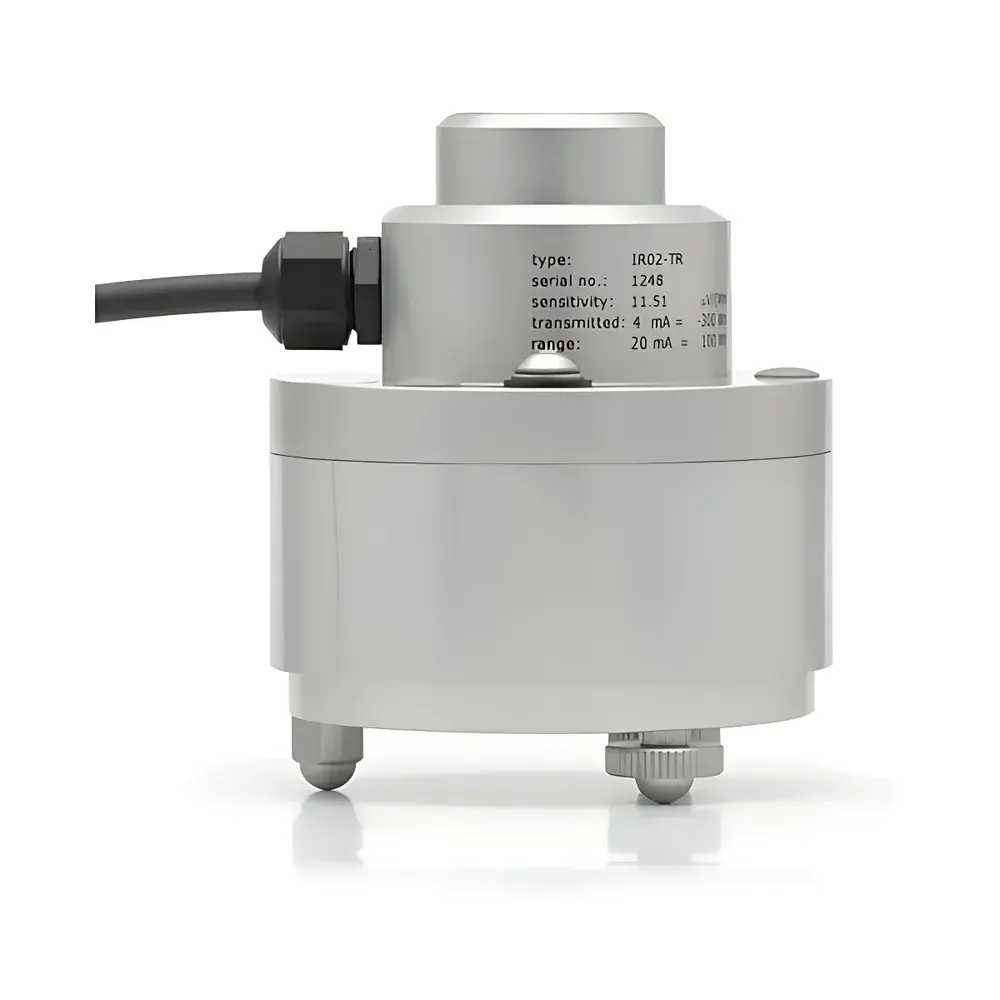
Hukseflux IR02-TR Longwave Infrared Radiometer
| Brand | Hukseflux |
|---|---|
| Origin | Netherlands |
| Model | IR02-TR |
| Spectral Range | 4.5–40 µm |
| Field of View | 150° |
| Output | 4–20 mA (2-wire loop) |
| Measurement Range | −300 to +100 W/m² |
| Response Time | 18 s |
| Operating Temperature | −40 to +80 °C |
| Temperature Sensitivity | < ±3 % (−10 to +40 °C) |
| Calibration Traceability | WISG or optional ITS-90 blackbody |
| Built-in Heater Power | 1.5 W @ 12 VDC |
| Cable Length | 5 m (extendable in 5-m increments) |
| Housing Material | Anodized Aluminum |
| Window | Flat Silicon with Solar-Blind UV-Blocking Filter |
| Sensor Type | Black-Coated Thermopile |
| Temperature Sensor | Pt100 |
| IP Rating | IP67 |
| Mass | 0.5 kg |
Overview
The Hukseflux IR02-TR is a precision longwave infrared radiometer engineered for continuous, high-stability measurement of terrestrial downward longwave irradiance (LW↓) in meteorological and climatological applications. It operates on the principle of thermopile-based detection: incident far-infrared radiation (4.5–40 µm) is absorbed by a black-coated thermal sensor, generating a temperature differential across thermocouple junctions, which produces a proportional voltage signal. This analog output is conditioned onboard by a calibrated 4–20 mA transmitter—eliminating external signal conditioning errors and ensuring compatibility with industry-standard SCADA, PLC, and data logger systems (e.g., Campbell Scientific CR series, Delta-T DL6, or HOBO RX3000). Unlike pyranometers measuring solar shortwave radiation, the IR02-TR captures only the Earth-emitted and atmospheric back-radiation component—critical for surface energy balance modeling, net radiation computation (in combination with a shortwave sensor), and frost prediction algorithms.
Key Features
- Integrated Peltier heater (1.5 W @ 12 VDC) prevents dew, frost, and condensation on the silicon window—maintaining optical transmission stability and minimizing diurnal zero-offset drift.
- 150° field-of-view (FOV) optimized for hemispheric sky integration while balancing cost, mechanical robustness, and cosine response fidelity—validated per ISO 9060:2018 Class C specifications for longwave instruments.
- Flat, solar-blind silicon window with UV-blocking coating ensures rejection of solar near-IR and visible contamination—enabling reliable day/night operation without spectral interference.
- Onboard Pt100 temperature sensor enables real-time cold-junction compensation and supports optional sky/surface temperature derivation via Stefan-Boltzmann inversion.
- IP67-rated anodized aluminum housing provides resistance to corrosion, dust ingress, and transient water immersion—suitable for unattended deployment in remote weather stations and agro-meteorological networks.
- Factory-calibrated traceable to WISG (World Infrared Standard Group); optional ITS-90 blackbody calibration available for GLP-compliant applications requiring metrological rigor.
Sample Compatibility & Compliance
The IR02-TR is designed for outdoor, fixed-mount installation on horizontal surfaces or dedicated radiation booms. Its 150° FOV ensures representative integration over the full sky dome—excluding only the instrument’s immediate mounting structure (typically <5° obstruction). The device complies with key international standards governing environmental monitoring instrumentation: IEC 61260-1:2014 (electromagnetic compatibility), EN 60529:2013 (IP67 enclosure rating), and ISO 9060:2018 (spectral classification for radiometers). While not certified for FDA 21 CFR Part 11 or EU Annex 11, its analog 4–20 mA output and deterministic response time (18 s) support audit-ready data acquisition when paired with compliant loggers featuring time-stamped, tamper-evident storage and calibration event logging.
Software & Data Management
The IR02-TR requires no proprietary software: its 4–20 mA output maps linearly to irradiance (e.g., 4 mA = −300 W/m²; 20 mA = +100 W/m²), enabling direct interpretation by any current-input data logger. Hukseflux provides calibration certificates with individual sensitivity coefficients (µV/W·m⁻² or mA/W·m⁻²) and temperature correction polynomials. For advanced post-processing, users may apply the Stefan-Boltzmann equation using simultaneous Pt100 readings to compute effective sky temperature (Tsky = (LW↓/σ)1/4, where σ = 5.670373×10⁻⁸ W·m−2·K−4). All calibration documentation adheres to ISO/IEC 17025 requirements for traceability, uncertainty reporting (< ±2.5 % k=2 at 20 °C), and environmental influence characterization.
Applications
- Meteorological observatories and national climate monitoring networks (e.g., WMO GSN, GCOS sites)
- Agricultural frost-warning systems—real-time LW↓ thresholds trigger irrigation or heating interventions to prevent crop damage
- Surface energy balance studies in eddy covariance flux towers and land-atmosphere interaction experiments
- Validation of satellite-derived longwave flux products (e.g., CERES, MODIS LST)
- Building physics research—roof surface cooling analysis and urban heat island mitigation assessments
- Calibration transfer reference for secondary standard radiometers in field laboratories
FAQ
What is the purpose of the built-in heater?
The heater maintains the silicon window temperature ~5–10 °C above ambient to suppress dew/frost formation—preventing transmittance loss and non-linear baseline shifts, especially during high-humidity nighttime conditions.
Can the measurement range be customized?
Yes. The default 4–20 mA span corresponds to −300 to +100 W/m², but Hukseflux can factory-program alternative ranges (e.g., 0 to +500 W/m²) upon order specification.
Is cosine correction applied in firmware or post-processing?
No. Cosine response is achieved mechanically via the flat window geometry and diffuser design—verified to < ±3 % deviation up to 80° zenith angle per ISO 9060:2018 Annex E.
How often does the IR02-TR require recalibration?
Hukseflux recommends recalibration every 2 years for critical networks; annual verification against a reference standard is advised for GLP/GMP environments.
Does the IR02-TR measure upward longwave radiation?
No—it is configured for downward-facing hemispheric measurement only. For net longwave (LW↑ − LW↓), a second IR02-TR must be inverted and mounted on a separate boom with proper thermal shielding.







