
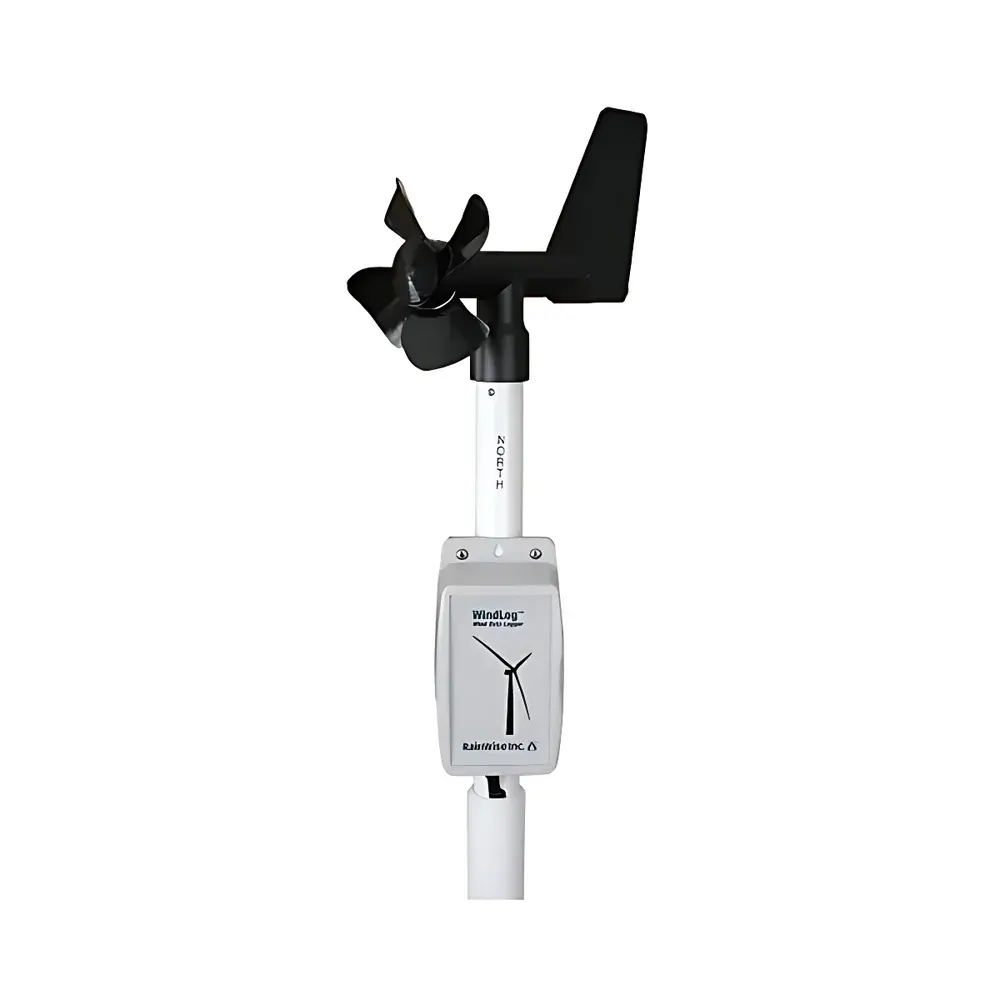
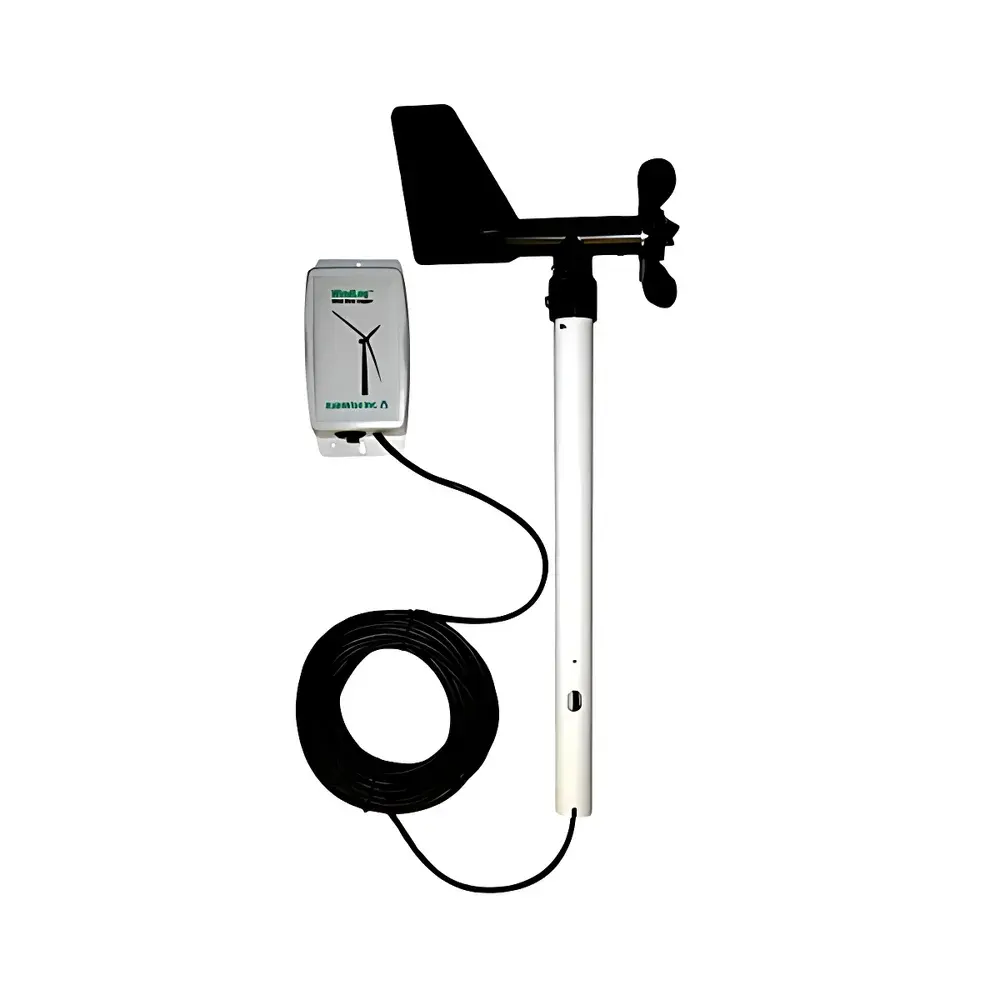
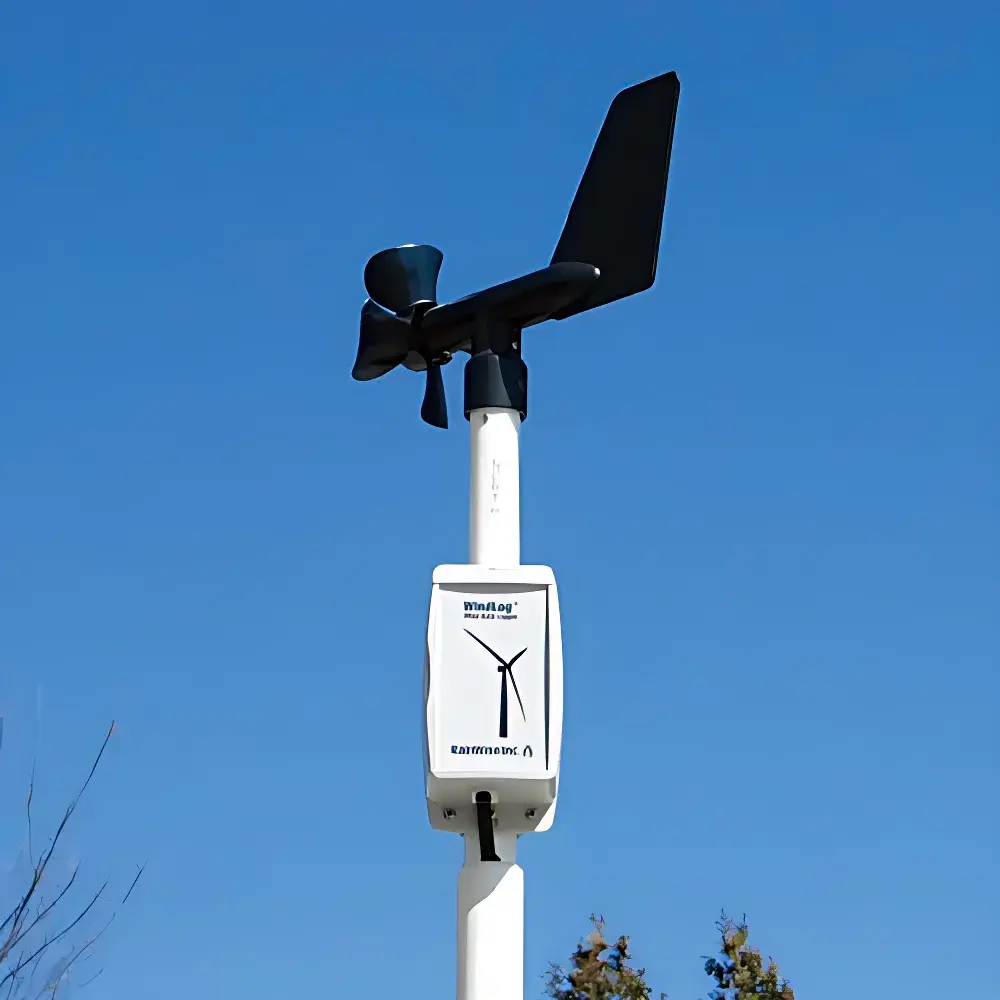
RainWise WindLog Wind Speed and Wind Direction Data Logger
| Brand | RainWise |
|---|---|
| Origin | USA |
| Model | WindLog |
| Resolution | 0.1 m/s |
| Measurement Range | 0–67 m/s |
| Accuracy | ±2% of full scale (wind speed), ±3° (wind direction) |
| Operating Temperature | −55°C to +70°C |
| Operating Humidity | 0–100% RH |
| Memory | 2 MB (stores >100,000 records) |
| Power | 3 × AA alkaline or lithium batteries |
| Interface | USB 2.0 (with real-time streaming and data download) |
| Sensor Type | Mini-AerVane (4-blade propeller + vane with magnetic reed switch array) |
| Wind Speed Threshold | 0.45 m/s |
| Wind Direction Resolution | 1° (16-point discrete output via reed switches) |
| Startup Wind Speed | 0.9 m/s |
| Materials | UV-stabilized Delrin®, Lexan®, stainless steel, and precision ball bearings |
Overview
The RainWise WindLog Wind Speed and Wind Direction Data Logger is a compact, field-deployable environmental monitoring instrument engineered for long-term, autonomous collection of meteorological wind parameters. It operates on the principle of mechanical anemometry combined with electromechanical directional sensing: a low-threshold, four-blade Lexan® propeller rotates in response to horizontal airflow, with each revolution triggering a magnetic reed switch to quantify rotational frequency; simultaneously, a balanced wind vane—equipped with an 8-switch reed array—rotates freely about a low-friction stainless-steel ball bearing pivot to resolve azimuthal orientation at 1° resolution across the full 0–360° range. The integrated microcontroller samples, time-stamps, and stores raw sensor outputs at user-configurable intervals (1 minute to 60 minutes), enabling statistically robust characterization of site-specific wind resources—critical for pre-feasibility assessment of small-scale wind turbine installations, microgrid planning, and regulatory compliance reporting in renewable energy development.
Key Features
- Mini-AerVane sensor architecture featuring UV-stabilized Delrin® housing, Lexan® blades, and corrosion-resistant stainless-steel components for extended outdoor service life
- Low detection threshold of 0.45 m/s and startup wind speed of 0.9 m/s—enabling reliable capture of light-wind regimes essential for urban or sheltered-site analysis
- 2 MB non-volatile flash memory supporting storage of over 100,000 timestamped records (average wind speed, gust speed, average wind direction)
- USB 2.0 interface enabling dual-mode operation: real-time streaming (when connected to host PC) and high-speed bulk download (up to 12 Mbps)
- Configurable logging interval from 1 minute to 60 minutes, programmable via Windows-based WindSoft software
- Power-efficient design: typical battery life of 6–9 months using 3 × AA alkaline cells; USB bus power supersedes battery draw during active connection
- Robust environmental rating: operational across −55°C to +70°C ambient temperature and 0–100% relative humidity without condensation-induced drift
Sample Compatibility & Compliance
The WindLog is designed for unattended deployment in diverse terrestrial and marine environments—including rooftop arrays, offshore platforms, port facilities, agricultural research stations, and remote meteorological observatories. Its mechanical sensor topology ensures immunity to electromagnetic interference (EMI) and compatibility with Class I, Division 2 hazardous locations when installed per NEC Article 500 guidelines. While not certified to IEC 61400-12-1 for turbine power performance testing, the device meets the data quality requirements outlined in ASTM D5096 (Standard Practice for Determining Wind Speed and Direction) for preliminary site assessment. All firmware and data handling routines adhere to NIST-traceable timekeeping standards, and timestamped datasets support GLP-compliant audit trails when archived with WindSoft’s SQLite database engine.
Software & Data Management
WindSoft—a free, Windows-native application provided with every WindLog unit—serves as the complete data acquisition, visualization, and export platform. It features automated firmware update checks over HTTPS, configurable data filtering (e.g., gust detection thresholds, vector averaging windows), and statistical summary generation (mean, standard deviation, Weibull k & c parameters). Time-series plots, rose diagrams, and scatter matrices are rendered natively; all visualizations support DPI-scalable export (PNG, SVG). Raw datasets export to CSV format with ISO 8601 timestamps, facilitating integration with MATLAB, Python (pandas), or enterprise GIS platforms. The embedded SQLite database maintains immutable record integrity, including write timestamps, battery voltage logs, and sensor health flags—enabling retrospective QA/QC traceability required under ISO/IEC 17025-accredited laboratory workflows.
Applications
- Preliminary wind resource assessment for distributed wind energy projects (IEC 61400-12-2 Annex A alignment)
- Environmental impact monitoring around construction zones, landfills, and industrial facilities
- Maritime safety and logistics optimization at ports, oil terminals, and offshore drilling rigs
- Microclimate studies in agronomy, forestry, and wildfire risk modeling
- Educational instrumentation for atmospheric science curricula and undergraduate engineering labs
- Long-term validation of numerical weather prediction (NWP) model outputs at mesoscale resolution
FAQ
Can WindLog operate continuously for more than one year?
Yes—configured at a 15-minute logging interval, the 2 MB memory supports approximately 14 months of continuous recording. Battery life remains the limiting factor; lithium AA cells extend operational duration beyond 12 months in moderate climates.
Is the USB interface compatible with modern Windows 10/11 systems without additional drivers?
Yes—WindLog enumerates as a CDC ACM-class USB serial device. No third-party drivers are required; native Microsoft WinUSB stack handles communication transparently.
Does WindLog meet FDA 21 CFR Part 11 requirements for electronic records?
While WindLog itself is not a regulated medical device, WindSoft’s SQLite database implements write-once append-only logging, SHA-256 hash integrity verification per session, and operator login audit trails—providing foundational controls that may be validated as part of a broader Part 11-compliant QMS.
Can multiple WindLog units be synchronized to a common time source?
No internal GPS or NTP client is included; however, WindSoft allows manual time correction prior to download, and host PC system clock synchronization (e.g., via Windows Time Service) ensures inter-unit temporal alignment within ±100 ms.
What mounting hardware is included, and is it suitable for pole or mast installation?
The MK-III Mono Mounting Bracket—constructed from galvanized steel, anodized aluminum, and UV-resistant PVC—is supplied standard. It supports adjustable tilt (0–90°) and azimuthal rotation, and accommodates mast diameters up to 76 mm (3 in) with optional clamping kits.
Related Products







