
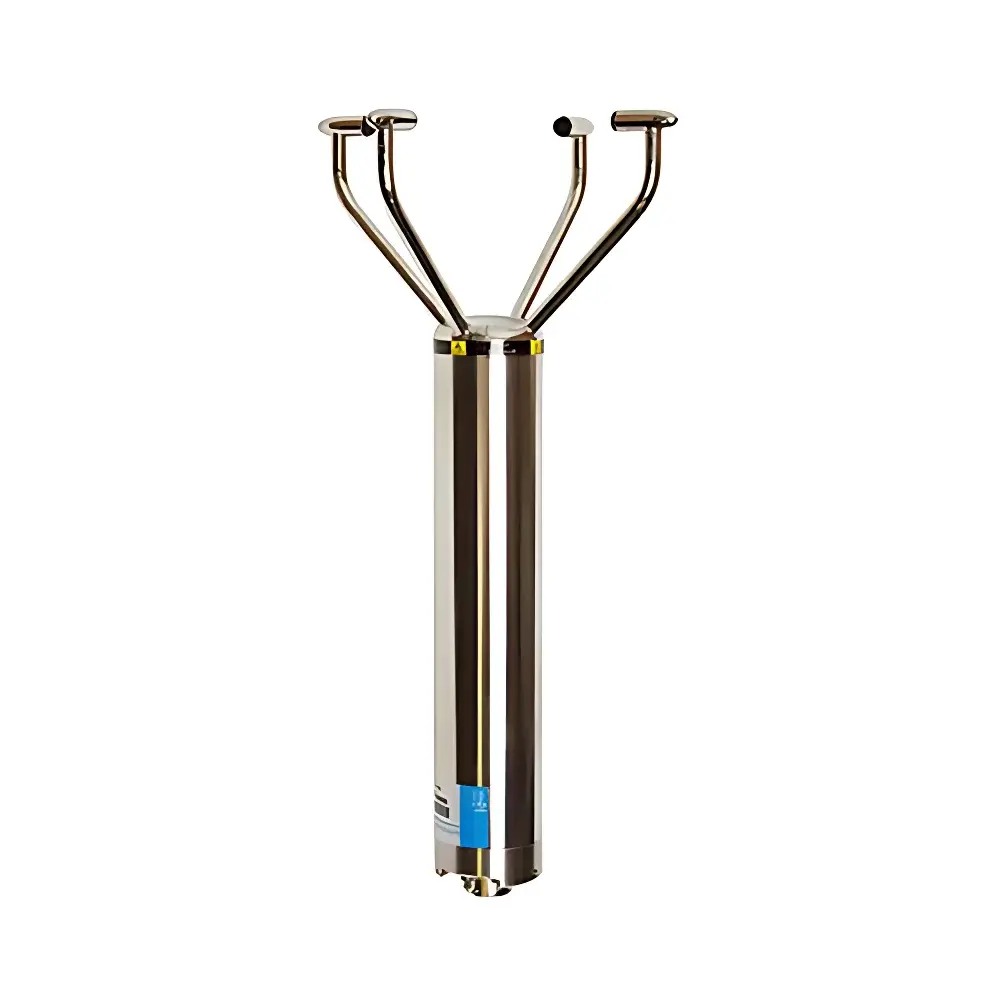

GILL WindObserver 90 Ultrasonic Anemometer
| Brand | GILL |
|---|---|
| Origin | United Kingdom |
| Model | WindObserver 90 |
| Instrument Type | Ultrasonic Anemometer |
| Resolution | 0.01 m/s |
| Measurement Range | 0 – 90 m/s |
| Accuracy | ±2% of reading |
| Operating Temperature | −55 °C to +70 °C |
| Operating Humidity | 0–100% RH |
| Heating Power | 150 W (7 A @ 24 VAC/DC, ~1 W/cm²) |
| Wind Direction Range | 0–360° (continuous, no dead zone) |
| Calibration | Traceable to NIST, performed in Merlin wind tunnel |
| Enclosure Material | Stainless steel (AISI 316) |
| Ingress Protection | IP66 |
| Output Interface | RS-422 / RS-485 (half-duplex, multi-drop capable) |
| Compliance | Meets WMO standards for mean wind and gust reporting |
| Mounting Options | Multiple base configurations available |
| Cable/Connector Options | Field-selectable |
Overview
The GILL WindObserver 90 Ultrasonic Anemometer is an industrial-grade, high-range ultrasonic wind sensor engineered for continuous, high-fidelity measurement of wind speed and direction under extreme environmental conditions. Utilizing time-of-flight (TOF) ultrasonic transit-time principle, the instrument calculates orthogonal wind components by precisely measuring the differential propagation time of ultrasonic pulses across three mutually perpendicular acoustic paths. This physics-based approach eliminates mechanical wear, inertia-related lag, and icing-induced signal loss—making it uniquely suited for applications where reliability at low temperatures, high velocities, or high humidity is non-negotiable. With a full-scale range extending to 90 m/s (201 mph), the WindObserver 90 exceeds standard meteorological requirements and aligns with IEC 61400-12-1 and WMO Guide to Meteorological Instruments and Methods of Observation (CIMO Guide) Annex 12 specifications for turbine site assessment and aviation-grade wind monitoring.
Key Features
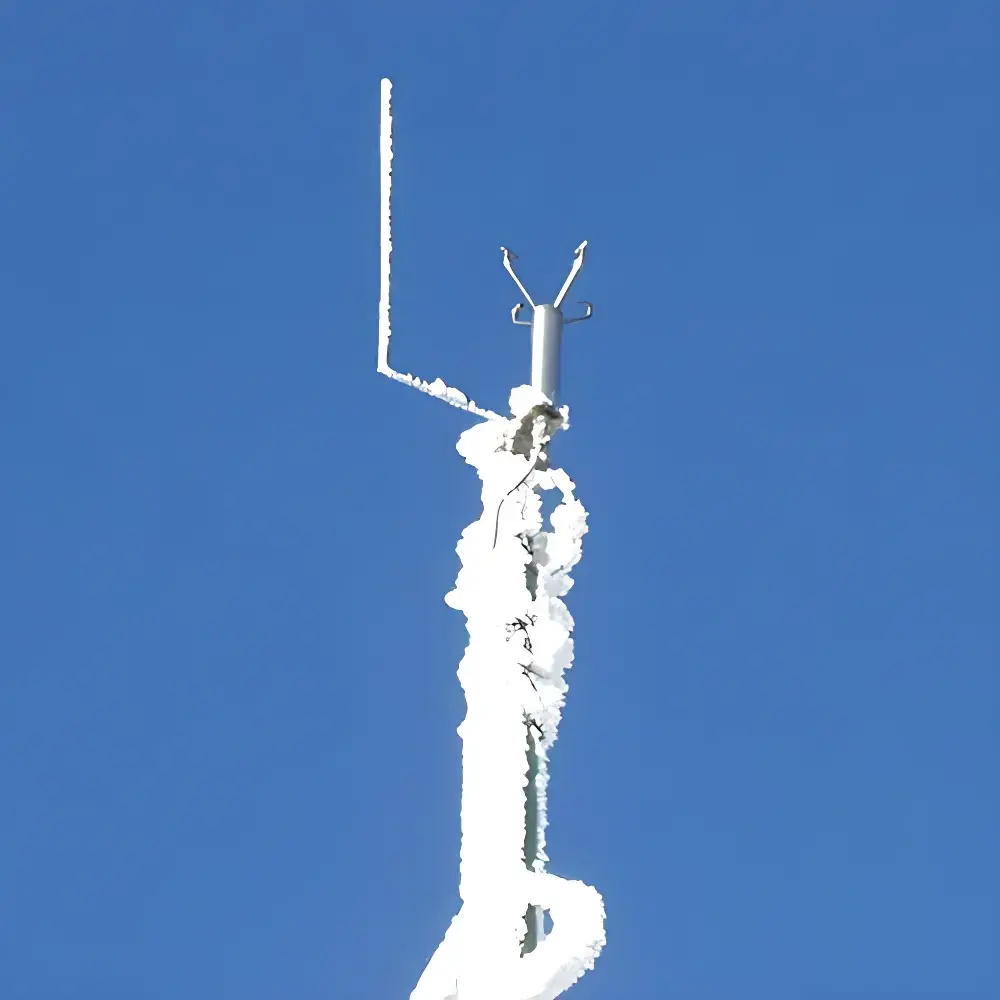
- Integrated 150 W resistive heater (7 A @ 24 VAC/DC), delivering uniform surface power density of ~1 W/cm² to prevent ice accretion on transducer faces—even at −40 °C ambient and high relative humidity;
- Stainless steel (AISI 316) housing rated IP66, ensuring long-term structural integrity and corrosion resistance in marine, offshore, polar, and industrial settings;
- True 0–360° wind direction measurement with no mechanical dead zones, enabled by solid-state transducer array geometry and digital signal processing;
- Factory calibration performed in the Merlin wind tunnel (UKAS-accredited facility), with full traceability to NIST standards and documented uncertainty budgets;
- Dual RS-422/RS-485 serial interface supporting multi-drop network topologies—enabling up to 32 sensors on a single bus with configurable node addressing and CRC-16 error checking;
- Real-time status code output (e.g., “Data Valid”, “Heater Active”, “Transducer Fault”) embedded within each data packet to support automated data quality assurance and remote diagnostics;
- Compliance with WMO definitions for 3-second gust, 10-minute mean wind, and directional standard deviation—internally computed and output via configurable averaging intervals.
Sample Compatibility & Compliance
The WindObserver 90 is designed for direct exposure to unfiltered ambient air without inlet conditioning or aspiration. It requires no consumables, moving parts, or routine recalibration under normal operation. Its stainless steel construction and IP66 enclosure meet ISO 9001 manufacturing controls and satisfy material compatibility requirements for Class I, Division 2 hazardous locations (per UL 1604). The device conforms to electromagnetic compatibility (EMC) standards IEC 61000-6-2 (immunity) and IEC 61000-6-4 (emissions), and its measurement methodology supports audit-ready compliance with GLP and ISO/IEC 17025 quality systems when integrated into validated environmental monitoring networks. For aviation applications, it satisfies FAA AC 150/5220-22B criteria for ASOS/AWOS wind sensor redundancy and response time.
Software & Data Management
Data output is delivered as ASCII or binary protocol over RS-422/RS-485, supporting Modbus RTU and GILL’s proprietary G-Link protocol. Both protocols include timestamped wind vector components (u, v, w), derived scalars (speed, direction, gust factor), heater status, internal temperature, and diagnostic flags. Integration with SCADA, DAQ, and cloud telemetry platforms (e.g., Ignition, LabVIEW, AWS IoT Core) is facilitated via open documentation and example drivers. Firmware updates are performed remotely using secure bootloader functionality. All data streams support optional UTC-synchronized timestamps (via external PPS input) and are compatible with FDA 21 CFR Part 11-compliant audit trail architectures when deployed with validated data acquisition software.
Applications
- Wind turbine power curve validation and yaw control feedback in Class III+ sites (e.g., mountain passes, offshore transition zones);
- Dynamic positioning (DP) systems aboard offshore support vessels and drillships operating in North Sea, Arctic, or Southern Ocean conditions;
- Permanent installation at polar research stations (e.g., McMurdo, Neumayer III), where sustained operation below −50 °C is required;
- Runway end identifier lights (REIL) and low-visibility approach systems at airports subject to crosswind turbulence and icing events;
- Tunnel ventilation control in road/rail infrastructure, meeting EN 13848-1 requirements for response time and repeatability;
- Structural health monitoring of tall buildings and suspension bridges, feeding real-time load models per ASCE 7-22 and Eurocode 1 Part 4;
- Port authority meteorological networks supporting vessel berthing operations and crane safety interlocks under high-wind alerts.
FAQ
What is the minimum detectable wind speed and how is zero-wind stability ensured?
The WindObserver 90 achieves a practical detection threshold of 0.03 m/s, with thermal drift compensated via dual-sensor differential timing and onboard temperature-stabilized oscillator references.
Can the heater be controlled externally or scheduled via software?
Yes—the heater enable state is configurable via serial command or hardware control line (TTL-level input), allowing integration with ambient temperature or dew point thresholds.
Is the device suitable for explosive atmospheres?
While not intrinsically safe certified, the unit meets Class I, Division 2 (non-incendive) requirements per UL 1604 when installed with appropriate barriers; ATEX/IECEx variants are available upon request.
How often does the sensor require recalibration?
GILL recommends verification every 24 months under continuous operation; field validation against a reference cup-and-vane anemometer (e.g., RM Young 05103) is supported via built-in diagnostic mode.
Does the WindObserver 90 support NMEA 0183 or CAN bus output?
NMEA 0183 is not natively supported, but protocol translation gateways are commercially available; CAN bus output is offered in the WindObserver 90-C variant (separate model).







