
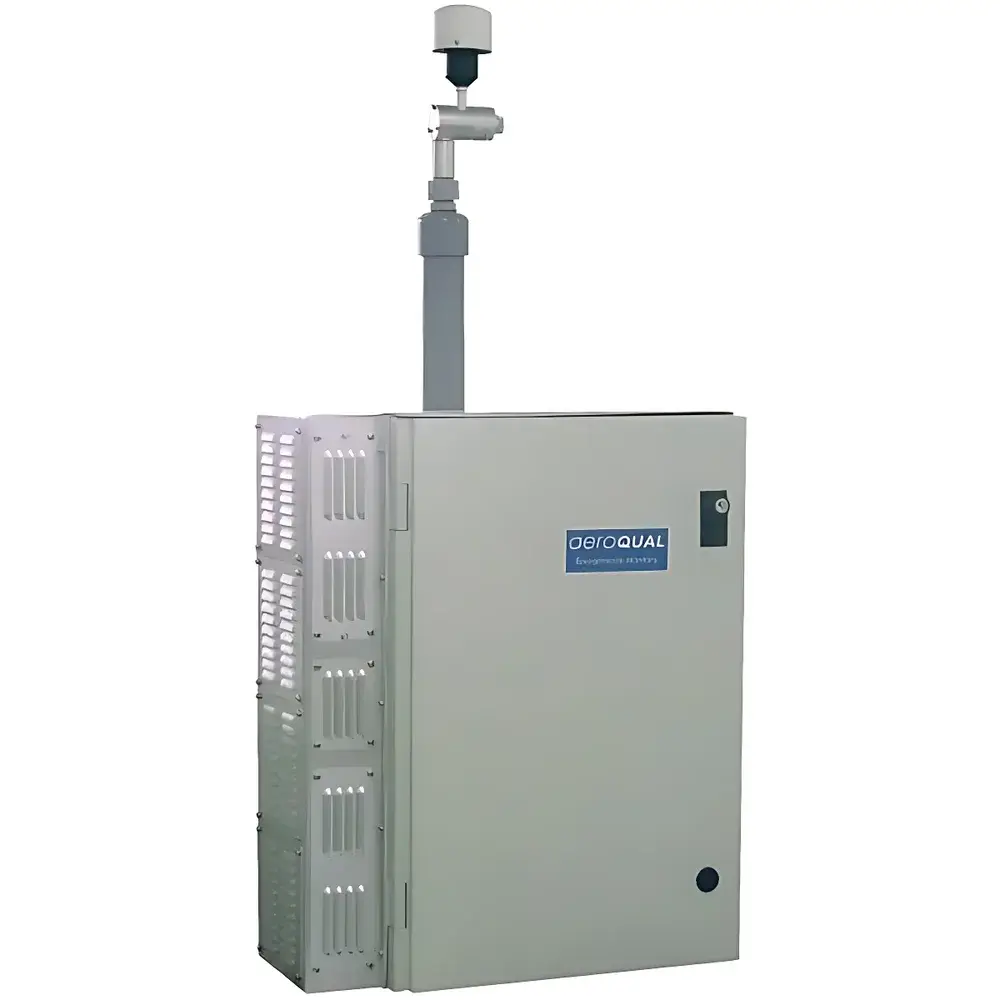
AeroQual AQM 60 Automatic Air Quality Monitoring System
| Brand | AeroQual |
|---|---|
| Model | AQM 60 |
| Measurement Principle | Electrochemical & Metal Oxide Semiconductor (MOS) Sensor Array |
| Gas Parameters | O₃, NO₂, CO, SO₂, CO₂, VOCs |
| Particulate Monitoring | PM₁₀ (optional PM₂.₅) |
| Meteorological Parameters | Temperature, Relative Humidity, Wind Speed, Wind Direction, Noise |
| Data Logging Interval | Configurable down to 2-minute sampling |
| Communication Interfaces | GSM/GPRS/UMTS modem, Ethernet (LAN/WLAN), RS232 |
| Calibration Traceability | NIST-traceable gas standards |
| Enclosure Rating | IP65-rated weatherproof housing |
| Onboard Storage | Internal flash memory (≥16 GB) |
| Power Supply | 12–24 V DC or solar-compatible |
Overview
The AeroQual AQM 60 is a compact, field-deployable automatic air quality monitoring system engineered for continuous, real-time measurement of gaseous pollutants and particulate matter in ambient environments. Unlike traditional fixed-reference stations—whose high capital cost and infrastructure dependency limit spatial coverage—the AQM 60 bridges the gap between regulatory-grade monitoring networks and low-cost, single-parameter sensors. It employs a modular sensor architecture combining electrochemical (EC) and metal oxide semiconductor (MOS) detection technologies, each calibrated against NIST-traceable standard gases to ensure metrological integrity. The system measures up to six target gases simultaneously—including ozone (O₃), nitrogen dioxide (NO₂), carbon monoxide (CO), sulfur dioxide (SO₂), carbon dioxide (CO₂), and total volatile organic compounds (VOCs)—alongside PM₁₀ (or optionally PM₂.₅) and core meteorological parameters (temperature, relative humidity, wind speed/direction, and ambient noise). Its design adheres to the functional requirements outlined in ISO 12039 (ambient air—determination of CO), ISO 10498 (NO₂ by chemiluminescence—principles applicable to EC validation), and EPA Method TO-15 (for VOC screening applications), supporting data usability in compliance-oriented reporting frameworks.
Key Features
- Modular multi-gas sensor platform with factory-calibrated, field-replaceable electrochemical and MOS sensors—up to six channels configurable per unit
- NIST-traceable calibration certificates provided for all gas sensors; on-site zero/span verification supported via integrated zero-air generator and certified span gases
- Integrated environmental sensing suite: precision temperature and humidity sensors (±0.3 °C, ±2 % RH), ultrasonic wind sensor (0–60 m/s, ±0.1 m/s), digital compass-based wind vane (±3°), and Class 2 sound level meter (30–130 dB)
- High-frequency data acquisition: programmable sampling intervals from 2 minutes to 1 hour, with time-stamped raw and processed values stored onboard
- Robust IP65-rated enclosure designed for unattended outdoor operation across -20 °C to +50 °C ambient conditions
- Flexible communication stack: embedded GSM/GPRS/UMTS modem, 10/100BASE-T Ethernet port, IEEE 802.11 b/g/n Wi-Fi, and RS232 serial interface for local diagnostics and firmware updates
- Onboard non-volatile storage (≥16 GB) retaining ≥12 months of high-resolution data at 2-minute intervals without external intervention
Sample Compatibility & Compliance
The AQM 60 is validated for use in ambient air matrices compliant with EN 14625 (O₃), EN 14626 (NO₂), EN 14662 (SO₂), and EN 15267-3 (performance evaluation of automated measuring systems). It meets the minimum technical specifications for indicative measurements as defined in EU Directive 2008/50/EC Annex XI, particularly for urban background, traffic, and industrial site monitoring. Particulate mass concentration measurements (PM₁₀/PM₂.₅) are performed using laser scattering with optical compensation algorithms aligned with EN 13284-1 and ISO 20922. All sensor modules undergo accelerated aging and cross-interference testing per IEC 61261 and ASTM D6330, ensuring stable performance in complex urban and peri-industrial atmospheres. The system supports audit-ready data logging with immutable timestamps and user-accessible calibration logs—fully compatible with GLP-aligned QA/QC workflows.
Software & Data Management
Data acquisition, visualization, and export are managed via AeroQual’s proprietary CloudConnect platform—a secure, role-based web application accessible via modern browsers. Raw sensor outputs are processed using adaptive baseline correction, humidity-compensated response algorithms, and outlier rejection filters compliant with ISO/IEC 17025:2017 clause 7.7. The platform generates automated daily summary reports (PDF/CSV), enables geospatial mapping of multi-node deployments, and supports API-driven integration into third-party environmental information systems (EIS) or SCADA platforms. Audit trails record all configuration changes, calibration events, and user logins—meeting FDA 21 CFR Part 11 requirements for electronic records and signatures when deployed under regulated programs. Local data retrieval is supported via USB mass storage mode or direct RS232 terminal session using standard AT command sets.
Applications
- Urban air quality management: dense-network deployment for hyperlocal pollution mapping, hotspot identification, and source apportionment modeling
- Roadside and tunnel monitoring: real-time tracking of traffic-related pollutants (NO₂, CO, PM) under dynamic flow conditions
- Industrial fence-line monitoring: continuous emission surveillance adjacent to manufacturing, refining, or waste treatment facilities
- Temporary or mobile monitoring campaigns: rapid deployment for construction impact assessments, event-related air quality assurance, or post-incident environmental forensics
- Academic and research applications: longitudinal trend analysis, sensor network validation studies, and boundary-layer atmospheric chemistry investigations
- Complementary reference monitoring: augmenting sparse national monitoring networks with higher spatial resolution data for model validation and policy support
FAQ
What calibration standards are used for sensor verification?
All gas sensors are calibrated using NIST-traceable certified reference materials (CRMs) prior to shipment. Field recalibration is supported using portable zero-air generators and pre-certified span gases (e.g., 100 ppb O₃ in synthetic air, 5 ppm CO in N₂).
Can the AQM 60 operate autonomously for extended periods?
Yes—when powered by a 24 V DC supply with battery backup or solar-charged system, the AQM 60 supports continuous operation for >30 days without maintenance, assuming typical 5-minute sampling and moderate GSM transmission frequency.
Is particulate measurement compliant with regulatory PM standards?
PM₁₀ and optional PM₂.₅ measurements follow light-scattering principles validated per EN 13284-1 and demonstrate correlation R² ≥ 0.92 against beta-attenuation reference monitors in controlled intercomparison studies.
How is data security ensured during wireless transmission?
GSM/GPRS and Wi-Fi communications employ TLS 1.2 encryption; device authentication uses X.509 client certificates. CloudConnect enforces OAuth 2.0 authorization and AES-256 encryption for all stored data.
Does the system support remote firmware updates?
Yes—over-the-air (OTA) firmware upgrades are delivered via signed binary packages through CloudConnect, with rollback capability and version-controlled change logs.
Related Products







