
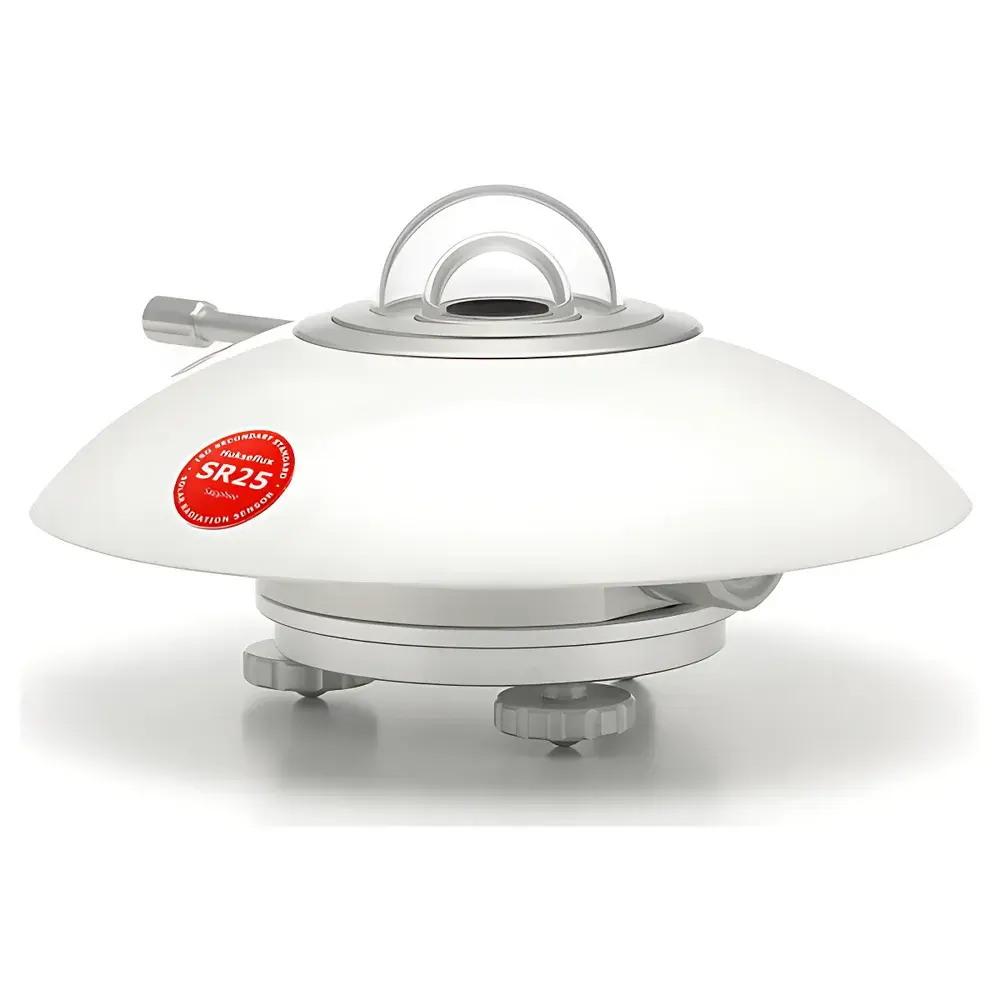
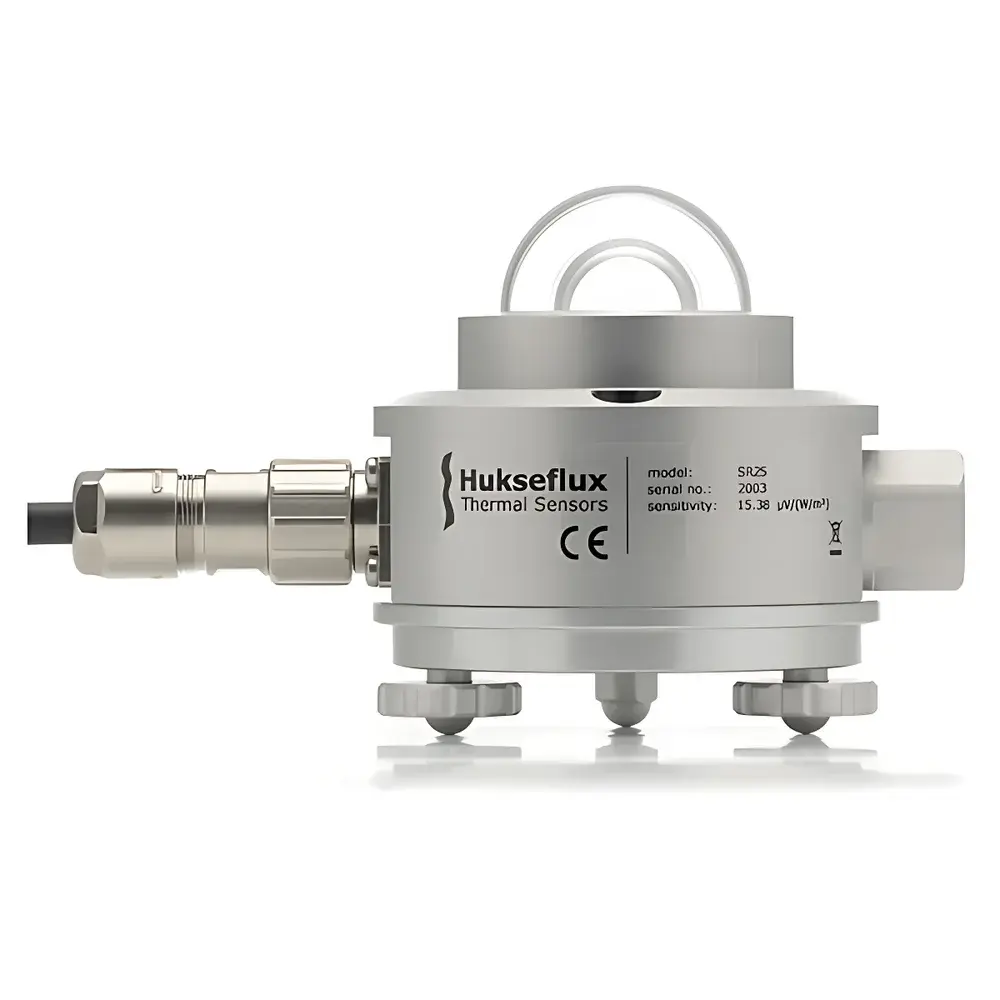
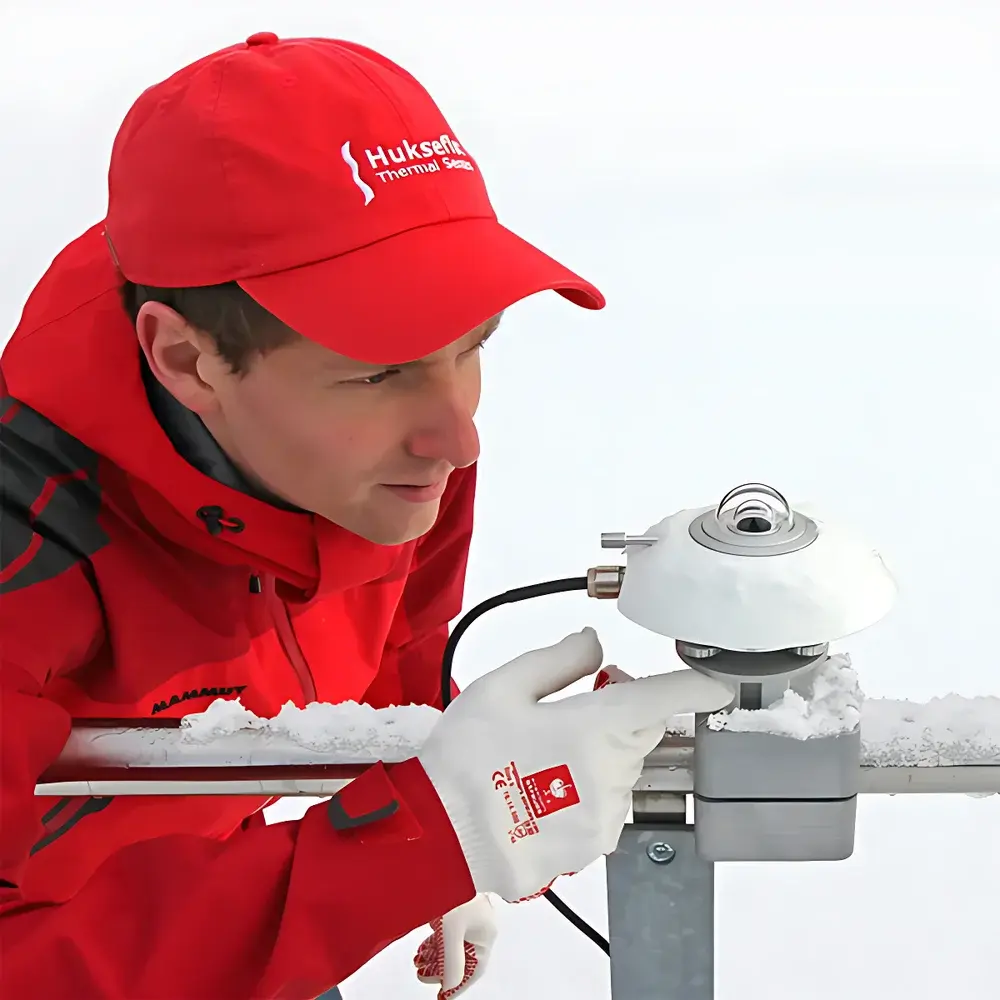
Hukseflux SR25 Secondary Standard Pyranometer
| Brand | Hukseflux |
|---|---|
| Origin | Netherlands |
| Model | SR25 |
| Spectral Range | 285–4000 nm |
| Measurement Range | 0–4000 W/m² |
| Sensitivity | 15 × 10⁻⁶ V/(W/m²) |
| Zero Offset (a) | ≤1 W/m² (unventilated) |
| Temperature Response | < ±1 % (−10 to +40 °C), < ±0.4 % (−30 to +50 °C, with correction) |
| Operating Temperature | −40 to +80 °C |
| Heating Power | 1.5 W @ 12 VDC |
| Cable Length | 5 m |
| Weight | 1 kg |
| IP Rating | IP67 |
| Calibration Traceability | World Radiometric Reference (WRR) |
| ISO Classification | Secondary Standard |
| Field of View | 180° hemispherical |
| Output | Analog mV signal |
| Thermal Offset | Ultra-low, engineered for diffuse radiation measurement |
Overview
The Hukseflux SR25 is a secondary standard pyranometer engineered for high-fidelity solar irradiance measurement under demanding environmental conditions. It operates on the thermopile principle: incident solar radiation is absorbed by a black-coated thermal sensor surface, generating a temperature gradient across a thermopile junction; this gradient produces a millivolt-level output proportional to irradiance (W/m²). Unlike conventional ventilated pyranometers—whose forced-air cooling introduces convective uncertainty and power demands—the SR25 employs an integrated low-power heater (1.5 W at 12 VDC) to prevent dew and frost formation on its sapphire outer dome. This passive-thermal stabilization strategy eliminates the need for mechanical ventilation while maintaining optical clarity and long-term calibration stability. Its 180° hemispherical field of view ensures full-sky integration in accordance with ISO 9060:2018 classification requirements for secondary standard instruments. The SR25 is specifically optimized for applications where zero-offset error and temperature-induced drift are critical limiting factors—particularly diffuse irradiance monitoring, PV performance assessment, and indoor solar simulator validation.
Key Features
- Ultra-low zero-offset (a ≤ 1 W/m², unventilated), enabling accurate diffuse radiation measurement without shading or ventilation artifacts
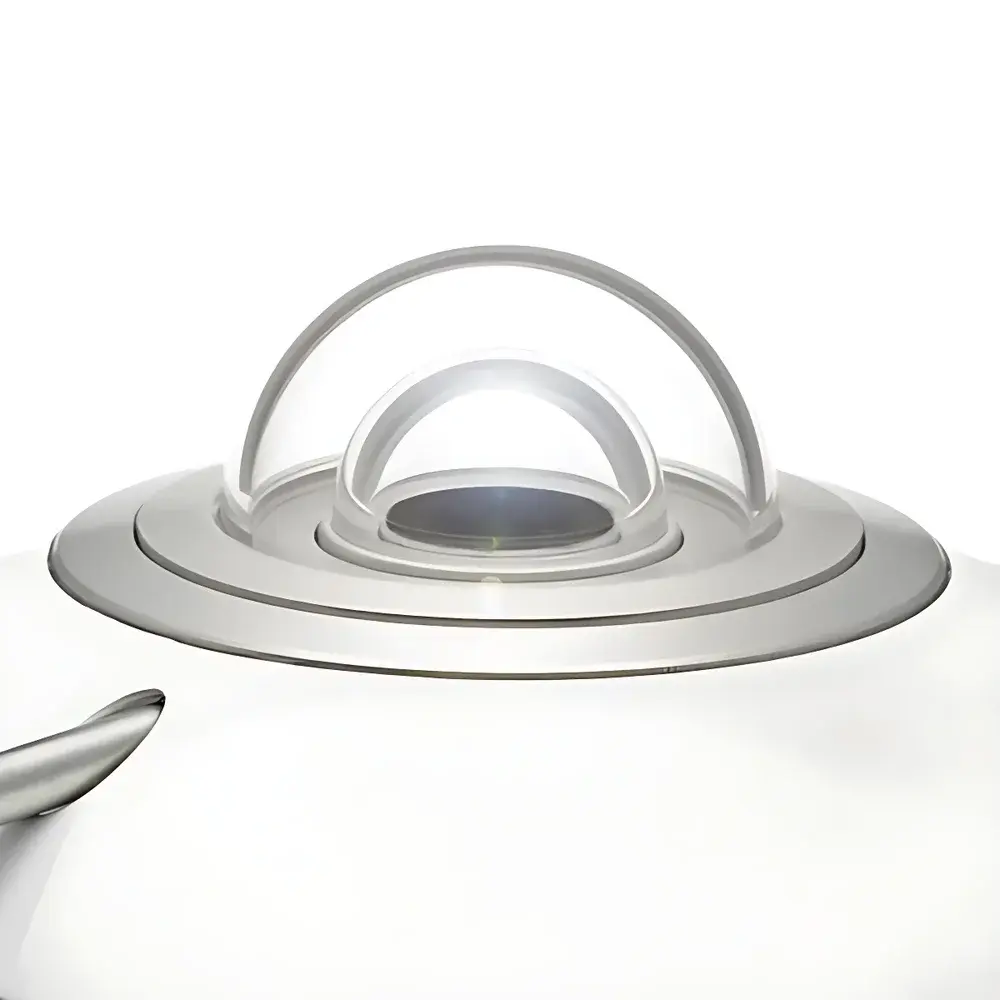
- Sapphire outer dome: chemically inert, scratch-resistant, and spectrally stable from 285 nm to 4000 nm—maintaining transmission integrity over decades of UV exposure
- Integrated 1.5 W DC heater: maintains dome surface temperature above dew/frost point without airflow disturbance or power burden typical of 10 W ventilators
- Thermopile sensor with blackened absorber and anodized aluminum body: ensures high thermal mass stability and minimal thermal lag
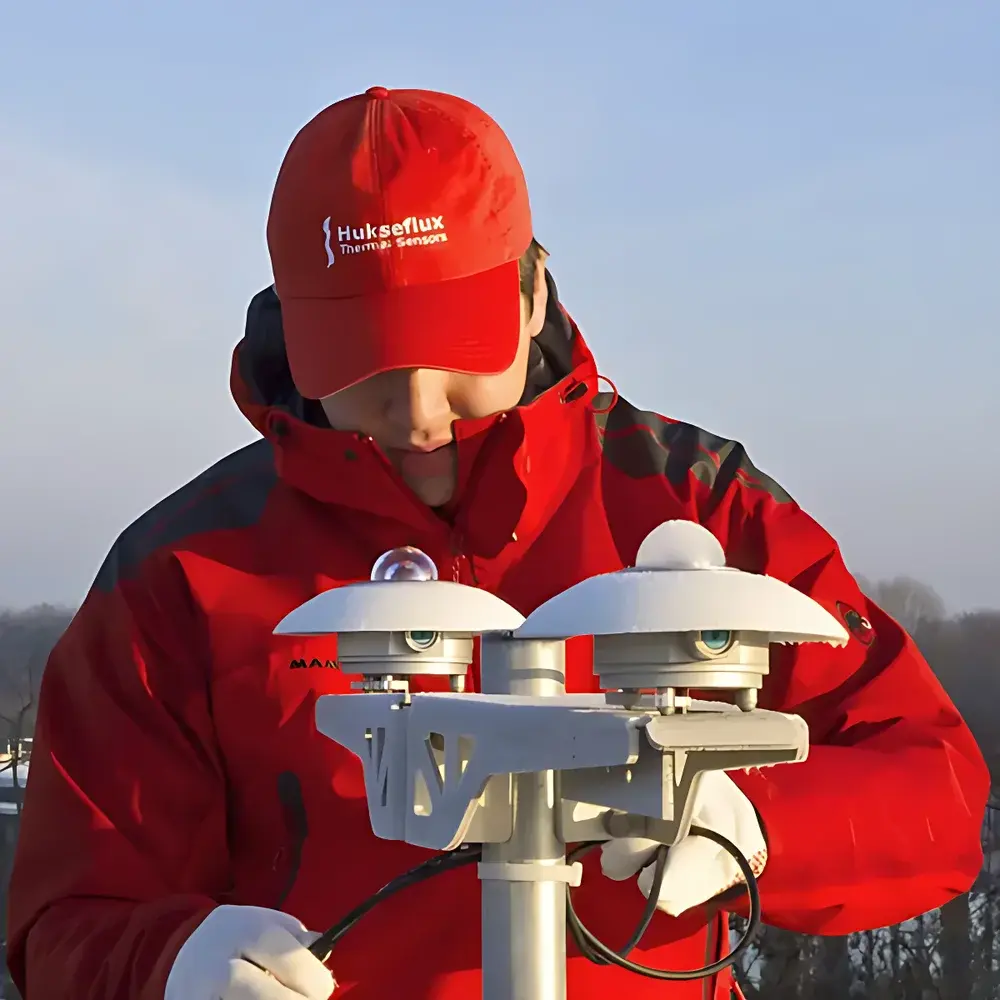
- IP67-rated housing with robust connector interface, desiccant holder, and precision-machined sun shield mount—designed for permanent outdoor deployment
- Traceable calibration against the World Radiometric Reference (WRR), compliant with ISO 9060:2018 secondary standard specifications
Sample Compatibility & Compliance
The SR25 meets the physical and metrological criteria defined in ISO 9060:2018 for secondary standard pyranometers. Its spectral response (285–4000 nm) aligns with the CIE erythemal action spectrum and photovoltaic quantum efficiency envelopes, making it suitable for both broadband meteorological and PV system performance monitoring. The instrument’s directional response and temperature dependence have been fully characterized per ISO 9060 Annex B and are documented in included test reports. For regulatory or quality-controlled environments—including GLP-compliant solar resource assessment, IEC 61724-1 PV monitoring, or ISO/IEC 17025-accredited calibration labs—the SR25 supports traceable uncertainty evaluation using the Guide to the Expression of Uncertainty in Measurement (GUM). An Excel-based uncertainty calculator is provided to assist users in propagating uncertainties from calibration, temperature response, directional error, and installation geometry.
Software & Data Management
The SR25 delivers a calibrated analog output (mV) compatible with standard data loggers supporting ±50 mV or ±100 mV differential inputs. No proprietary software or firmware is required for basic operation. However, for advanced uncertainty quantification, Hukseflux supplies a GUM-compliant spreadsheet tool that integrates user-input parameters—including mounting tilt, local albedo, and ambient temperature logs—to compute expanded measurement uncertainty (k = 2) per ISO/IEC 17025 requirements. While the SR25 itself does not feature digital communication or onboard storage, its analog output is inherently compatible with SCADA systems, cloud-connected IoT loggers (e.g., Campbell Scientific CR series, Onset HOBO, or Delta-T DL2e), and laboratory DAQ platforms. Optional cable extensions (in 5-meter increments) preserve signal integrity up to 50 m without active amplification.
Applications
- Diffuse horizontal irradiance (DHI) measurement when deployed with a shading ring or tracker-mounted shadow band
- Ground-truth validation of satellite-derived solar irradiance products and numerical weather prediction models
- Performance ratio (PR) analysis and degradation monitoring in utility-scale and rooftop PV plants per IEC 61724-1
- Indoor solar simulator characterization for PV cell and module testing under controlled STC-equivalent conditions
- Airborne solar radiation profiling on UAVs and light aircraft, where low mass (1 kg), low power draw, and frost resilience are essential
- Long-term climatological networks operating in high-humidity, coastal, or sub-zero environments where condensation and frost compromise traditional pyranometers
FAQ
Is the SR25 compliant with ISO 9060:2018?
Yes—the SR25 is classified as a secondary standard pyranometer per ISO 9060:2018, with full test reports available for directional response, temperature dependence, and non-stability.
Does the SR25 require ventilation to achieve its specified accuracy?
No—its integrated 1.5 W heater eliminates reliance on ventilation, avoiding convective errors and reducing power demand by >85% compared to ventilated counterparts.
Can the SR25 be used for direct normal irradiance (DNI) measurement?
Not directly—the SR25 measures global horizontal irradiance (GHI) or diffuse horizontal irradiance (DHI) only. DNI requires a pyrheliometer mounted on a solar tracker.
What is the recommended recalibration interval?
Hukseflux recommends recalibration every two years for critical applications, or annually when deployed in high-UV, high-dust, or marine environments—consistent with WRR traceability maintenance guidelines.
Is the heating function controllable externally?
Yes—the heater circuit is electrically isolated and can be powered via external 12 VDC supply with on/off control, enabling integration into automated frost-protection logic within larger monitoring systems.







