
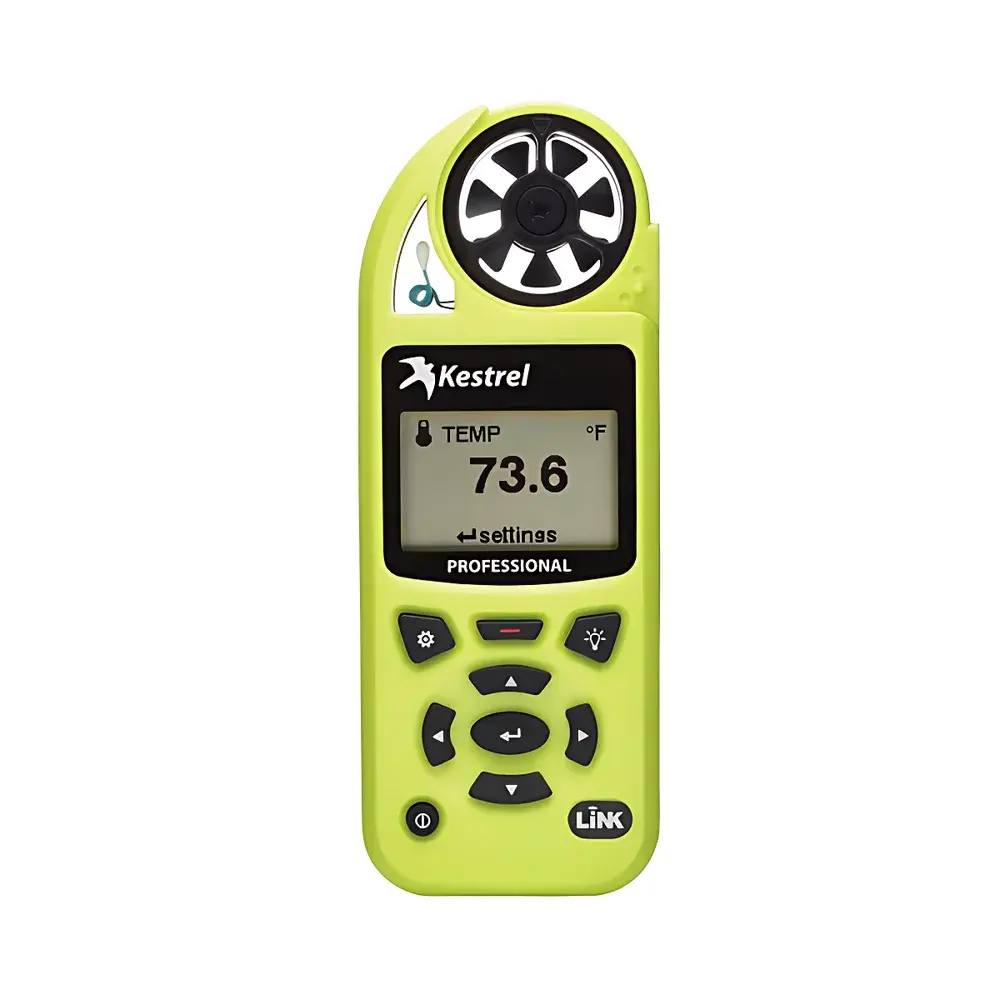
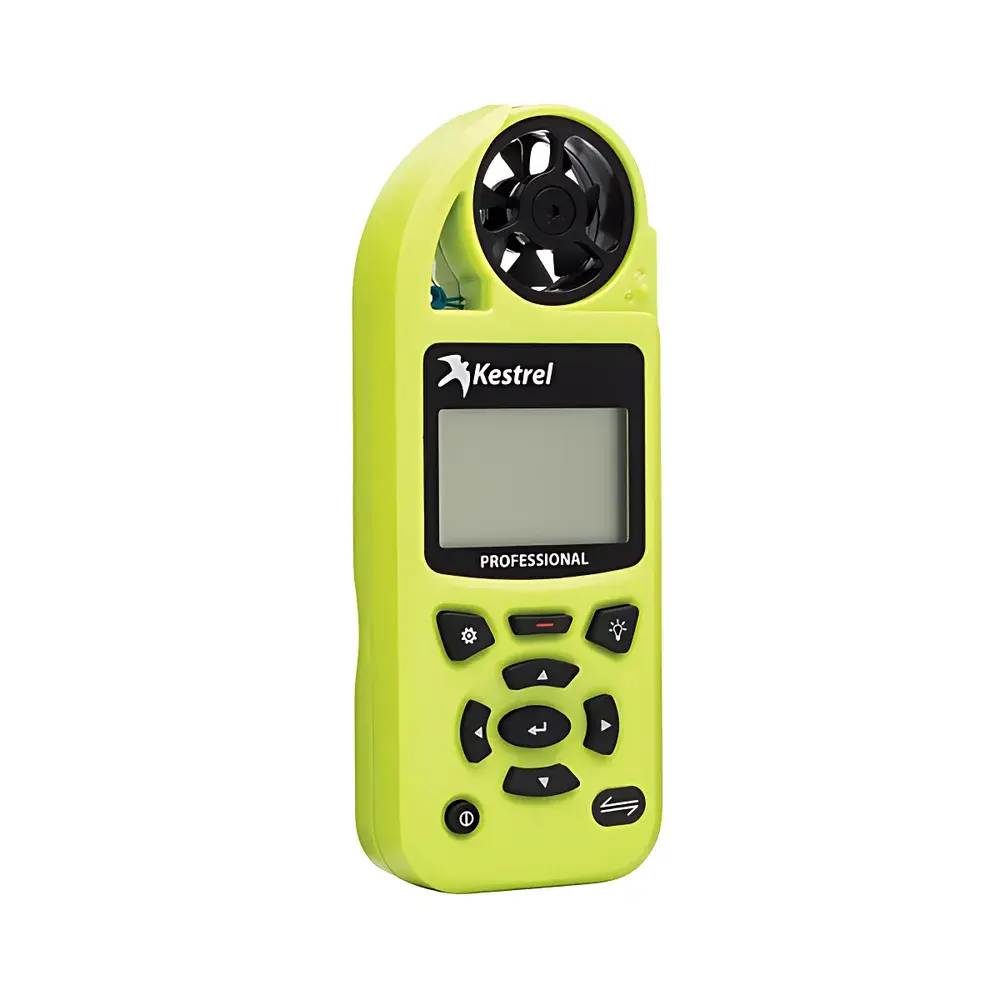
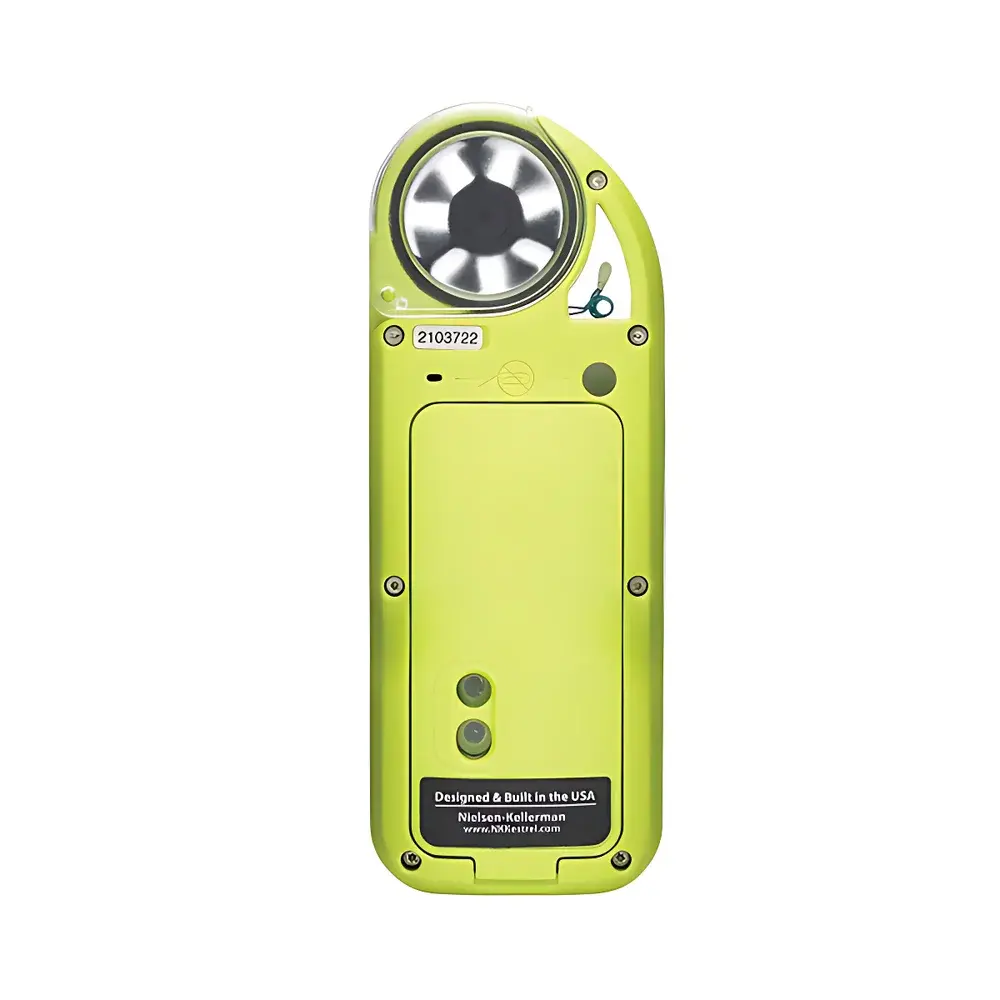
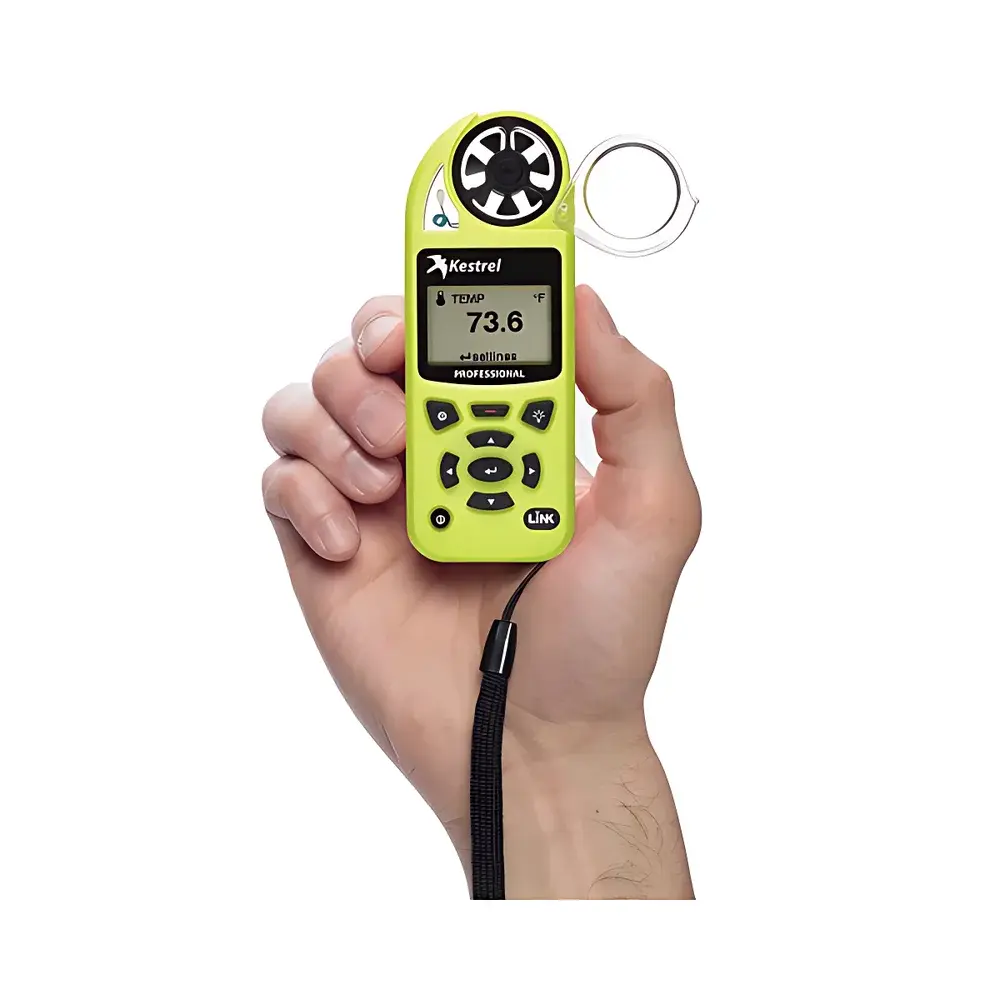
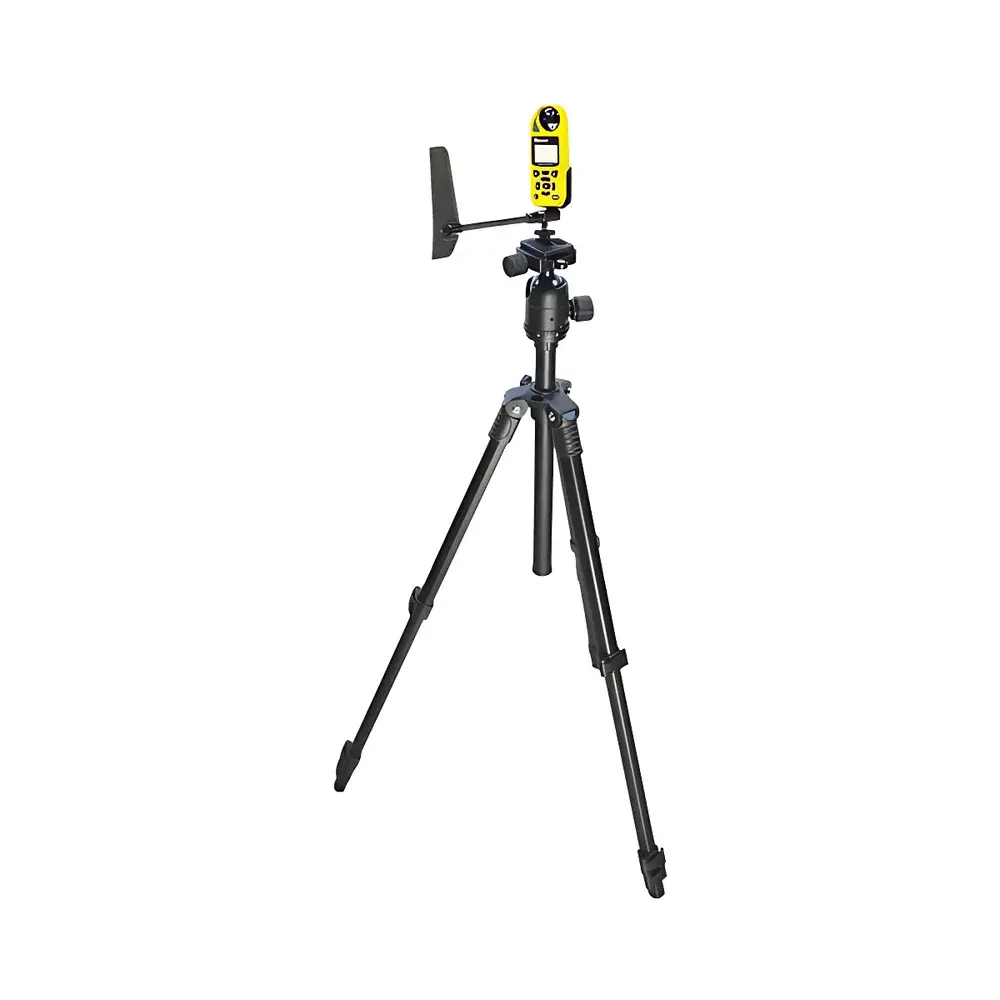
NK Kestrel 5200 Professional Environmental Meter
| Brand | NK |
|---|---|
| Origin | USA |
| Model | Kestrel 5200 |
| Instrument Type | Vane Anemometer |
| Resolution | 0.1 m/s |
| Measurement Range | 0.4–60 m/s |
| Accuracy | ±3% of reading |
| Operating Temperature | −10 to +55 °C |
| Operating Humidity | 0–100% RH |
| IP Rating | IP67 |
| Data Logging Capacity | >10,000 timestamped records |
| Power | Two AA batteries (≈400 h typical life) |
| Wireless Connectivity | Bluetooth Smart® (Kestrel LiNK compatible) |
| Display | High-contrast, sunlight-readable LCD with dual-color backlight |
Overview
The NK Kestrel 5200 Professional Environmental Meter is a rugged, handheld vane anemometer engineered for precision environmental monitoring in demanding field and industrial applications. Unlike basic airflow meters, the Kestrel 5200 integrates a calibrated vane sensor with a multi-parameter environmental sensing suite—including temperature, relative humidity, barometric pressure, and derived meteorological indices—enabling comprehensive on-site assessment of ambient conditions. Its measurement principle relies on rotational kinetics of a precision-balanced vane rotor, coupled with NIST-traceable thermistor and capacitive humidity sensors, ensuring repeatable wind speed quantification across its full 0.4–60 m/s range. Designed specifically for HVAC commissioning, building diagnostics, agricultural spraying operations, and environmental compliance verification, the device meets the operational rigor required by facility engineers, energy auditors, and field researchers who depend on real-time, traceable environmental data without laboratory-grade infrastructure.
Key Features
- Vane-based anemometry with ±3% accuracy and 0.1 m/s resolution—optimized for turbulent and low-velocity airflow common in ductwork, ventilation shafts, and outdoor microclimates.
- Sunlight-readable high-contrast LCD with dual-color (red/blue) backlight—engineered for legibility under direct solar exposure or low-light nighttime inspections.
- IP67-rated enclosure and MIL-STD-810G drop-tested construction—fully sealed against dust and immersion up to 1 m for 30 minutes; buoyant design enables safe operation near water bodies or wet worksites.
- Onboard calculation engine supporting 20+ derived environmental parameters—including Delta-T (ΔT), air density, relative air density (RAD), evaporation rate, heat index, wind chill, dew point, wet-bulb temperature, and density altitude—calculated per ASHRAE Fundamentals and ISO 7726 standards.
- Integrated data logging with automatic timestamping—stores >10,000 measurement sets internally; supports both manual and interval-triggered capture (1 s to 12 h intervals).
- Bluetooth Smart® connectivity via Kestrel LiNK app (iOS/Android) and optional USB data transfer dongle—enables secure export of CSV-formatted datasets compliant with GLP documentation requirements.
Sample Compatibility & Compliance
The Kestrel 5200 is validated for use across heterogeneous environmental matrices—including indoor air streams, outdoor boundary-layer microenvironments, agricultural spray zones, concrete curing surfaces, and ecological restoration sites. Its vane sensor maintains mechanical stability under particulate-laden airflow (e.g., grain silos, compost facilities) and resists thermal shock during rapid ambient transitions. The instrument complies with IEC 60529 (IP67), MIL-STD-810G (Method 516.6, Shock), and ASTM D3241 (for ambient air property derivation). While not certified as a medical or pharmaceutical-grade device, its data output meets foundational requirements for HVAC system validation per ASHRAE Guideline 12-2020 and ISO 14644-3 cleanroom monitoring protocols when used within specified operating limits (−10 to +55 °C, 0–100% RH).
Software & Data Management
Kestrel LiNK software provides secure, audit-ready data handling: time-synchronized acquisition, customizable parameter selection, real-time graphing, and batch export to CSV or PDF reports. All logged entries include embedded timestamps, unit metadata, and firmware version identifiers—supporting traceability in regulated environments. When paired with the optional Kestrel LiNK Dongle, the device interfaces with Windows/macOS platforms for integration into enterprise asset management (EAM) systems or LIMS databases. Data integrity is preserved through non-volatile memory architecture; no internal battery backup is required for log retention during power cycling. Firmware updates are delivered via signed binaries, maintaining cryptographic authenticity per NIST SP 800-193 guidelines.
Applications
- HVAC system balancing, duct traverse surveys, and commissioning verification per SMACNA and ACCA standards.
- Concrete curing environment monitoring—including Delta-T tracking between surface and ambient air to prevent thermal cracking.
- Precision agricultural operations—calibrating spray droplet drift potential using real-time wind vector and evaporation rate data.
- Facility energy audits—quantifying infiltration rates, ventilation efficiency, and thermal comfort indices (PMV/PPD estimation).
- Ecological field studies—recording microclimatic gradients across restoration plots or wildlife corridors.
- Educational laboratories—teaching atmospheric physics, psychrometrics, and fluid dynamics with empirically grounded instrumentation.
FAQ
Is the Kestrel 5200 suitable for calibration traceability in ISO/IEC 17025 laboratories?
The device ships with a Certificate of Conformance (COC); however, formal metrological traceability requires third-party calibration against NIST-traceable standards—available through accredited calibration providers.
Can the Kestrel 5200 measure wind direction?
No—wind direction measurement requires the optional Kestrel Vane Mount accessory; the base unit measures only scalar wind speed.
Does the internal data logger retain measurements after battery replacement?
Yes—logged data is stored in non-volatile flash memory and persists across battery changes and full power cycles.
What is the recommended recalibration interval?
NK recommends annual functional verification; recalibration frequency should align with organizational quality procedures and usage intensity—typically every 12–24 months for routine field deployment.
Is Bluetooth transmission compliant with FDA 21 CFR Part 11 for electronic records?
While Kestrel LiNK supports audit trails and user authentication, full Part 11 compliance depends on enterprise-level configuration—including electronic signatures, access controls, and system validation—implemented by the end-user organization.
Related Products







