
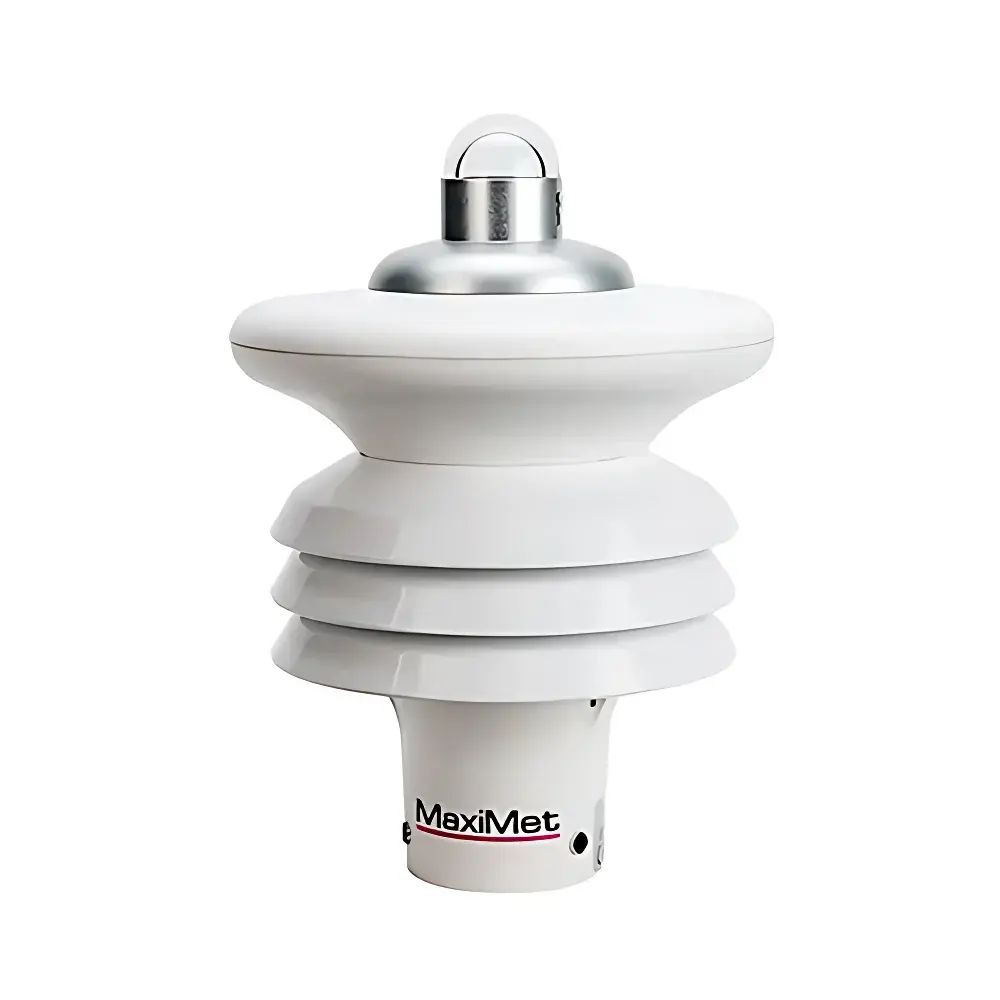
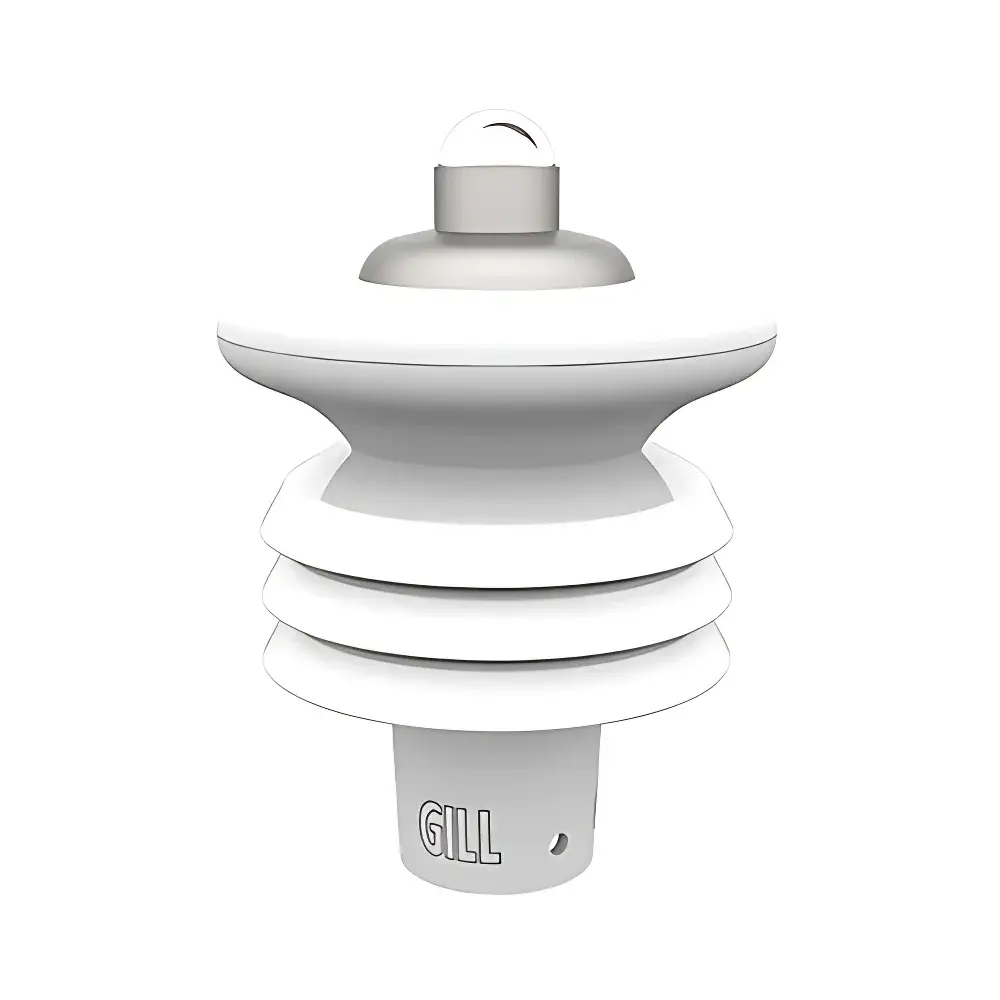
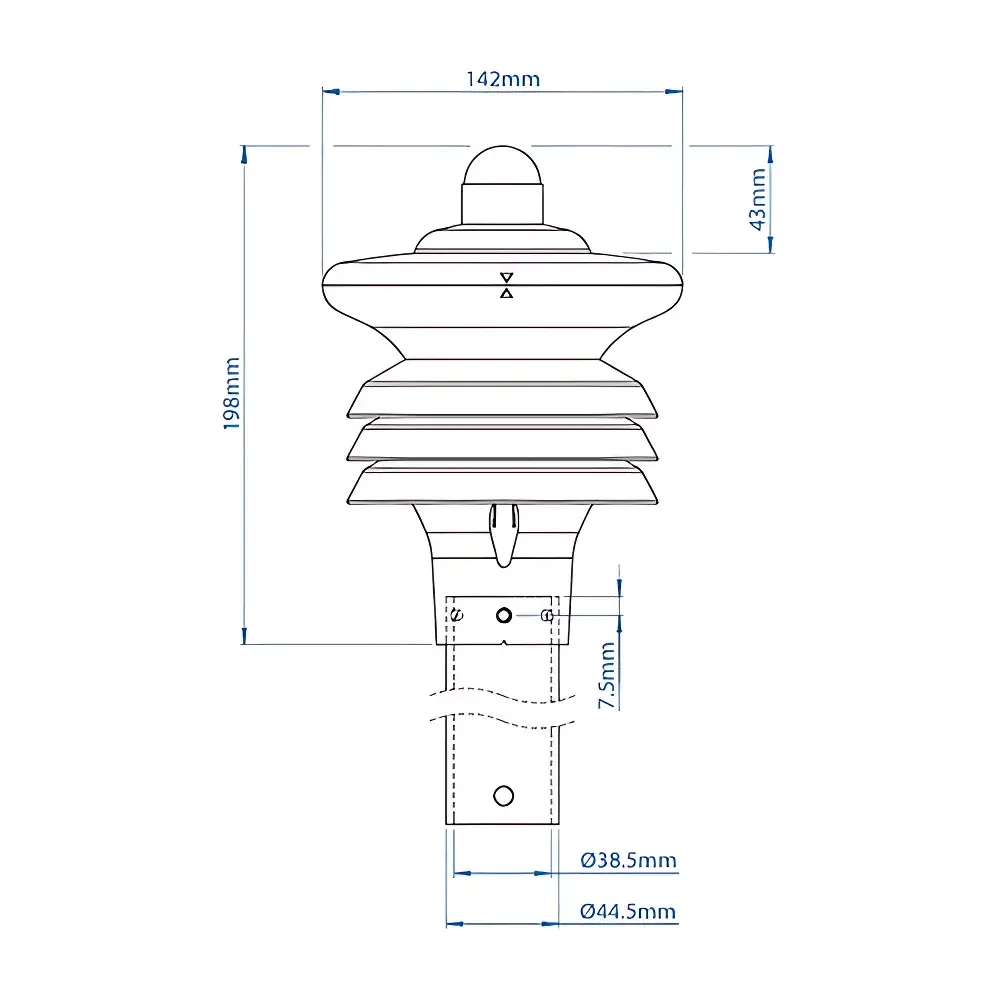
Gill GMX301 Compact Weather Station
| Brand | Gill |
|---|---|
| Origin | United Kingdom |
| Model | GMX301 |
| Instrument Type | Portable Weather Station |
| Compliance | ISO 9060:2018 Class C, WMO Guide to Meteorological Instruments and Methods of Observation (WMO-No. 8) |
| Radiation Sensor | Integrated Hukseflux LP02 Pyranometer |
| Housing | Triple-layer double-louvered, UV-stabilized natural-ventilation radiation shield |
| Output Protocols | RS-232 / RS-422 / RS-485 (ASCII), SDI-12, NMEA 0183, MODBUS RTU, Analog (optional) |
| Measured Parameters | Air Temperature (°C/°F/K), Relative Humidity (% RH), Atmospheric Pressure (hPa/mbar/mmHg/inHg), Global Solar Irradiance (W/m²), Sunshine Duration (hrs), Wet-Bulb Temperature (°C/°F/K), Absolute Humidity (g/m³), Air Density (kg/m³), Tilt Angle (°) |
| Radiation Field of View | 180° hemispherical |
| Sensor Architecture | Solid-state, no moving parts |
Overview
The Gill GMX301 Compact Weather Station is a fully integrated, maintenance-free environmental monitoring system engineered for high-reliability deployment in demanding outdoor environments. Designed and manufactured by Gill Instruments Ltd. in the United Kingdom, the GMX301 implements a solid-state sensor architecture—eliminating mechanical components such as fans or rotating anemometers—to ensure long-term stability, minimal drift, and consistent metrological performance across extended operational lifetimes. At its core, the station combines three fundamental atmospheric measurement subsystems: a precision thermohygrometer with barometric pressure sensing housed within a triple-layer, double-louvered, UV-resistant natural-ventilation radiation shield; a co-located, factory-calibrated Hukseflux LP02 thermopile-based pyranometer compliant with ISO 9060:2018 Class C and World Meteorological Organization (WMO) specifications; and embedded microprocessor-based data acquisition capable of real-time parameter derivation—including wet-bulb temperature, absolute humidity, air density, and solar noon timing. Unlike traditional aspirated or fan-ventilated stations, the GMX301 relies on passive thermal equilibrium principles within its optimized louver geometry, reducing power dependency while maintaining traceable accuracy under variable wind, solar loading, and precipitation conditions.
Key Features
- Solid-state design with zero moving parts—ensures >10-year operational integrity without recalibration cycles or mechanical wear.
- Triple-layer double-louvered radiation shield meeting WMO guidance for temperature/humidity measurement—engineered to minimize solar loading error and enhance response time under low-wind conditions.
- Integrated Hukseflux LP02 pyranometer with fused silica dome, 180° field-of-view, and spectral response 305–2800 nm—certified to ISO 9060:2018 Class C for global horizontal irradiance (GHI) quantification.
- Multi-protocol digital output interface supporting RS-232/422/485 (ASCII), SDI-12, NMEA 0183, and MODBUS RTU—enabling seamless integration into SCADA, IoT telemetry, and legacy industrial control systems.
- Onboard computation of derived meteorological variables: wet-bulb temperature, absolute humidity (g/m³), air density (kg/m³), and solar noon timestamp—reducing post-processing overhead for end users.
- IP66-rated enclosure with marine-grade stainless-steel mounting hardware—validated for continuous operation in coastal, industrial, and agricultural zones subject to salt spray, dust ingress, and thermal cycling.
Sample Compatibility & Compliance
The GMX301 is validated for continuous unattended operation across diverse environmental regimes—from arid desert installations to high-humidity tropical deployments and temperate maritime locations. Its sensor suite meets internationally recognized metrological benchmarks: the LP02 pyranometer conforms to ISO 9060:2018 Class C for spectral responsivity, directional response, and temperature dependence; temperature and humidity measurements adhere to WMO No. 8 Annex 4.3 requirements for naturally ventilated shields; and pressure transduction follows IEC 61298-2 linearity and hysteresis tolerances. The station supports configurable data logging intervals (1 s to 60 min) and is compatible with GLP-aligned audit trails when deployed with compliant host software. While not intrinsically certified for hazardous areas, its low-power design (<1.5 W nominal) and non-sparking construction permit use in Zone 2/Class I Division 2 environments when installed per IEC 60079-14 guidelines.
Software & Data Management
The GMX301 operates as a protocol-agnostic sensor node—requiring no proprietary firmware or vendor-specific drivers. ASCII-formatted serial output enables direct ingestion into Python-based data pipelines, MATLAB environmental toolboxes, or commercial platforms including Campbell Scientific LoggerNet, DTN Meteologger, and OSIsoft PI System. Optional analog outputs (0–5 V or 4–20 mA) facilitate integration with PLC-based building management systems (BMS) or industrial HVAC controllers. For regulatory applications, the station’s deterministic timestamping, checksummed packet structure, and support for MODBUS register mapping enable alignment with FDA 21 CFR Part 11 electronic record requirements when paired with validated host software and access-controlled user authentication workflows.
Applications
- Agricultural microclimate monitoring—supporting irrigation scheduling, frost prediction, and evapotranspiration modeling (FAO-56).
- Solar energy asset performance verification—providing GHI and sunshine duration inputs for PV yield forecasting and degradation analysis per IEC 61724-1.
- Transport infrastructure resilience—deployed along railways, highways, and airport runways for real-time visibility, icing, and crosswind hazard assessment.
- Coastal and offshore environmental compliance—monitoring ambient conditions for emissions dispersion modeling and marine boundary layer studies.
- Educational meteorology labs—delivering traceable, classroom-ready datasets aligned with NOAA and EUMETSAT curriculum standards.
- Smart city environmental layers—feeding air quality modeling, urban heat island mapping, and adaptive lighting control algorithms.
FAQ
Does the GMX301 require external power for the radiation shield ventilation?
No—the triple-louvered shield relies entirely on natural convection; no fan or active ventilation system is integrated or required.
Is the LP02 pyranometer replaceable in-field without recalibration?
Yes—the LP02 is a modular, factory-calibrated component with NIST-traceable certificate; replacement maintains full ISO 9060 compliance when installed per Hukseflux torque and leveling specifications.
Can the GMX301 output dew point temperature directly?
Dew point is not a native output but can be computed in real time using onboard absolute humidity and air temperature values via Magnus formula implementation in host software.
What is the maximum recommended cable length for RS-485 communication?
Up to 1,200 meters at 9.6 kbps, provided twisted-pair shielded cable (AWG 24 minimum) and proper termination resistors are used per EIA/TIA-485 standard.
Is tilt angle measurement intended for structural health monitoring?
Tilt sensing provides installation validation and long-term mounting stability assessment—not structural deformation quantification; resolution is ±0.5°, suitable for mast settlement detection only.
Related Products







