
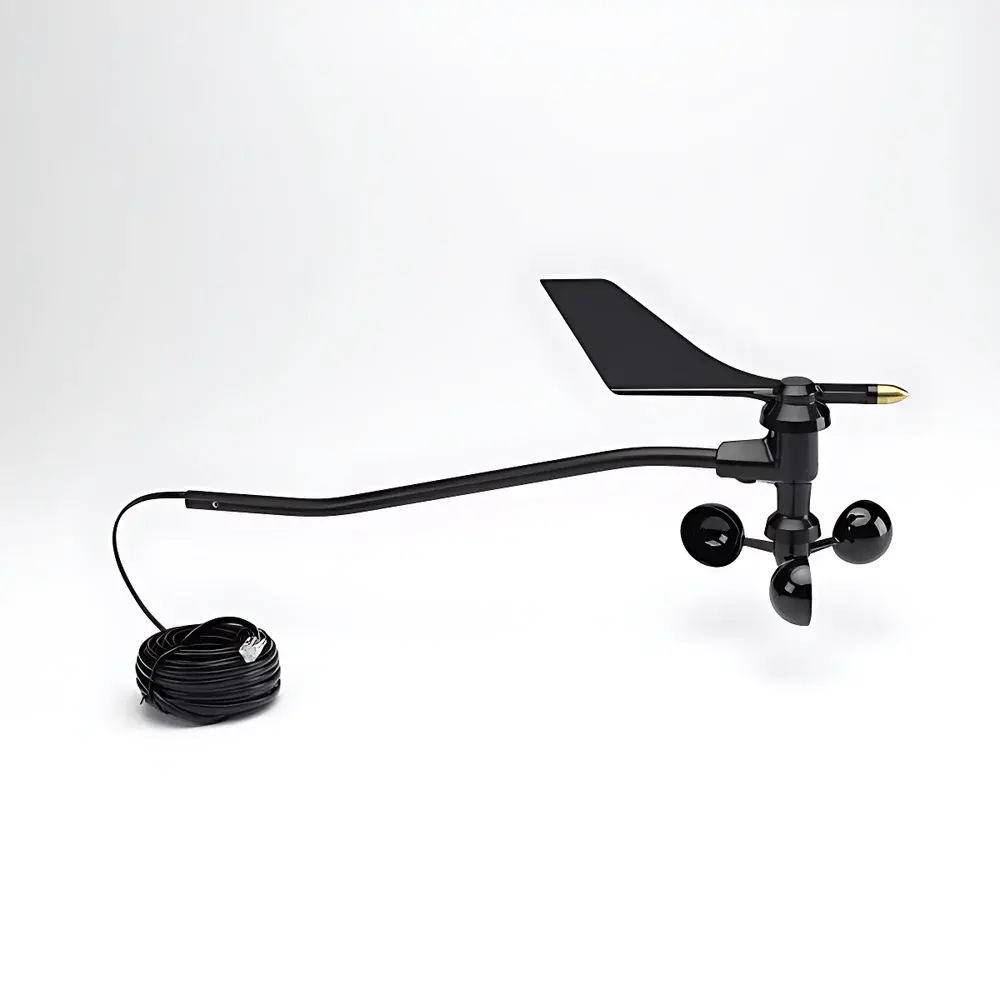
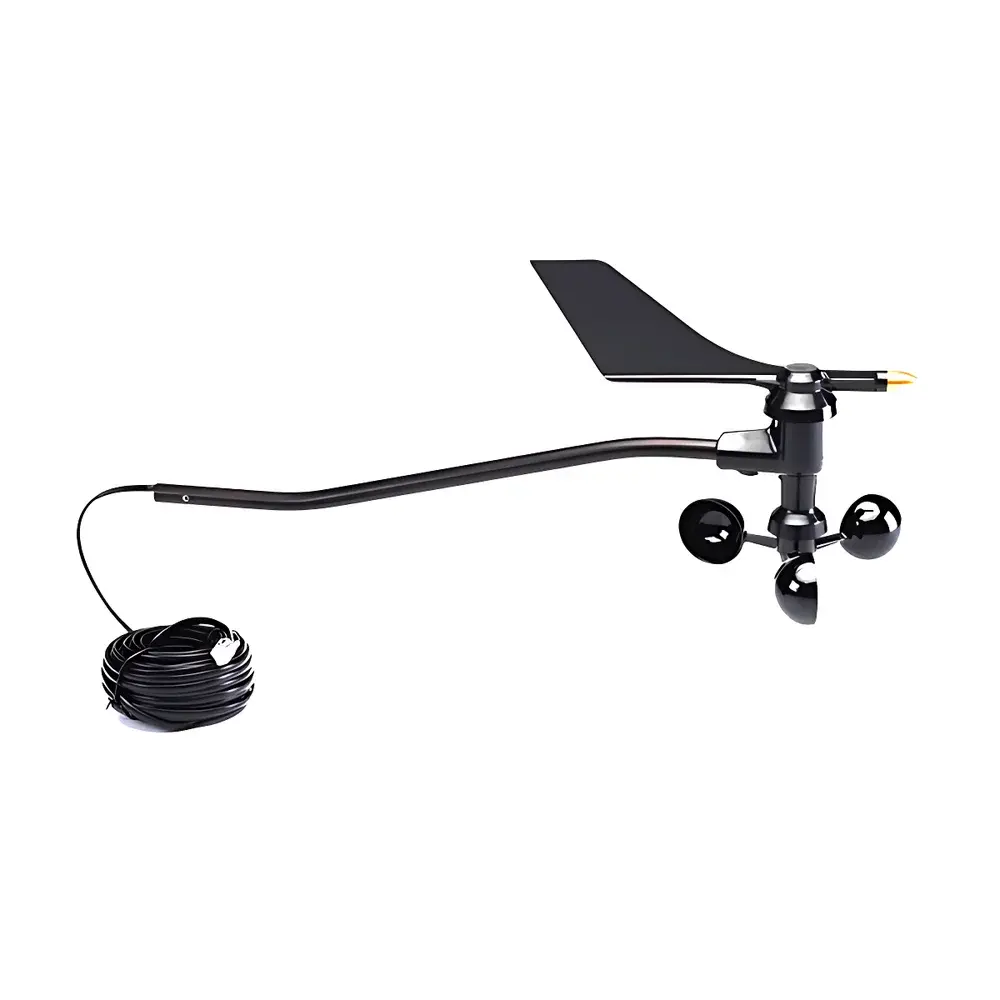
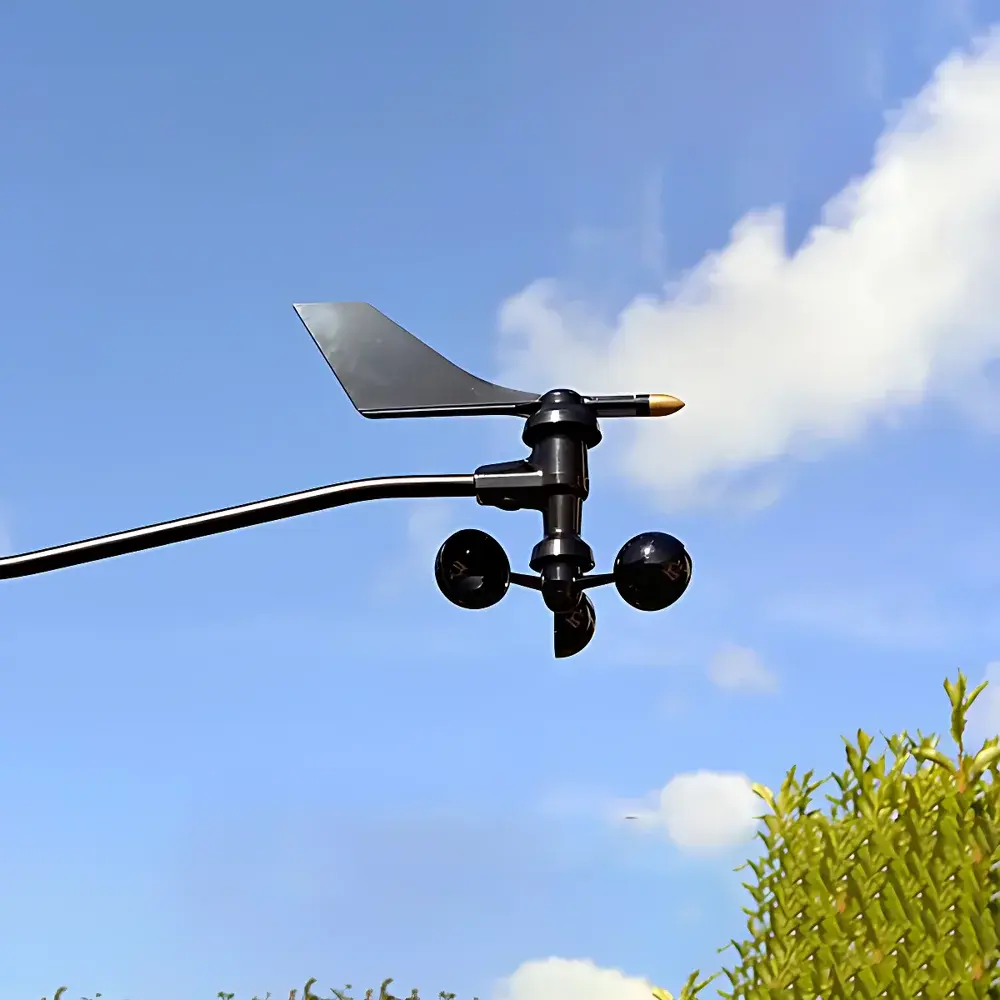
Davis Instruments 7911 Wind Speed and Direction Sensor
| Brand | Davis Instruments |
|---|---|
| Origin | USA |
| Model | 7911 |
| Instrument Type | Cup Anemometer with Vane-Based Direction Sensor |
| Wind Speed Range | 0.5–89 m/s |
| Wind Speed Accuracy | ±5% or ±1 m/s (whichever is greater) |
| Wind Speed Resolution | 0.1 m/s |
| Wind Speed Sampling Interval | 2.25 s |
| Wind Direction Range | 0–360° |
| Wind Direction Accuracy | ±7° |
| Wind Direction Resolution | 1° |
| Wind Direction Sampling Interval | 1 s |
| Operating Temperature | −40°C to +66°C |
| Operating Humidity | 0–100% RH |
| Housing Material | UV-stabilized ABS (vane), Polycarbonate (cups), Anodized Aluminum (crossarm) |
| Cable | 4-conductor, 26 AWG, standard RJ11 connector |
| Standard Cable Length | 12 m |
| Maximum Extended Cable Length | 42 m |
| Dimensions | 470 mm × 191 mm × 121 mm |
| Weight | 1.332 kg |
Overview
The Davis Instruments 7911 Wind Speed and Direction Sensor is an industrial-grade, field-deployable environmental transducer engineered for long-term outdoor operation in demanding meteorological and environmental monitoring applications. It employs a dual-sensor architecture grounded in proven physical measurement principles: wind speed is determined via a three-cup anemometer using magnetic reed switch pulse generation — where rotational frequency is linearly proportional to airflow velocity — while wind direction is measured using a precision potentiometric vane assembly. The vane rotates a conductive wiper across a resistive track; output voltage varies linearly with azimuthal position when supplied with a stable excitation voltage (<15 V DC), enabling straightforward analog-to-digital conversion. All critical performance specifications — including dynamic range, linearity, hysteresis, and thermal stability — were validated under controlled wind tunnel conditions per ASTM D5096 and ISO 12213-2 protocols, ensuring traceable metrological integrity for regulatory and research-grade deployments.
Key Features
- Robust mechanical design optimized for continuous exposure to UV radiation, rain, ice, and particulate-laden air — featuring UV-stabilized ABS for the directional vane and impact-resistant polycarbonate for the anemometer cups.
- Anodized aluminum crossarm provides structural rigidity and corrosion resistance across extreme temperature gradients (−40°C to +66°C) and full-range humidity (0–100% RH).
- High-fidelity analog outputs: wind speed as TTL-compatible pulse train (frequency ∝ m/s); wind direction as ratiometric voltage (0–5 V DC corresponding to 0–360°).
- Factory-calibrated sensor pair with documented uncertainty budgets traceable to NIST standards; calibration certificates available upon request for GLP/GMP-compliant installations.
- Modular cabling architecture supporting standard 12 m lead with verified signal integrity up to 42 m using shielded 26 AWG twisted-pair construction and RJ11 termination.
Sample Compatibility & Compliance
The 7911 sensor is compatible with any data acquisition system capable of counting digital pulses (wind speed) and measuring analog voltage (wind direction) with appropriate input conditioning. It meets IEC 61326-1 (EMC for measurement equipment) and complies with FCC Part 15 Class B emission limits. Its mechanical and electrical specifications align with requirements for automated weather stations (AWS) referenced in WMO No. 8 guidelines and NOAA/NWS ASOS/MAWS infrastructure specifications. No hazardous substances are used in construction; RoHS 2011/65/EU and REACH SVHC declarations are provided with shipment documentation.
Software & Data Management
While the 7911 operates as a hardware-level transducer without embedded firmware, it integrates seamlessly with industry-standard environmental data loggers (e.g., Campbell Scientific CR1000X, Onset HOBO RX3000, or third-party SCADA platforms) via configurable input modules. Pulse counting and analog voltage scaling are implemented at the logger level using user-defined equations. Data logging intervals, averaging periods (e.g., 1-min mean wind speed/direction), and statistical post-processing (e.g., vector-averaged wind, gust detection per WMO definitions) are fully programmable. For audit-trail compliance, systems configured with FDA 21 CFR Part 11–enabled software (e.g., LoggerNet with security extensions) support electronic signatures, role-based access control, and immutable event logs.
Applications
- Permanent and temporary atmospheric boundary layer studies in mesoscale meteorology and microclimate modeling.
- Wind resource assessment for small-scale renewable energy feasibility (e.g., rooftop solar-wind hybrid systems).
- Regulatory air quality monitoring networks requiring concurrent wind vector inputs for dispersion modeling (e.g., EPA AERMOD pre-processing).
- Industrial site safety systems for crane operation, stack emissions monitoring, and fugitive dust control.
- Educational and research laboratories conducting fluid dynamics validation experiments under real-world ambient conditions.
FAQ
What excitation voltage is required for the wind direction output?
A stable DC voltage between 5 V and 15 V must be supplied to the vane’s potentiometer circuit; output voltage scales linearly from 0 V (0°) to full supply voltage (360°).
Can the 7911 be used in salt-laden coastal environments?
Yes — the anodized aluminum crossarm and sealed potentiometer housing provide enhanced resistance to chloride-induced corrosion; however, routine visual inspection and cleaning are recommended per IEC 60068-2-52 salt mist test maintenance guidelines.
Is the sensor suitable for integration with Modbus or SDI-12 interfaces?
No — the 7911 delivers raw analog and pulse signals only. Protocol translation requires external signal conditioning hardware (e.g., analog-to-Modbus converters or SDI-12-enabled dataloggers with pulse-counting capability).
Does Davis Instruments provide NIST-traceable calibration reports?
Yes — optional factory calibration reports with uncertainty analysis and reference standard traceability are available at time of order; calibration interval recommendations follow ISO/IEC 17025:2017 Clause 7.7 guidance.
What is the maximum recommended cable length for maintaining signal fidelity?
Signal degradation remains within specification up to 42 m using the specified 4-conductor, 26 AWG shielded cable; beyond this, active signal repeaters or differential line drivers are advised.
Related Products







