
Gill WindMaster HS 3D Ultrasonic Anemometer
| Brand | Gill |
|---|---|
| Origin | United Kingdom |
| Model | WindMaster HS |
| Instrument Type | Ultrasonic Anemometer |
| Resolution | 0.01 m/s |
| Measurement Range | 0–45 m/s |
| Accuracy | ±1% of reading |
| Operating Temperature | −40 °C to +60 °C |
| Operating Humidity | 5–100% RH |
| Output Frequency | 32 Hz |
| Output Signals | U, V, W vector components, sonic temperature |
| Housing Material | Stainless steel |
| Analog I/O | 4-channel integrated electronics |
Overview
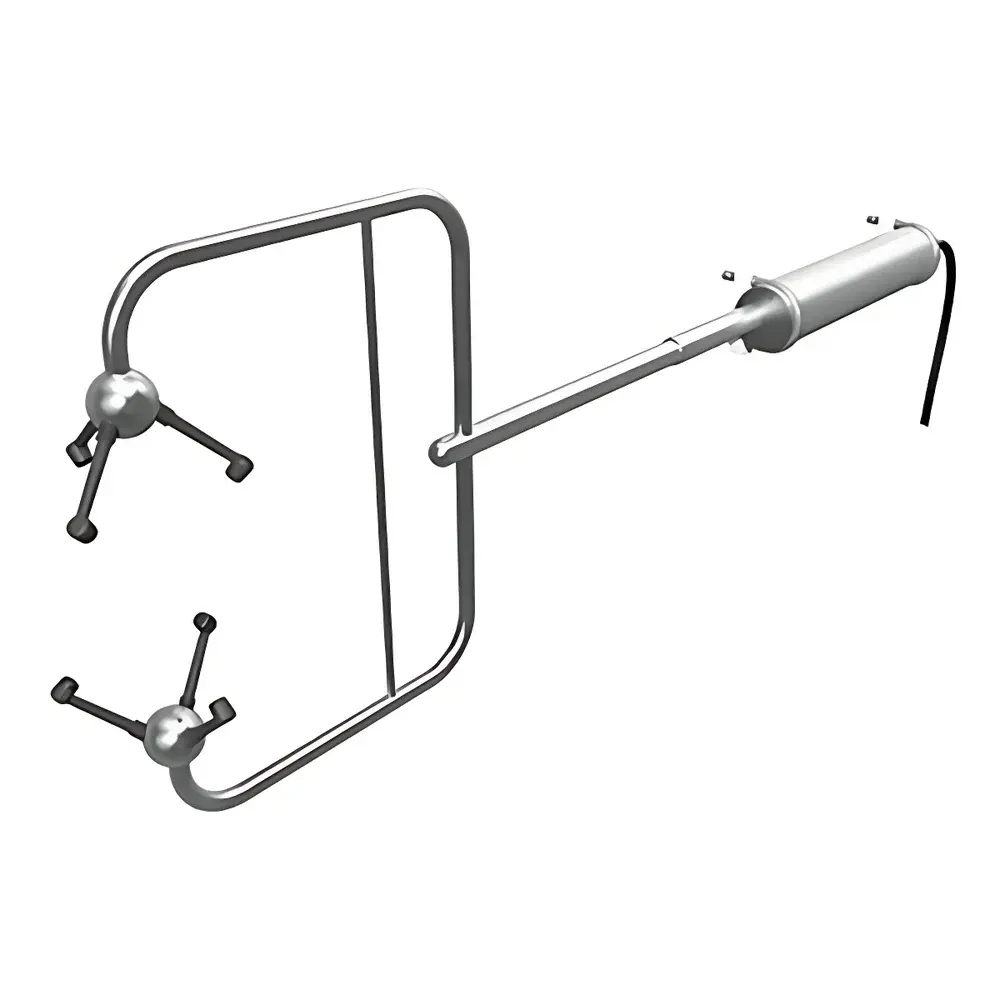
The Gill WindMaster HS is a high-specification 3D ultrasonic anemometer engineered for scientific-grade atmospheric turbulence measurement and long-term environmental monitoring. It operates on the principle of time-of-flight ultrasonic transit-time difference measurement: four precisely aligned transducers arranged in a tetrahedral configuration emit and receive acoustic pulses across orthogonal paths. By calculating the differential propagation times of ultrasound traveling with and against the wind along each axis, the instrument resolves instantaneous three-component wind velocity vectors (U, V, W) and sonic temperature with high temporal resolution. Its horizontally oriented sensor head minimizes flow distortion caused by mechanical obstruction—critical for accurate eddy covariance flux calculations where flow separation and wake effects must be rigorously controlled. Designed for deployment in demanding field environments—including offshore platforms, tall towers, and alpine research stations—the WindMaster HS delivers consistent performance across extreme thermal and humidity gradients while maintaining structural integrity and signal stability.
Key Features
- Three-dimensional wind vector measurement (U, V, W) at 32 Hz native output frequency, supporting high-frequency turbulence analysis and spectral studies
- Horizontally aligned transducer head geometry optimized to reduce aerodynamic shadowing and streamline-induced flow distortion, enabling reliable measurements at high angles of attack
- Integrated electronics housing with four configurable analog inputs and outputs (0–5 V or 4–20 mA), simplifying integration into existing data acquisition systems without external signal conditioning
- Stainless steel construction (AISI 316 grade) ensures corrosion resistance in marine, coastal, and industrial settings
- Sonic temperature output derived from mean acoustic speed—used for virtual temperature correction in eddy covariance computations and atmospheric stability assessment
- Compliance with IEC 61000-6-2 (EMC immunity) and IEC 61000-6-4 (EMC emissions), suitable for installation in electromagnetically noisy infrastructure environments
Sample Compatibility & Compliance
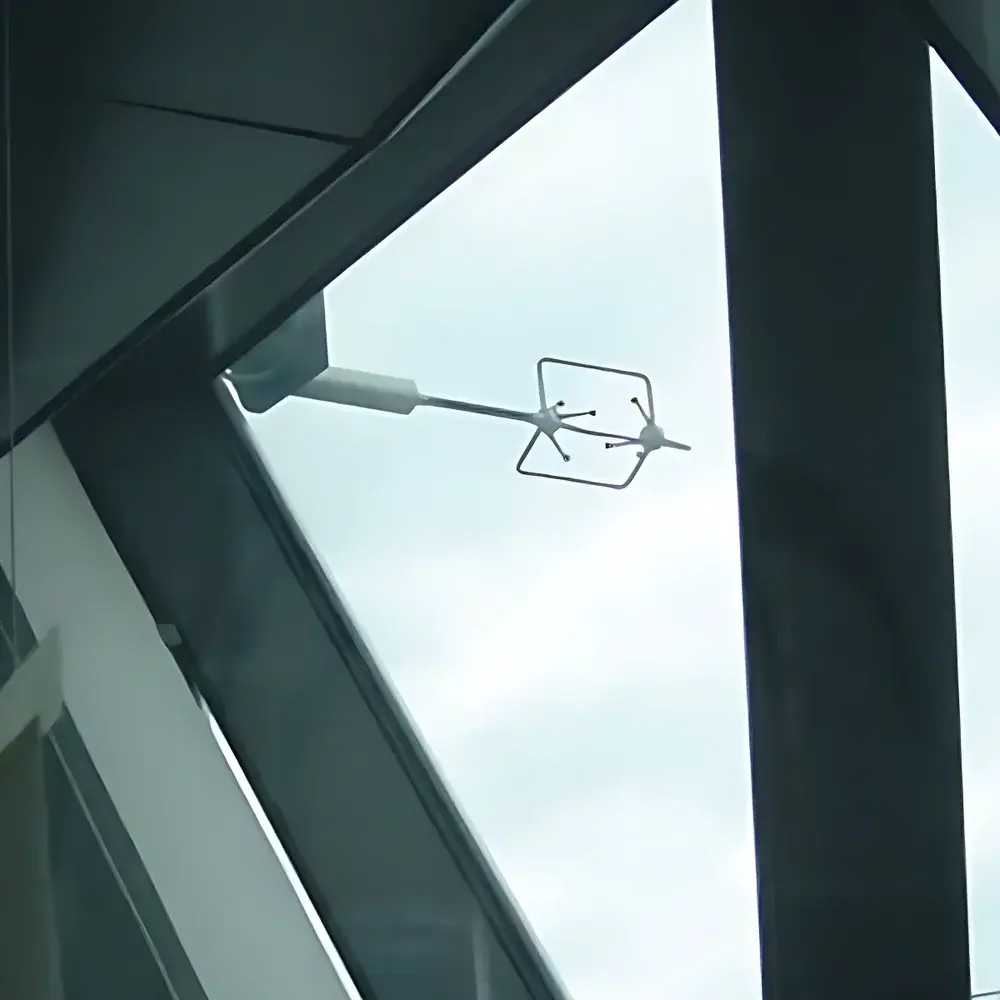
The WindMaster HS is compatible with standard meteorological masts, flux towers, and buoy-mounted sensor arrays. Its low power consumption (typically <1.5 W at 12 V DC) enables solar-powered operation in remote locations. The instrument meets requirements for long-term unattended deployment under GLP-aligned environmental monitoring protocols. While not certified to ISO/IEC 17025 for calibration traceability out-of-the-box, it supports NIST-traceable field calibration via manufacturer-recommended procedures and is routinely deployed in networks adhering to WMO Guide to Meteorological Instruments and Methods of Observation (CIMO Guide). Its output format conforms to CF Standard Names and NetCDF conventions when interfaced with compliant DAQ software.
Software & Data Management
Gill provides the optional GillData software suite for configuration, real-time visualization, and basic post-processing. Raw outputs are delivered as ASCII or binary serial streams (RS-232/RS-485), compatible with Campbell Scientific CR-series loggers, DI-LOG DL2000, and other industry-standard DAQ platforms. For eddy covariance applications, the WindMaster HS integrates natively with EddyPro®, TK3, and PyFlux software via standardized .dat or .csv ingestion. All firmware updates are performed via UART interface; no proprietary drivers are required. Audit trails for configuration changes and operational logs (including internal diagnostics and temperature-compensated transducer health metrics) are accessible through command-line interface (CLI) commands—supporting 21 CFR Part 11-compliant data governance when paired with validated third-party logging infrastructure.
Applications
- Eddy covariance flux systems for greenhouse gas (CO₂, CH₄, H₂O) and energy balance studies in terrestrial and aquatic ecosystems
- Offshore wind resource assessment and turbine wake characterization on fixed and floating platforms
- Structural health monitoring of bridges, tall buildings, and transmission towers—capturing dynamic wind loading profiles for modal analysis
- Vertical wind profiling and boundary layer meteorology in urban, mountainous, and polar environments
- Validation of numerical weather prediction (NWP) models and large-eddy simulation (LES) outputs
- Aviation safety monitoring at airports and helipads, particularly in low-visibility or crosswind-sensitive operations
FAQ
What is the recommended mounting orientation for optimal accuracy?
The WindMaster HS must be installed with its horizontal sensor head aligned to true north (or grid north, with documented declination offset) and leveled to within ±0.5° using the integrated bubble level. Tilting beyond 2° introduces systematic bias in vertical velocity (W) due to coordinate rotation error.
Does the instrument require periodic recalibration?
Annual field verification against a reference anemometer is recommended per WMO guidelines. Gill provides factory calibration certificates traceable to UKAS-accredited standards; drift is typically <0.2% per year under normal operating conditions.
Can the WindMaster HS operate in icing conditions?
It is not equipped with active de-icing. For sites prone to rime or glaze ice, supplemental heating (e.g., low-power resistive bands) must be externally implemented—Gill offers compatibility guidance but does not supply heated housings.
Is sonic temperature output suitable for thermodynamic calculations?
Yes—the sonic temperature reflects the virtual temperature of air and is directly usable in Monin–Obukhov similarity theory, sensible heat flux derivation, and density corrections for mass flux computation.
What communication protocols are supported?
Native serial (ASCII/binary) over RS-232 or RS-485. Modbus RTU and SDI-12 implementations are available via firmware upgrade upon request.
Related Products







