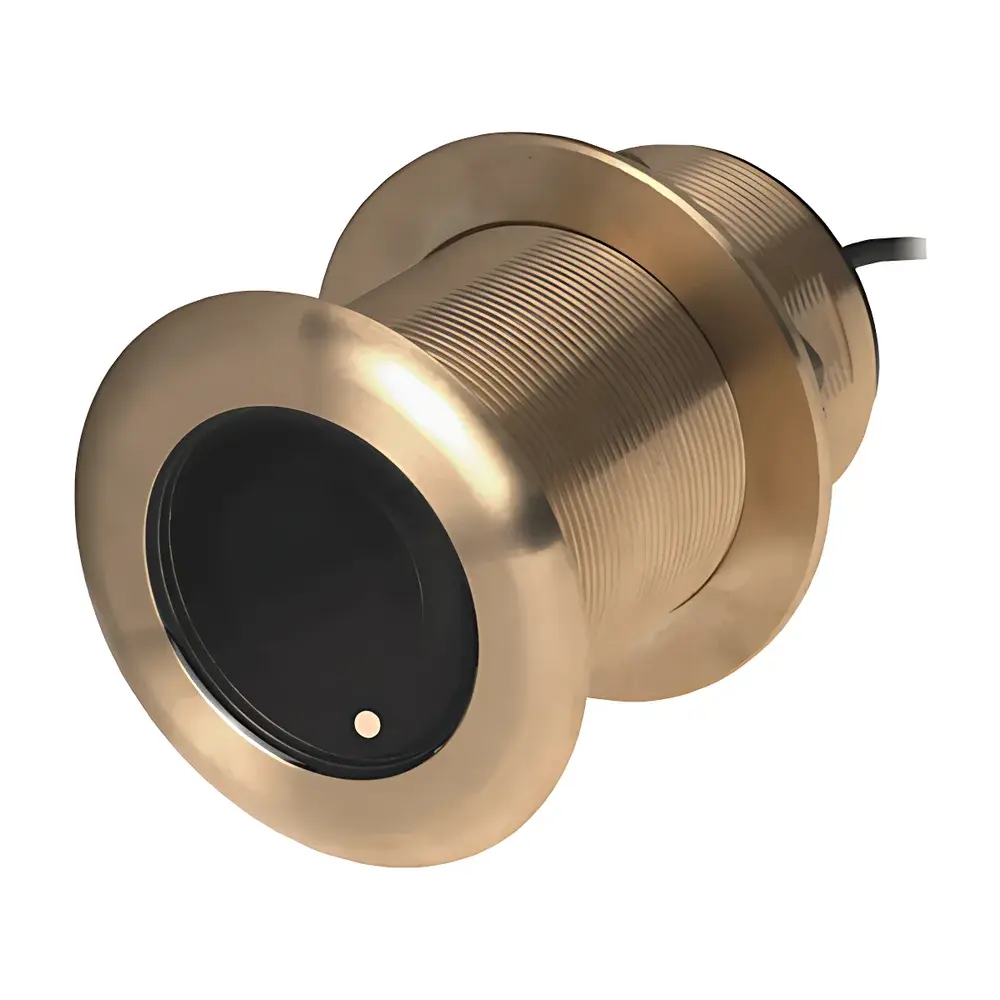
Airmar B75HW Chirp Depth Sounder Transducer
| Brand | Airmar |
|---|---|
| Origin | USA |
| Model | B75HW |
| Operating Frequency Range | 150–250 kHz |
| Beam Width | 30° |
| Maximum Depth Rating | 106 m (350 ft) |
| Transmit Power | 600 W |
| Housing Material | Bronze |
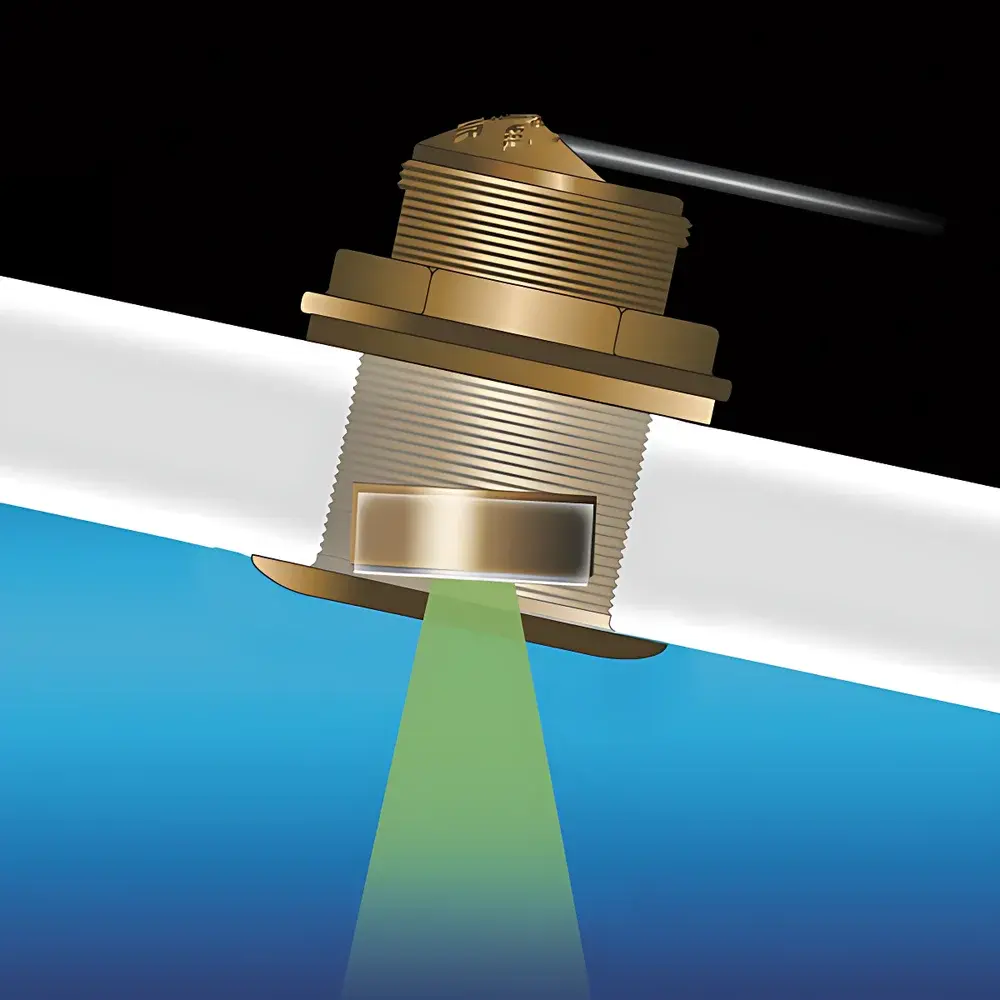
| Mounting Type | Through-hull with fixed-angle transducer element |
| Element Tilt Options | 0°, 12°, or 20° |
| Acoustic Window Material | Polyurethane |
| Required Hull Thickness | ≤ 45 mm |
| Minimum Hull Radius of Curvature | 150 mm |
| Operating Temperature Range | –15 °C to +60 °C |
| Integrated Temperature Sensor | Yes |
| Weight | 1.4 kg |
| Cutout Diameter | 70 mm |
| Shaft Length | 95 mm |
| Compatible Hull Types | Fiberglass, wood, aluminum (non-metallic hulls recommended for optimal performance) |
| Maximum Vessel Length | 8 m |
| Maximum Keel Angle | 24° |
Overview
The Airmar B75HW is a high-frequency, wideband CHIRP (Compressed High-Intensity Radar Pulse) through-hull depth sounder transducer engineered for precision hydrographic performance on small to mid-sized recreational and fishing vessels—particularly those with planing, semi-displacement, or displacement hull forms up to 8 meters in length. Unlike conventional single-frequency echo sounders, the B75HW employs broadband FM sweep technology across 150–250 kHz, enabling superior target resolution, improved signal-to-noise ratio, and enhanced bottom discrimination in shallow to medium-depth waters. Its 30° conical beam provides broad coverage beneath the vessel while maintaining sufficient angular resolution to resolve individual baitfish schools and discrete predator targets at ranges up to 106 meters (350 feet). The transducer’s low-profile, flush-mount design minimizes drag and cavitation risk, making it especially suitable for high-speed operation on sportfishing and center-console platforms.
Key Features
- CHIRP broadband sonar operation from 150 to 250 kHz for optimized target separation and bottom detail
- Fixed-angle ceramic transducer element (0°, 12°, or 20° tilt) compensates for hull deadrise angle—ensuring acoustic beam alignment perpendicular to the water surface
- 600 W peak transmit power supports reliable detection in turbid or thermocline-affected water columns
- Integrated high-accuracy NTC thermistor for real-time water temperature measurement, calibrated to ±0.5 °C
- Robust bronze housing with polyurethane acoustic window—corrosion-resistant and acoustically transparent across the operating band
- Xducer ID® digital identification protocol enables automatic transducer recognition and configuration by compatible multifunction displays (MFDs)
- Through-hull mounting with minimal hull penetration (70 mm cutout); shaft length of 95 mm accommodates standard fiberglass or wooden hull thicknesses
- Optimized for vessels with keel angles up to 24°; tilt variants ensure beam orthogonality without mechanical gimbal systems
Sample Compatibility & Compliance
The B75HW is certified for use on non-metallic hulls—including fiberglass-reinforced polymer (FRP), wood, and select aluminum configurations—where acoustic coupling remains unimpeded. It complies with IEC 62287-1:2017 (Marine echosounders — Part 1: Performance requirements, methods of testing and required test results) for depth measurement accuracy and repeatability. While not classified as a safety-critical navigation sensor per IMO Resolution MSC.191(79), its output is compatible with ECDIS and radar overlay systems when integrated via NMEA 2000 or NMEA 0183 v3.00 protocols. The transducer meets RoHS Directive 2011/65/EU and FCC Part 15 Subpart B electromagnetic compatibility requirements. For GLP-aligned marine research deployments, raw CHIRP IQ data export (via compatible MFD firmware) supports post-processing in MATLAB, SonarScope, or Echoview environments.
Software & Data Management
The B75HW operates natively with Airmar-compatible chartplotters and multifunction displays supporting CHIRP processing—including Raymarine Axiom, Garmin GPSMAP, and Simrad NSS evo3 series. Xducer ID® enables plug-and-play configuration: the transducer self-reports frequency range, tilt angle, and calibration coefficients to the host display, eliminating manual setup errors. Real-time depth and water temperature data are transmitted over NMEA 2000 at 10 Hz update rate, with optional high-resolution CHIRP IQ data streaming for advanced analysis. Firmware updates are delivered via MFD-based utilities; no external programming interface is required. All operational logs—including temperature-compensated depth timestamps and beam alignment diagnostics—are retained onboard the display system for auditability in commercial fishing or academic survey applications.
Applications
- Recreational and sportfishing operations requiring precise fish arch detection and seabed contour mapping in depths ≤ 106 m
- Shallow-water bathymetric profiling for coastal habitat assessment and marina dredging planning
- Integration into autonomous surface vehicle (ASV) platforms for unmanned hydrographic surveys
- Academic field studies involving pelagic biomass estimation, thermocline tracking, and sediment classification
- Commercial small-craft navigation where low-drag, through-hull installation is mandated by hull geometry or regulatory constraints
FAQ
What hull materials are compatible with the B75HW?
The transducer is validated for fiberglass, wood, and certain non-ferrous aluminum hulls. Stainless steel or copper-clad hulls are incompatible due to acoustic attenuation.
Can the B75HW be used on vessels exceeding 8 meters in length?
While mechanically installable, Airmar specifies an 8 m maximum for optimal beam alignment and noise rejection; larger vessels may require dual-transducer arrays or higher-power alternatives.
Is the integrated temperature sensor traceable to NIST standards?
The NTC thermistor is factory-calibrated against reference standards traceable to NIST; full calibration certificates are available upon request for ISO/IEC 17025-compliant laboratories.
Does the B75HW support split-beam or Doppler velocity functionality?
No—it is a single-beam, intensity-based CHIRP transducer. Split-beam or current-profiling capabilities require dedicated scientific echosounders such as the BioSonics DT-X or EK80 series.
How does the 30° beam width affect vertical resolution at 50 m depth?
At 50 m, the 30° conical beam yields a circular footprint diameter of approximately 26.8 m; vertical resolution remains governed by pulse length and sampling rate of the host processor—not beam geometry.