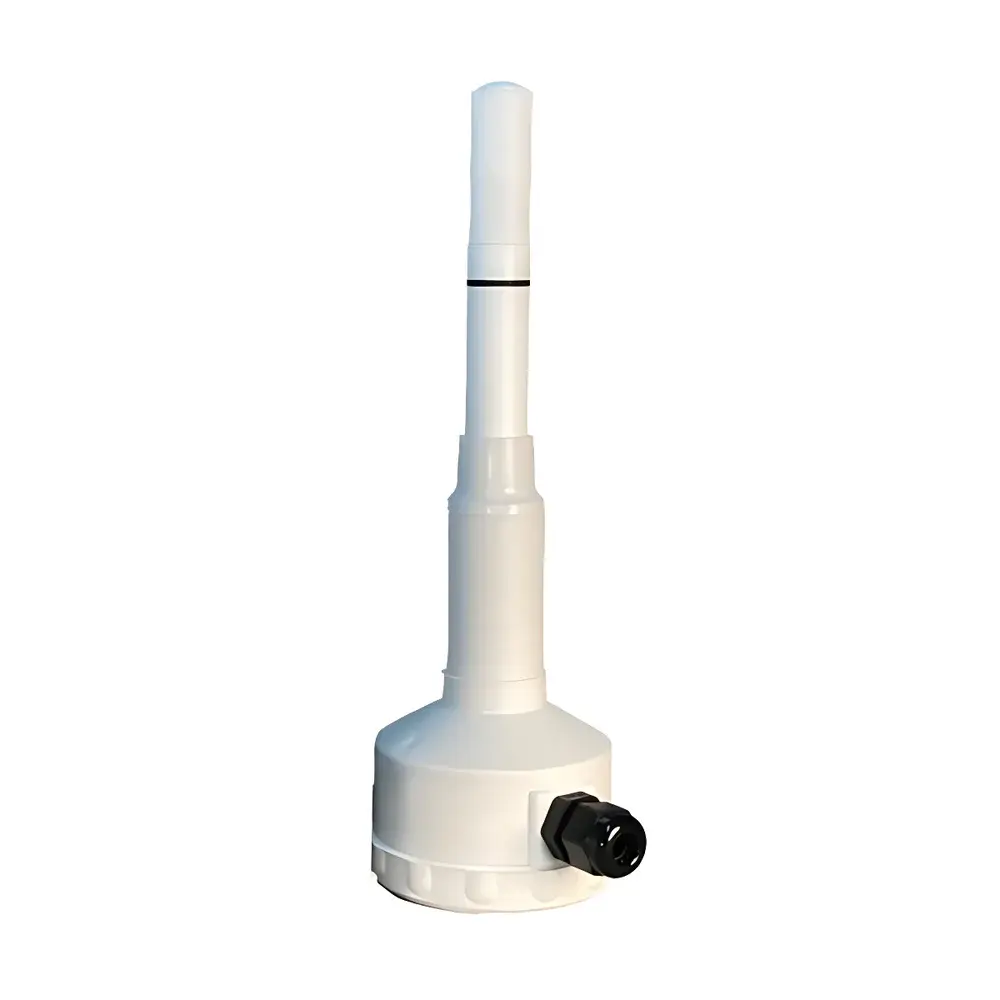
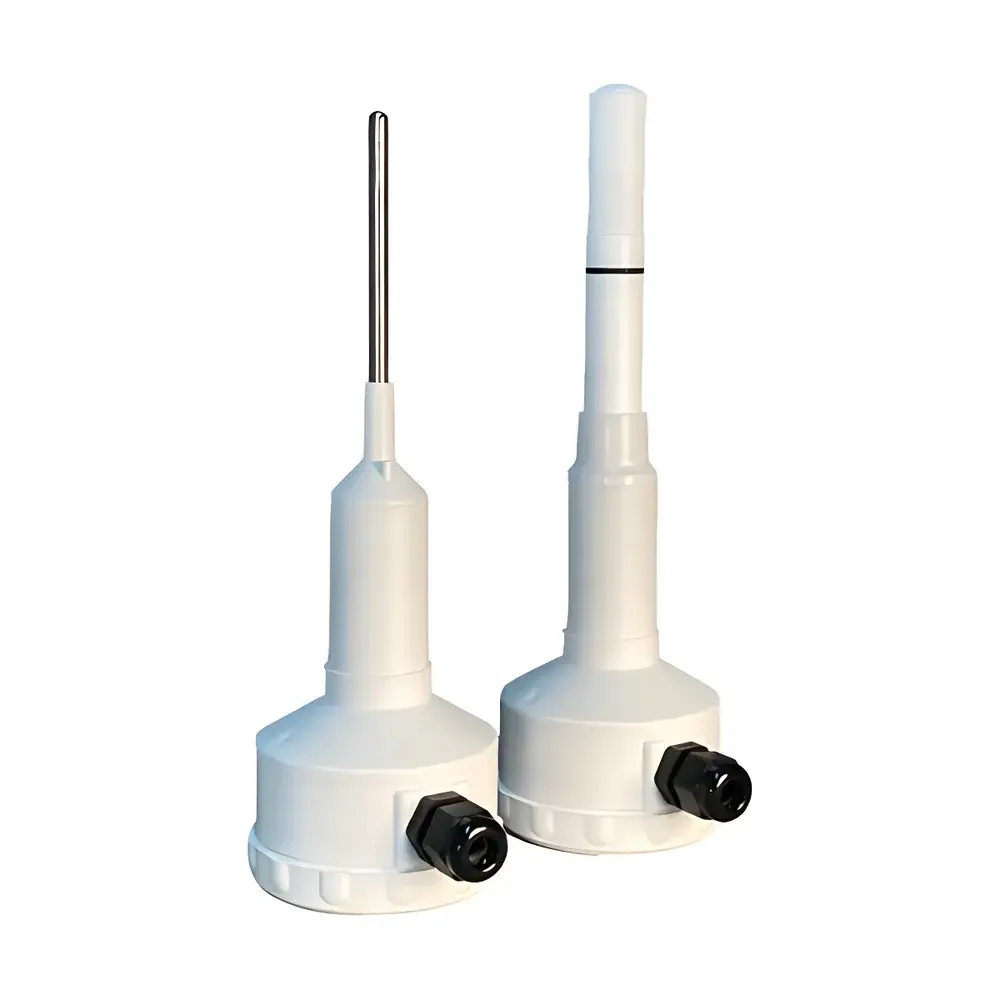
R.M. Young 41382VC Precision Temperature and Humidity Sensor
| Brand | R.M. Young |
|---|---|
| Origin | USA |
| Model | 41382VC |
| Temperature Range | -50 to +50 °C |
| Temperature Accuracy | ±0.3 °C @ 23 °C |
| Temperature Resolution | 0.1 °C |
| Relative Humidity Range | 0–100 %RH |
| RH Accuracy | ±1 %RH @ 20 °C |
| RH Stability | <1 %RH/year |
| Response Time (with radiation shield) | 10 s |
| Output Signal | 0–1 VDC or 0–5 VDC (jumper-selectable) |
| Power Supply | 12–30 VDC |
| Operating Ambient Temperature | -50 to +50 °C |
| Dimensions | Ø64 mm × 176 mm |
| Weight | 200 g |
| Sensor Type (Temp) | Platinum RTD (Pt1000) |
| Sensor Type (RH) | Rotronic Hygromer® capacitive polymer |
| Recommended Cable | 5-conductor shielded (Young P/N 18723) |
| Optional Radiation Shields | 43502 (aspirated), 41003P (multi-layer passive) |
Overview
The R.M. Young 41382VC is a high-stability, dual-parameter environmental sensor engineered for long-term, unattended monitoring of ambient air temperature and relative humidity in meteorological, ecological, industrial hygiene, and building performance applications. Integrating a platinum resistance thermometer (Pt1000 RTD) and a Rotronic Hygromer® capacitive polymer humidity sensing element within a single compact probe, the 41382VC delivers traceable, low-drift measurements under demanding outdoor and semi-outdoor conditions. Its measurement principle relies on the well-characterized resistive response of platinum to temperature change and the dielectric permittivity shift of a hygroscopic polymer film as a function of water vapor concentration—both calibrated against NIST-traceable standards. Designed for integration into data acquisition systems compliant with WMO guidelines, the sensor operates across the full arctic-to-tropical ambient range (-50 to +50 °C) while maintaining metrological integrity over extended deployment cycles.
Key Features
- Integrated Pt1000 RTD and Rotronic Hygromer® sensors in a single, weather-resistant stainless-steel housing
- Temperature accuracy of ±0.3 °C at 23 °C; RH accuracy of ±1 %RH at 20 °C, certified per ISO/IEC 17025-accredited calibration procedures
- Long-term RH stability better than 1 %RH per year—critical for climate trend analysis and regulatory compliance reporting
- Jumper-selectable analog output: factory-configurable 0–1 VDC or 0–5 VDC, compatible with most SCADA, PLC, and datalogger inputs (e.g., Campbell Scientific CR series, Onset HOBO, Delta-T DL2)
- Low-power operation (7 mA typical) with wide-input DC supply range (12–30 VDC), supporting solar-battery and PoE-powered remote stations
- Optimized thermal mass and aerodynamic profile for rapid 10-second response time when used with recommended radiation shields (e.g., Model 43502 aspirated or 41003P multi-layer passive)
- IP65-rated enclosure with marine-grade 316 stainless steel body and UV-stabilized cable gland
Sample Compatibility & Compliance
The 41382VC is designed for continuous measurement of ambient air in open-air, ventilated enclosures, and controlled-environment chambers. It is not intended for immersion, high-velocity gas streams (>10 m/s), or corrosive atmospheres without supplemental filtration. The sensor meets IEC 60529 IP65 ingress protection requirements and complies with EN 13037 (meteorological instruments — general requirements) and WMO No. 8 Guide to Meteorological Instruments and Methods of Observation. Calibration certificates include uncertainty budgets per GUM (JCGM 100) and are issued by an ILAC-MRA signatory laboratory. For GLP/GMP-regulated environments (e.g., HVAC validation, cleanroom monitoring), the device supports audit-ready documentation when paired with compliant data loggers featuring 21 CFR Part 11–enabled electronic signatures and secure audit trails.
Software & Data Management
The 41382VC outputs linear, ratiometric analog signals requiring no onboard firmware or configuration software. Signal conditioning, scaling, and unit conversion are performed externally by the host data logger or control system. Users may apply standard NIST-recommended correction algorithms (e.g., Magnus formula for dew point, Callendar-Van Dusen for RTD linearization) within their acquisition software. When integrated with R.M. Young’s proprietary YSI Logger Suite or third-party platforms such as LabVIEW, Python-based PyCampbellCR, or MATLAB Data Acquisition Toolbox, the sensor enables automated calibration verification, drift trending, and statistical process control (SPC) charting. Raw voltage outputs are fully compatible with IEEE 1451.2 TEDS templates for plug-and-play transducer identification in smart sensor networks.
Applications
- Automated weather stations (AWS) and mesonets for synoptic and climatological observation
- Environmental monitoring in national parks, flux towers, and eddy-covariance research sites
- Building energy management systems (BEMS) and ASHRAE-compliant HVAC commissioning
- Pharmaceutical warehouse temperature mapping and cold chain validation (when deployed with qualified data loggers)
- Soil-atmosphere interaction studies requiring co-located microclimate profiling
- Calibration reference for secondary sensors in field-deployed IoT networks
FAQ
What radiation shield is recommended for highest accuracy in direct sunlight?
The Model 43502 aspirated radiation shield is strongly recommended for applications requiring WMO Class I or II accuracy; it actively draws ambient air across the sensor at >2.5 m/s, minimizing radiative heating error.
Can the 41382VC be used indoors without a radiation shield?
Yes—indoors or in shaded, well-ventilated enclosures, the sensor may be mounted directly; however, passive shielding (e.g., Model 41003P) is advised if radiant heat sources (e.g., lighting, HVAC ducts) are present.
Is the output signal compatible with 12-bit analog input modules?
Yes—the 0–1 VDC or 0–5 VDC output provides sufficient dynamic range for 12-bit resolution (0.24 mV or 1.22 mV LSB), assuming proper grounding and shielded cabling per Young P/N 18723 specification.
Does the sensor require periodic recalibration?
Annual recalibration is recommended for metrologically critical applications; the Rotronic Hygromer® element exhibits <1 %RH/year drift, and the Pt1000 RTD maintains stability within ±0.05 °C/year under stable storage conditions.
What is the maximum cable length supported without signal degradation?
With Young P/N 18723 (5-conductor, 24 AWG, foil+braided shield), lengths up to 100 m maintain signal integrity; beyond 100 m, active signal conditioning or 4–20 mA conversion (e.g., via Model 41383LC2) is advised.