
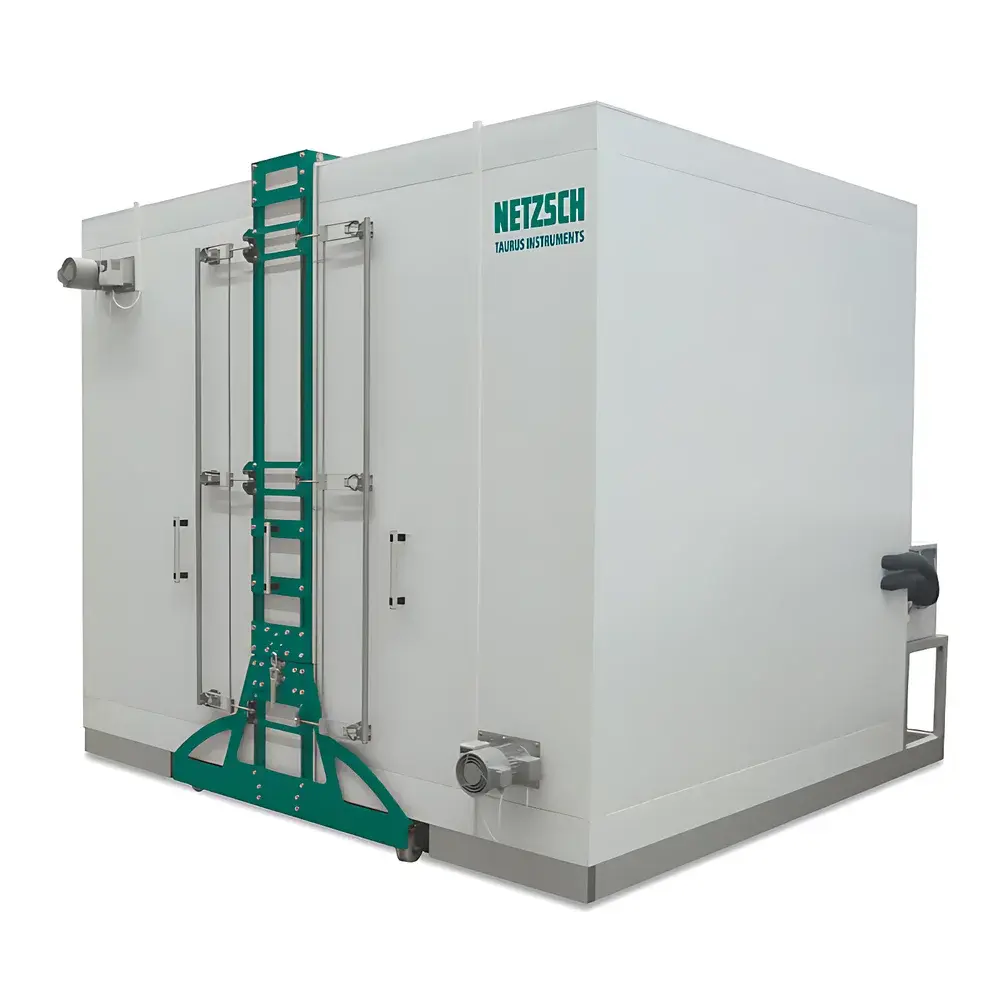
Netzsch TDW 4040 Guarded Hot Box Thermal Transmittance Testing System
| Brand | Netzsch |
|---|---|
| Origin | Germany |
| Model | TDW 4040 |
| Measurement Principle | Guarded Hot Box (Steady-State Heat Flow Method) |
| Instrument Type | Thermal Transmittance (U-value) and Thermal Resistance (R-value) Analyzer |
| External Dimensions (H×W×D) | 300 × 500 × 360 cm |
| Weight | 3890 kg |
| Temperature Range (Hot Side) | 10–40 °C |
| Temperature Range (Cold Side) | −10–40 °C |
| Sample Area Options | 1500 × 1500 mm or 2000 × 2000 mm |
| Maximum Sample Thickness | 360 mm (Standard), 560 mm (Extended) |
| Thermal Resistance Range (R) | 0.10–8.00 m²·K/W |
| Accuracy | ±3.0% (per DIN EN 12937 & ISO 8990) |
| Repeatability | ±1.0% |
| Cooling System | Water-Cooled Circulating Chiller |
| Compliance | DIN EN 12937, DIN EN 1934, ISO 8990, ASTM C1363, EN ISO 10211 |
| Software | HotBox v5.x (Single-User License) |
| Test Frame | Insulated, Forklift-Compatible Roller Base with Adjustable Aperture |
Overview
The Netzsch TDW 4040 Guarded Hot Box Thermal Transmittance Testing System is a high-precision, steady-state apparatus engineered for the standardized determination of thermal transmittance (U-value) and thermal resistance (R-value) of full-scale building components under controlled environmental conditions. Based on the guarded hot box principle defined in ISO 8990 and DIN EN 12937, the system maintains independent, actively regulated temperature zones—hot and cold—separated by a precisely insulated test frame. A guarded heating zone surrounds the central measurement area to minimize lateral heat loss, ensuring metrologically traceable results compliant with international building physics standards. Designed for architectural product certification and R&D validation, the TDW 4040 accommodates large-format specimens including doors, windows, curtain walling systems, prefabricated façade panels, vaulted ceilings, and masonry assemblies up to 2000 × 2000 mm in plan view and 560 mm in thickness.
Key Features
- Guarded hot box architecture with active perimeter heating and dynamic thermal compensation for minimized edge effects and enhanced measurement fidelity
- Forklift-compatible insulated test frame with roller base and adjustable aperture—enabling rapid, repeatable specimen loading without structural modification
- Independent dual-zone climate control: hot side (10–40 °C) and cold side (−10–40 °C), each equipped with water-cooled circulating chillers for stable, low-drift thermal boundary conditions
- High-stability temperature regulation (±0.1 K) supported by redundant Pt100 sensors and PID-controlled heating/cooling loops
- Modular sample support configuration accommodating both standard (1500 × 1500 mm) and extended (2000 × 2000 mm) specimen footprints
- Integrated safety interlocks, thermal over-limit protection, and real-time system diagnostics aligned with IEC 61000-6-2/6-4 EMC requirements
Sample Compatibility & Compliance
The TDW 4040 is validated for testing heterogeneous, anisotropic, and geometrically complex building elements—including multi-layer composite doors, thermally broken aluminum windows, vacuum-insulated panels (VIPs), autoclaved aerated concrete (AAC) blocks, and double-skin façades. Its mechanical design conforms to dimensional and operational requirements specified in DIN EN 1934 (thermal performance of windows and glazed façades), DIN EN 12937 (calibration and verification of hot box systems), ISO 8990 (steady-state thermal performance determination), and ASTM C1363 (thermal performance of building materials and envelopes). All measurements are traceable to national metrology institutes via calibrated reference sensors and documented uncertainty budgets per GUM (Guide to the Expression of Uncertainty in Measurement).
Software & Data Management
HotBox v5.x software provides full instrument control, automated test sequencing, real-time thermal flux monitoring, and ISO-compliant reporting. The application enforces mandatory data logging intervals, automatic drift correction, and built-in validation checks against convergence criteria (e.g., <0.1 % variation in mean heat flow over 30 min). Audit trails record all operator actions, parameter changes, and calibration events in accordance with GLP and FDA 21 CFR Part 11 requirements. Export formats include CSV, PDF (EN-compliant test reports), and XML for integration into LIMS or BIM-based energy modeling workflows (e.g., EnergyPlus, IESVE). A single-user license is supplied with the system; network deployment options are available under separate agreement.
Applications
- Certification testing of building products for CE marking, Passive House Institute (PHI) approval, and national energy code compliance (e.g., IECC, EnEV, BBC Effinergie)
- R&D validation of novel insulation materials, dynamic glazing systems, and thermally adaptive façade concepts
- Thermal bridge analysis of junction details (e.g., window-to-wall interfaces, slab-edge connections) per EN ISO 10211
- Quality assurance in industrial manufacturing of prefabricated building elements
- Third-party verification for green building rating systems (LEED, BREEAM, DGNB)
- Academic research in building physics, low-energy architecture, and climate-resilient construction
FAQ
What standards does the TDW 4040 comply with for U-value testing?
The system meets the metrological and procedural requirements of DIN EN 12937, ISO 8990, ASTM C1363, and EN ISO 10211 for steady-state thermal transmittance measurement.
Can the TDW 4040 measure air-tightness or moisture transmission?
No—it is dedicated solely to thermal transmittance and resistance under steady-state conditions. Air permeability and vapor diffusion require complementary instrumentation (e.g., blower door systems or cup tests per ISO 12572).
Is remote operation or unattended testing supported?
Yes—HotBox v5.x supports scheduled test runs, email alerts upon completion or fault detection, and secure remote desktop access via IT-approved protocols.
How is calibration maintained over time?
Annual verification using certified reference panels (traceable to PTB or NIST) is recommended; internal sensor linearity checks and thermal gradient mapping are performed automatically during startup and idle cycles.
Does the system require special electrical or HVAC infrastructure?
It operates on three-phase 400 V AC power (32 A per phase) and requires connection to a facility cooling water loop (12–25 °C supply, 3–5 bar pressure); no dedicated HVAC room is needed beyond standard laboratory ventilation.



