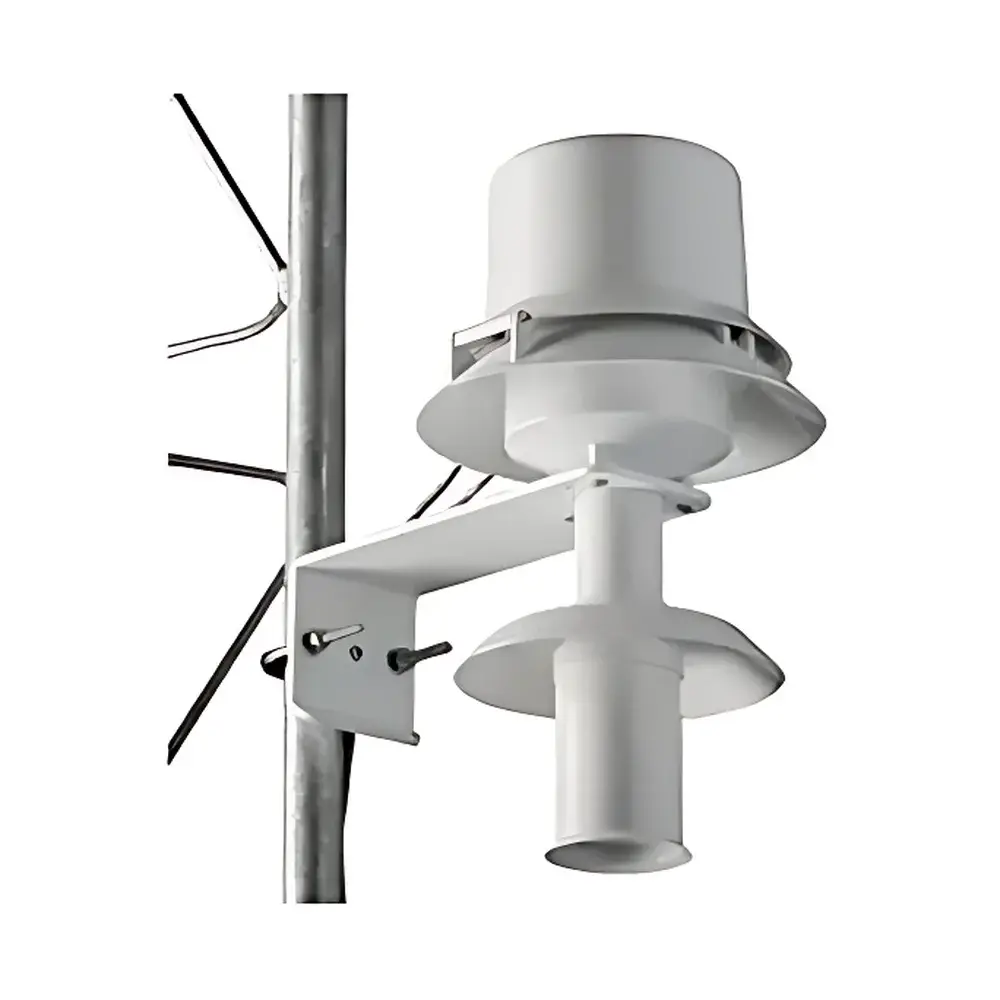
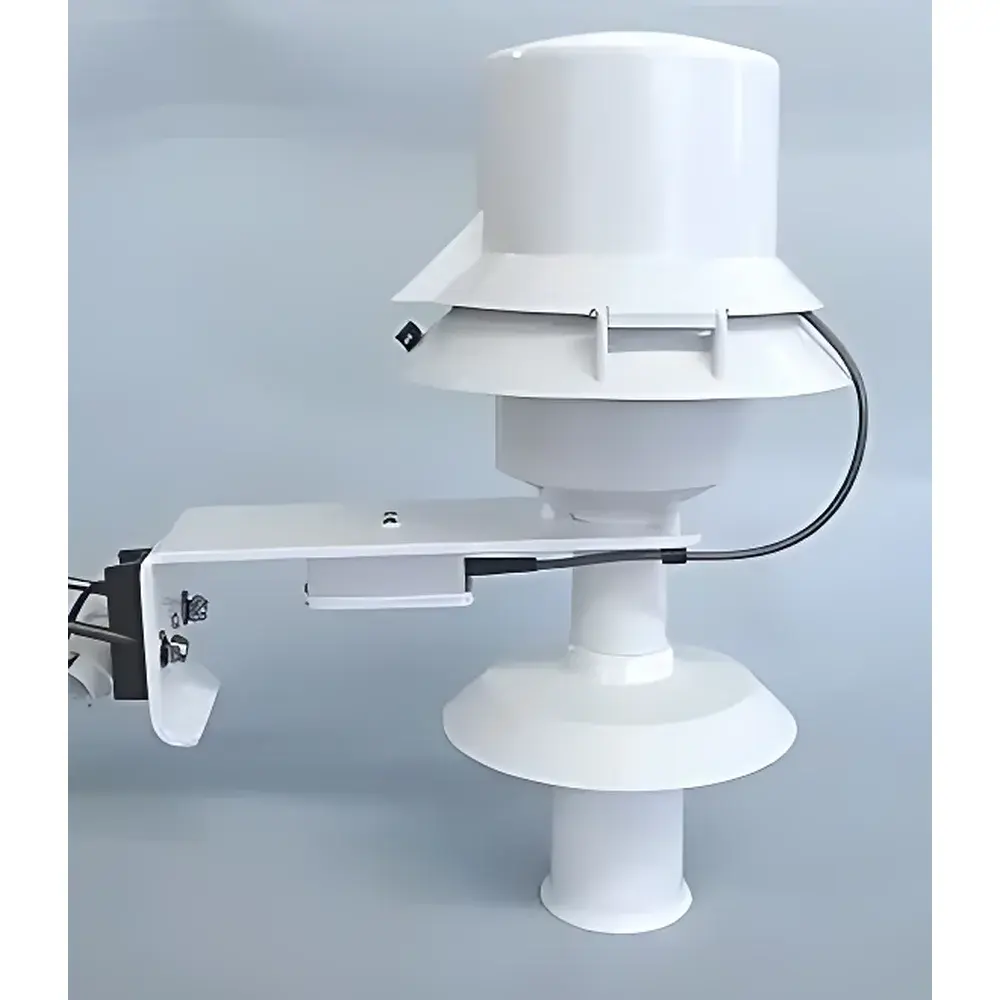
R.M. Young 41502 Aspirated Radiation Shield for Temperature and Relative Humidity Sensors
| Brand | R.M. Young |
|---|---|
| Origin | USA |
| Model | 41502 |
| Material | UV-stabilized white thermoplastic housing, anodized aluminum support frame, stainless steel mounting hardware |
| Dimensions | 20 cm (diameter) × 33 cm (height) |
| Net Weight | 1.1 kg |
| Shipping Weight | ~2.7 kg |
| Power Supply | 12–14 VDC @ 500 mA |
| Airflow Rate | 5–11 m/s (16–35 ft/s), dependent on sensor power draw |
| Radiative Error (Temperature) | ≤0.2 °C RMS at 1000 W/m² solar irradiance |
| Delta-T Error | ≤0.05 °C RMS under identical shielding exposure |
| Fan Lifetime | >80,000 hours continuous operation at 25°C |
| Sensor Compatibility | RTD-based temperature probes (e.g., 41342), combined RH/T probes (e.g., 41382) |
| Output Options | 4–20 mA or 0–1 VDC |
| Operating Environment | Outdoor, all-weather, low-wind-speed microclimates |
Overview
The R.M. Young 41502 Aspirated Radiation Shield is a precision-engineered passive-active hybrid enclosure designed to minimize radiative heating and cooling errors in high-accuracy temperature and relative humidity (RH) measurements under unsheltered outdoor conditions. Unlike static multi-plate radiation shields, the 41502 integrates a continuously operating, brushless DC fan that forces ambient air through a triple-wall inlet tube and across the sensing elements—ensuring rapid thermal equilibration between the sensor and true atmospheric conditions. Its measurement principle relies on forced convection to suppress both shortwave (solar) and longwave (terrestrial/infrared) radiation-induced offsets, particularly critical in low-wind environments (< 2 m/s) where natural ventilation is insufficient. The shield complies with WMO (World Meteorological Organization) guidelines for radiation error mitigation and supports traceable climate monitoring in compliance with ISO/IEC 17025-accredited calibration workflows.
Key Features
- Triple-wall aspirated inlet design with multiple light baffles to attenuate direct and diffuse solar radiation while maintaining laminar airflow across sensors
- UV-stabilized white thermoplastic housing with high solar reflectance (>90%) and low thermal conductivity (<0.2 W/m·K), minimizing conductive heat gain
- Brushless DC fan with solid-state electronic commutation, rated for >80,000 hours MTBF at 25°C—engineered for unattended, year-round operation in remote stations
- Optimized geometry: compact 20 cm diameter reduces exposed surface area, lowering daytime heat absorption and nighttime radiative cooling bias
- Modular mounting system featuring anodized aluminum support frame, molded plastic V-groove cradle, and stainless steel U-clamp—compatible with standard meteorological masts and crossarms
- Electrical interface supports dual-output configurations (4–20 mA or 0–1 VDC) for seamless integration into SCADA, data loggers (e.g., Campbell Scientific CR series), and industrial PLC systems
Sample Compatibility & Compliance
The 41502 is validated for use with R.M. Young’s certified temperature and RH/T probes—including the 41342 platinum RTD temperature sensor (IEC 60751 Class A, ±0.15 °C at 0 °C) and the 41382 integrated RH/T probe (Vaisala HUMICAP® sensor, ±1.5 %RH, ±0.2 °C). It meets WMO No. 8 “Guide to Instruments and Methods of Observation” requirements for aspirated shields used in synoptic and climatological networks. The design supports GLP/GMP-aligned environmental monitoring when paired with calibrated sensors and audit-trail-capable data acquisition systems. While not intrinsically rated for hazardous locations, its non-metallic housing and low-voltage DC operation facilitate deployment in Class I, Division 2 environments per NEC Article 500 when installed with appropriate barriers.
Software & Data Management
The 41502 operates as a hardware-level correction layer—requiring no embedded firmware or onboard processing. Its performance is fully characterized in manufacturer-provided correction tables (available in NIST-traceable calibration reports), enabling post-processing compensation in software platforms such as MATLAB, Python (with Pandas/NumPy), or commercial meteorological suites (e.g., MetView, WRAP). When integrated with data loggers supporting analog input scaling and linearization (e.g., Onset HOBO RX3000 or Campbell CR6), real-time compensated temperature and RH values can be derived using preloaded coefficients. For FDA 21 CFR Part 11-compliant deployments, the shield’s passive role ensures full auditability: raw voltage/current outputs remain unaltered, preserving data integrity throughout acquisition, transmission, and archival.
Applications
- Reference-grade weather stations for national meteorological services and climate reference networks (e.g., USCRN, GCOS)
- Agricultural microclimate monitoring—especially in orchards, vineyards, and controlled-environment agriculture where dew point accuracy affects irrigation scheduling
- Environmental impact assessments requiring long-term, low-drift temperature/RH baselines near industrial sites or construction zones
- Calibration verification labs performing intercomparison studies between reference sensors and field-deployed units
- Urban heat island (UHI) research deploying dense sensor arrays where spatial consistency demands uniform radiative error suppression
- Validation of satellite-derived land surface temperature (LST) products via ground-truthing with minimally biased in situ measurements
FAQ
Does the 41502 require periodic maintenance?
Yes—fan intake filters should be inspected quarterly and cleaned with compressed air; annual verification of fan current draw and airflow velocity (using a calibrated hot-wire anemometer) is recommended for mission-critical installations.
Can the 41502 be used with third-party sensors?
Yes, provided the sensor’s physical dimensions, thermal mass, and electrical interface are compatible with the internal mounting geometry and output specifications (4–20 mA or 0–1 VDC); users must validate radiative error performance independently.
Is the 41502 suitable for marine or coastal environments?
Its anodized aluminum frame and stainless steel hardware provide enhanced corrosion resistance, but extended salt-laden exposure requires biannual inspection of mounting hardware and optional conformal coating of electrical connections.
What is the maximum cable length supported for 4–20 mA output?
Up to 1,000 meters with 18 AWG twisted-pair shielded cable and proper grounding—consistent with ISA RP12.6 standards for industrial current-loop transmission.
How does the 41502 compare to static multi-plate shields (e.g., 41383)?
Under low-wind conditions (<1.5 m/s), the 41502 reduces daytime temperature radiation error by up to 75% compared to static designs, with significantly faster response to rapid ambient temperature transients due to forced convection.