
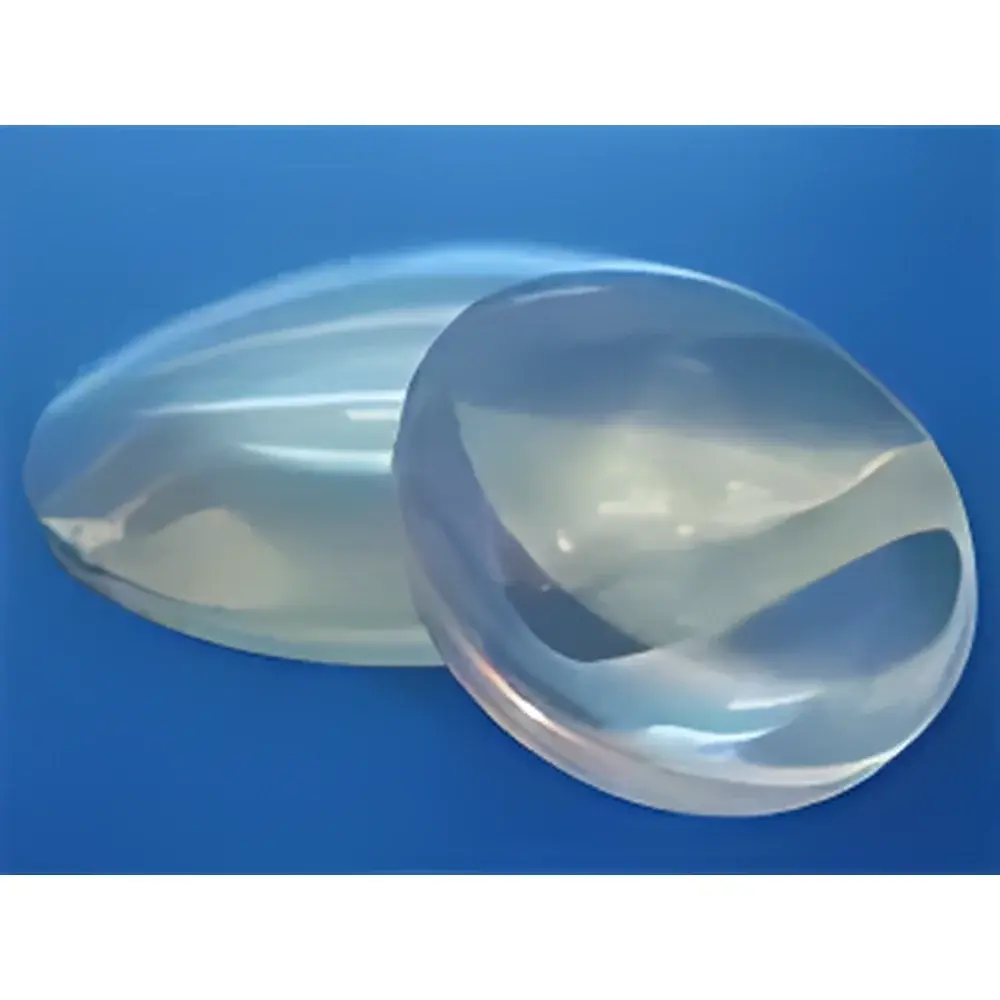
THz Lenses – High-Performance Terahertz Optical Components for THz-TDS and Imaging Systems
| Origin | USA |
|---|---|
| Supplier Type | Authorized Distributor |
| Import Status | Imported |
| Model | THz Lenses |
| Component Category | Optical Element |
| Substrate Materials | HRFZ-Si (High-Resistivity Float-Zone Silicon), TPX (Polymethylpentene) |
| Lens Types | Plano-Convex, Bi-Convex, Positive Meniscus, Hyper-/Hypo-/Hemispherical, Bullet, Diffractive (Fresnel, Beam Divider) |
| Diameter Range | 2 mm to 150 mm |
| EFL Tolerance | ±1% |
| Surface Quality | 80/50 Scratch-Dig |
| Surface Accuracy | ±0.01 mm (spherical), variable for aspheric profiles |
| Clear Aperture | ≥90% |
| Coating | Optional Anti-Reflection (AR) Coating for 0.1–3 THz band |
Overview
THz Lenses are precision-engineered optical components designed specifically for manipulation and focusing of terahertz radiation (0.1–3 THz) in time-domain spectroscopy (THz-TDS), pulsed imaging, continuous-wave (CW) THz systems, and free-space beam delivery setups. Unlike conventional visible or infrared optics, THz lenses must address unique challenges including strong material dispersion, low refractive index contrast, and high absorption in common optical glasses. These lenses utilize low-loss, broadband-transmissive substrates—primarily high-resistivity float-zone silicon (HRFZ-Si) and TPX polymer—both exhibiting minimal absorption and near-constant refractive index across the THz band. The optical design follows classical geometries (plano-convex, bi-convex, meniscus) as well as specialized forms (hemispherical, hyper-hemispherical, bullet) to minimize spherical aberration and Fresnel reflection losses at air-substrate interfaces. Each lens is fabricated using diamond-turning or precision molding techniques to maintain sub-wavelength surface fidelity required for diffraction-limited performance in THz focal spots.
Key Features
- Substrate options optimized for THz transmission: HRFZ-Si (n ≈ 3.42, low dispersion, high thermal conductivity) and TPX (n ≈ 1.45, low density, excellent impact resistance)
- Multiple lens geometries supporting diverse beam shaping requirements: standard spherical (plano-convex, bi-convex), aberration-corrected meniscus, and immersion-type hemispherical configurations for NA enhancement
- Diameter range from 2 mm to 150 mm, accommodating compact fiber-coupled modules up to large-aperture collimation optics
- Tight dimensional tolerances: ±0.1 mm for critical diameters, ±0.25 mm for general dimensions; EFL tolerance maintained at ±1% for reproducible focal positioning
- Surface quality rated at 80/50 scratch-dig per MIL-PRF-13830B, ensuring minimal scatter in low-signal THz applications
- Optional broadband anti-reflection (AR) coatings deposited via physical vapor deposition (PVD), reducing Fresnel losses to <2% per surface across 0.1–3 THz
- Diffractive variants available—including Fresnel lenses and beam dividers—enabling compact achromatic focusing and multi-channel THz detection architectures
Sample Compatibility & Compliance
THz Lenses are compatible with standard THz-TDS platforms (e.g., Menlo Systems, TOPTICA, Advantest), CW THz sources (e.g., Virginia Diodes VDI multipliers), and quantum cascade laser (QCL) systems. All HRFZ-Si lenses meet ASTM F798 for silicon wafer purity specifications and are certified for use in Class 100 cleanroom environments during assembly. TPX lenses comply with ISO 10993-5 for cytotoxicity and are RoHS-compliant. While not medical devices, these components support research-grade instrumentation used in non-destructive testing (NDT), pharmaceutical tablet analysis (per USP THz characterization guidelines), and security screening R&D. No FDA clearance or CE marking is required for optical components sold as laboratory consumables under EU Directive 2014/30/EU (EMC) and 2011/65/EU (RoHS).
Software & Data Management
As passive optical elements, THz Lenses do not incorporate embedded firmware or digital interfaces. However, they are fully compatible with industry-standard optical design and simulation tools—including Zemax OpticStudio (with THz material libraries), COMSOL Multiphysics (RF Module), and Lumerical MODE—for ray tracing, wavefront error analysis, and focal spot modeling. Lens serial numbers and metrology reports (surface profile, interferometric maps, spectral transmittance data) are provided in PDF format upon request and archived for traceability. For GxP-regulated environments, calibration certificates (traceable to NIST standards) and controlled document packages—including material certifications and coating deposition logs—can be supplied under formal QA agreement.
Applications
- Focusing and collimating THz beams in pump-probe experiments requiring spatial resolution down to ~100 µm
- Immersion-mode coupling into semiconductor wafers, biological tissues, or polymer films to enhance signal-to-noise ratio in reflection geometry
- Beam conditioning in real-time THz imaging systems for industrial quality control (e.g., delamination detection in composites, coating thickness mapping)
- Integration into multi-element THz objectives for confocal or near-field scanning configurations
- Custom diffractive optics enabling parallel THz spectroscopy with multi-pixel detector arrays
- Front-end optics for THz quantum cascade lasers operating above 2 THz where conventional dielectric lenses exhibit excessive loss
FAQ
What substrate should I choose for my THz application: HRFZ-Si or TPX?
HRFZ-Si offers superior thermal stability and higher refractive index, making it ideal for high-power CW systems and vacuum-compatible setups. TPX is preferred for lightweight, portable systems and applications requiring mechanical resilience or compatibility with aqueous environments.
Are AR-coated lenses available off-the-shelf or only custom-ordered?
Standard AR coatings for 0.1–3 THz are available on select stock items (e.g., LHS-HRFZ-Si-D25.4-F100); full customization—including multi-band or angle-specific designs—is supported with lead times of 4–6 weeks.
Can these lenses be used in cryogenic THz systems?
Yes. HRFZ-Si lenses retain mechanical integrity and optical performance down to 4 K; coefficient of thermal expansion mismatch with aluminum mounts is accounted for in mounting recommendations.
Do you provide Zemax or CODE V lens files?
Yes. Non-proprietary sequential and non-sequential lens files—including surface sag tables and material dispersion models—are supplied with every order upon request.
Is there a minimum order quantity (MOQ) for custom diameters or focal lengths?
No MOQ applies to standard geometries. Custom geometries (e.g., bullet or hypo-hemispherical profiles) require technical review but no volume commitment for prototype quantities.




