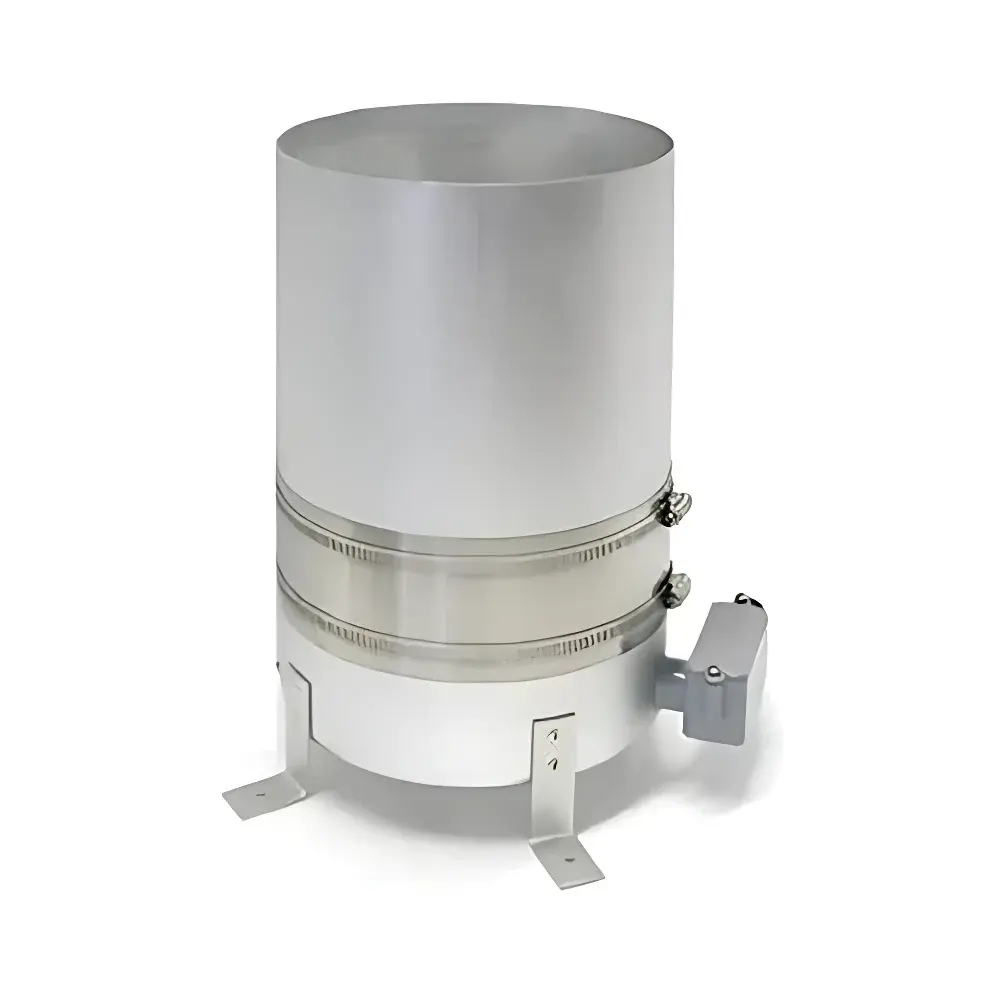
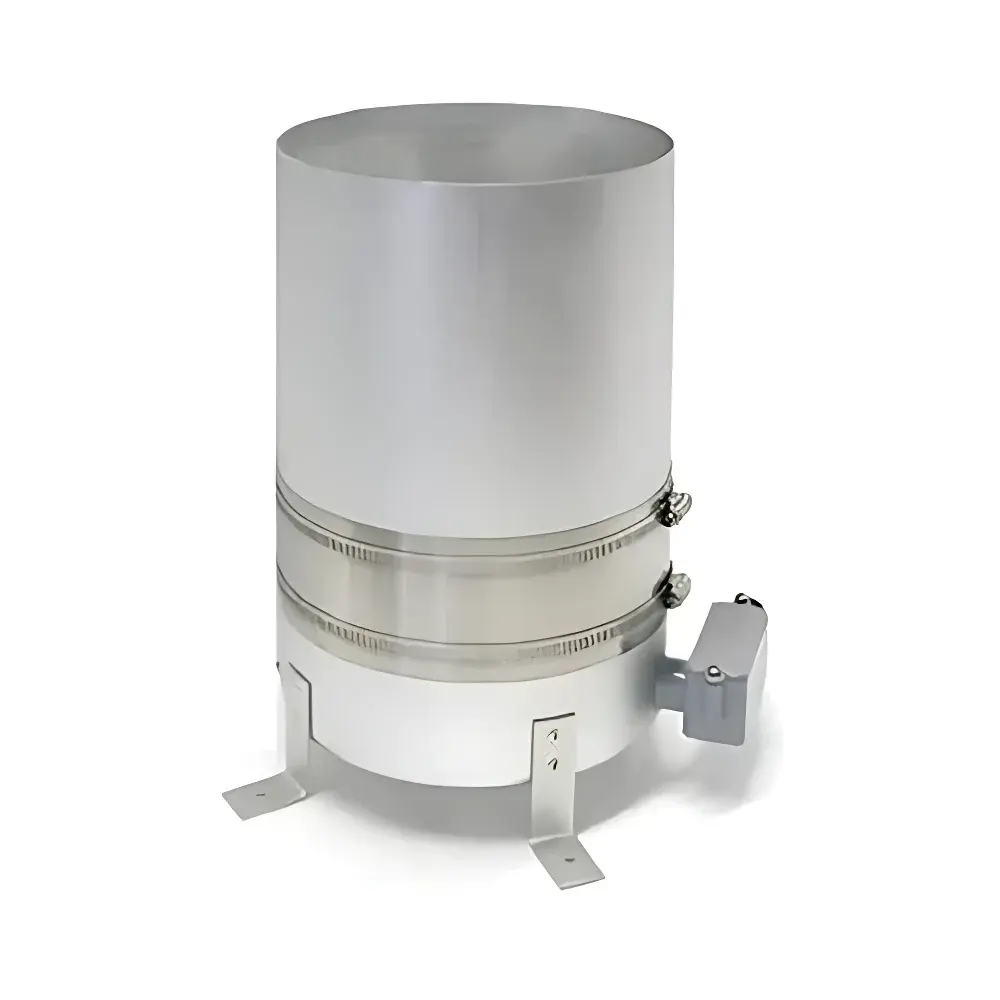
RainWise PG/H Heated Tipping Bucket Rain Gauge
| Brand | RainWise |
|---|---|
| Origin | USA |
| Model | PG/H |
| Construction | Anodized aluminum housing, stainless steel components, low-surface-tension polymer tipping bucket |
| Heating | Integrated thermostatically controlled heater (activates below 1°C) |
| Switch Type | Reed switch |
| Output | Momentary closure pulse (< 0.1 s duration) |
| Resolution Options | 0.1 mm, 0.2 mm, or 0.25 mm per tip |
| Accuracy | ±0.5% at 12.5 mm/h rainfall rate |
| Dimensions | 21.9 cm diameter × 31.75 mm height |
| Compliance | Designed for continuous outdoor deployment in accordance with WMO Guide to Instruments and Methods of Observation (CIMO Guide), ISO 9060:2018 Class B performance expectations for precipitation measurement |
Overview
The RainWise PG/H Heated Tipping Bucket Rain Gauge is an engineered precision instrument designed for reliable, long-term quantitative measurement of liquid precipitation under challenging environmental conditions. It operates on the well-established tipping bucket principle: accumulated rainwater flows into a dual-chamber, low-adhesion polymer bucket mounted on a precision pivot. When the collected volume reaches the calibrated threshold—corresponding to a user-selectable resolution of 0.1 mm, 0.2 mm, or 0.25 mm—the bucket tips under gravity, emptying its contents and actuating a hermetically sealed reed switch. Each tip generates a clean, low-jitter digital pulse (< 0.1 s duration), enabling accurate accumulation and real-time calculation of rainfall intensity (mm/h). Critically, the integrated thermostatic heating system activates automatically when ambient temperature falls below 1°C, preventing ice formation, snow bridging, and rim freezing—common sources of undercatch in unheated gauges. This ensures metrological continuity across seasonal transitions and sub-zero operational environments without manual intervention.
Key Features
- Thermostatically regulated heating element with automatic activation below 1°C, maintaining consistent mechanical response and minimizing thermal hysteresis effects
- High-stability tipping mechanism fabricated from proprietary low-surface-tension polymer, reducing residual water retention and improving repeatability at low-intensity events
- Rugged enclosure combining anodized aluminum (corrosion-resistant, non-magnetic) and stainless steel hardware for extended service life in coastal, industrial, or high-UV exposure sites
- Integrated bubble level and standardized mounting interface compatible with RainWise Monopod series tripods and third-party NEMA TS-1 compliant poles
- Reed switch output provides galvanically isolated, ESD-hardened digital pulses suitable for direct interfacing with data loggers, SCADA systems, or IoT edge controllers without signal conditioning
- No moving parts beyond the tipping bucket—no motors, gears, or lubricants—ensuring maintenance-free operation over multi-year deployments
Sample Compatibility & Compliance
The PG/H is validated for measurement of natural rainfall only; it is not intended for snowmelt runoff, artificial irrigation, or non-atmospheric liquid discharge monitoring. Its mechanical design conforms to the geometric and functional recommendations outlined in the World Meteorological Organization (WMO) CIMO Guide (2022 edition), particularly Chapter 6 on Precipitation Measurement. While not certified to ISO 9060:2018 as a spectral radiometer, its tipping bucket performance aligns with Class B expectations for field-deployed rain gauges—specifically in terms of dynamic range (effectively unlimited accumulation), threshold sensitivity, and recovery time post-tip. The device meets UL 61010-1 requirements for electrical safety in measurement equipment and carries CE marking for EMC compliance (EN 61326-1). It supports GLP-aligned data integrity when paired with audit-trail-capable data acquisition systems.
Software & Data Management
The PG/H produces raw pulse-count data only—it does not embed firmware, onboard storage, or wireless transmission. Integration requires connection to an external data logger (e.g., Campbell Scientific CR1000X, Onset HOBO UX120, or equivalent) capable of counting TTL/CMOS-compatible digital inputs. RainWise provides open protocol documentation for pulse-to-rainfall conversion logic, including temperature-compensated calibration coefficients and tip-error correction algorithms for high-wind scenarios. When deployed within validated environmental monitoring networks, the PG/H’s pulse stream supports traceable data lineage under FDA 21 CFR Part 11 when logged via compliant systems featuring electronic signatures, audit trails, and secure user access controls.
Applications
- Automated weather stations (AWS) operated by national meteorological services, universities, and hydrological research programs
- Urban stormwater management systems requiring high-temporal-resolution precipitation input for real-time runoff modeling
- Agricultural irrigation scheduling platforms where sub-hourly intensity data informs evapotranspiration (ET) calculations
- Aviation weather observation (AWOS/ASOS) infrastructure meeting FAA AC 150/5220-16B siting and accuracy criteria
- Long-term climate monitoring networks (e.g., GCOS reference stations) requiring stable, drift-minimized mechanical transduction
- Calibration transfer sites supporting intercomparison studies between disdrometers, weighing gauges, and radar-derived QPE products
FAQ
Does the PG/H require regular recalibration?
No scheduled recalibration is specified by RainWise; however, annual verification against a traceable standard (e.g., NIST-traceable volumetric calibrator) is recommended per ISO/IEC 17025 guidelines for accredited environmental monitoring labs.
Can the heater be disabled or manually controlled?
The heating circuit is fully autonomous—no user-accessible override or manual enable/disable function is provided. Thermal activation is governed solely by the internal thermistor and solid-state controller.
Is the PG/H suitable for measuring snowfall?
It measures only liquid-equivalent precipitation. For solid-phase accumulation, a separate heated weighing gauge or snow depth sensor is required; the PG/H may underreport during mixed-phase events without supplemental instrumentation.
What is the maximum measurable rainfall intensity?
The mechanical tipping frequency limits sustained intensity to approximately 20 mm/min (1200 mm/h); beyond this, bucket inertia and drainage lag introduce systematic undercatch—consistent with industry-standard tipping bucket limitations.
How is wind-induced undercatch mitigated?
While no aerodynamic shield is integrated, the PG/H’s low-profile geometry and standardized mounting reduce turbulence effects. For installations in exposed locations, pairing with a WMO-recommended Alter-type wind shield is strongly advised to maintain ±4% measurement uncertainty at 8 m/s wind speed.