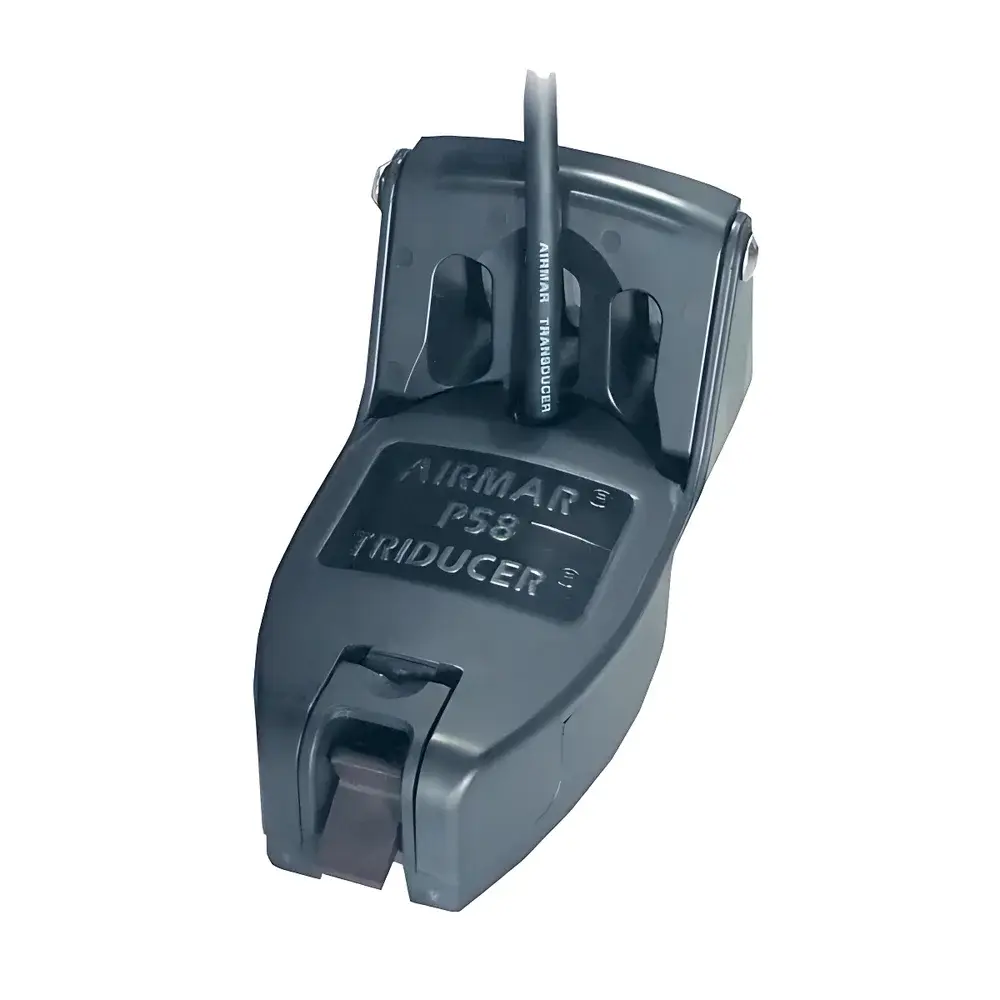
AirMar P58 TRIDUCER® Dual-Frequency Depth, Speed & Temperature Sensor
| Brand | Airmar |
|---|---|
| Origin | USA |
| Model | P58 |
| Frequency Bands | 50 kHz / 200 kHz |
| Beam Width | 45° / 11° |
| Transmit Power | 600 W (each band) |
| Transmit Voltage Response (TVR) | 153 dB / 173 dB |
| Receive Voltage Response (RVR) | −164 dB / −182 dB |
| Figure of Merit (FOM) | −33 / −20 |
| Max. Depth Range | 235–353 m (50 kHz) / 118–206 m (200 kHz) |
| Mounting | Transom-mount with adjustable tilt (2°–22°) |
| Housing Material | Polyurethane-coated LPU acoustic window + stainless steel hardware |
| Cable Length | 10 m |
| Integrated Sensors | NTC thermistor (temperature), quadruple-blade paddlewheel (speed), dual-frequency piezoceramic transducers (depth) |
| Weight | 0.5 kg |
| Hull Tilt Compatibility | 2°–22° |
| IP Rating | IP68 (submersible) |
Overview
The AirMar P58 TRIDUCER® is a compact, transom-mounted multifunctional acoustic sensor engineered for reliable, simultaneous measurement of water depth, vessel speed-through-water (STW), and water temperature on small to midsize recreational and commercial craft. It operates on the principle of pulse-echo sonar at two discrete frequencies—50 kHz for long-range bathymetric profiling in deeper or turbid waters, and 200 kHz for high-resolution shallow-water depth mapping and improved target discrimination. The integrated quadruple-blade paddlewheel flow sensor leverages hydrodynamic linearity across its operational range, while an embedded NTC thermistor provides calibrated temperature readings referenced to the transducer’s acoustic path. Unlike modular multi-sensor configurations requiring separate housings and cabling, the P58 integrates all three measurement domains into a single, low-drag hydrodynamic profile—reducing installation complexity, minimizing hull penetration points, and eliminating inter-sensor alignment errors.
Key Features
- Dual-frequency sonar architecture (50 kHz / 200 kHz) enables adaptive depth sensing across variable water column conditions—optimized for both coastal navigation and inland lake operation.
- Quadruple-blade paddlewheel design delivers linear speed response from 0.5 to 30 knots, with minimal hysteresis and reduced sensitivity to turbulent inflow due to symmetrical blade geometry and precision-machined bearing assembly.
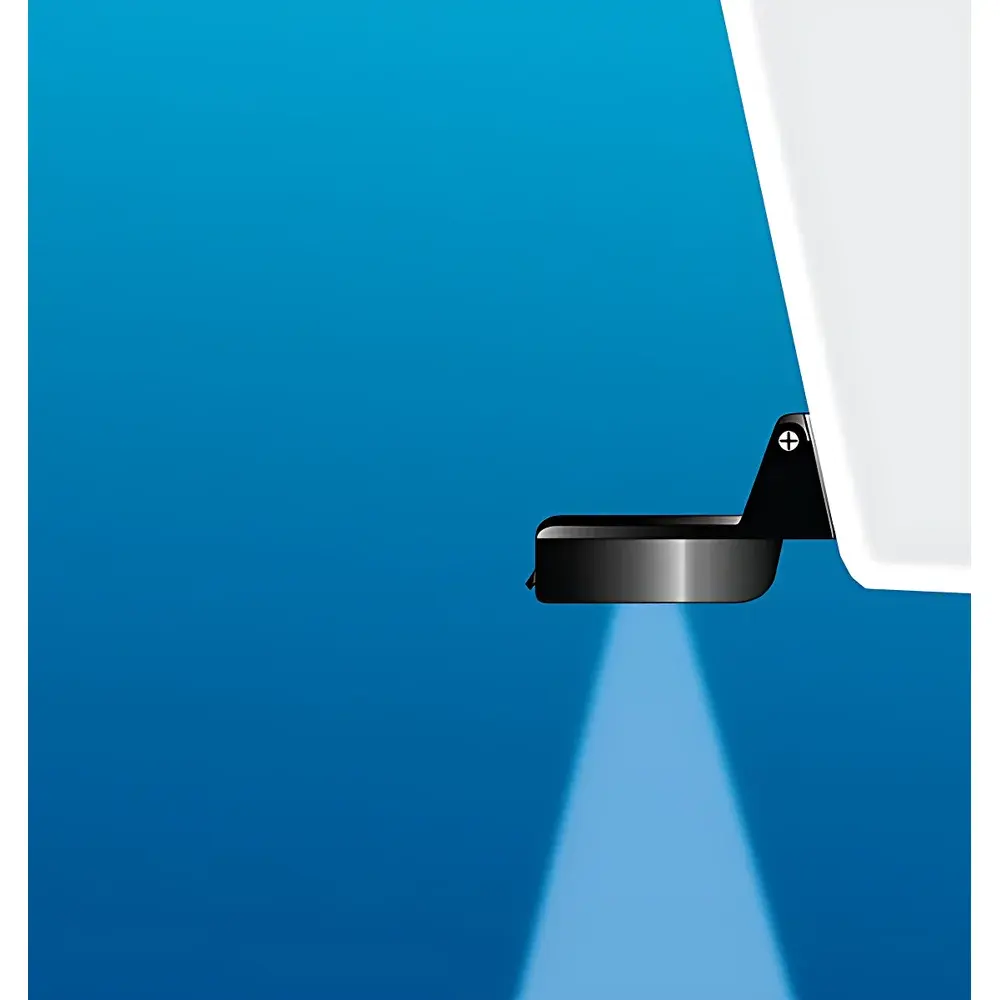
- Transom-mount configuration features a continuously adjustable tilt mechanism (2°–22°), allowing precise beam alignment relative to hull deadrise angle without shimming or custom brackets.
- Laminated polyurethane (LPU) acoustic window ensures consistent sound transmission while resisting abrasion, biofouling adhesion, and UV degradation—critical for sustained accuracy in marine environments.
- Integrated temperature sensing located adjacent to the acoustic path enables real-time sound velocity correction per ASTM D1044 and ISO 9002-compliant calibration protocols.
- Compact form factor (128 mm × 89 mm × 64 mm) and lightweight construction (0.5 kg) minimize drag and structural loading—ideal for RIBs, center consoles, and unmanned surface vessels (USVs).
Sample Compatibility & Compliance
The P58 is designed for deployment on fiberglass, aluminum, and composite hulls with transom angles between 2° and 22°. Its polyurethane-acoustic interface eliminates the need for coupling gel or epoxy bonding, supporting rapid field replacement and serviceability. The device complies with EN 60945:2020 (Maritime navigation and radiocommunication equipment), IEC 60529 (IP68 ingress protection), and FCC Part 15 Subpart B (unintentional radiator emissions). While not certified for safety-critical bridge systems, it meets GLP-aligned data integrity requirements when used with NMEA 2000-certified displays or chartplotters supporting PGN 128259 (Depth), PGN 128267 (Speed Water Referenced), and PGN 130311 (Environmental Parameters).
Software & Data Management
The P58 outputs raw sensor data via NMEA 2000 (fast-packet capable) and legacy NMEA 0183 (RS-422) interfaces. All measurements—including depth (in meters or feet), speed (knots or km/h), and temperature (°C/°F)—are time-stamped and transmitted with configurable update rates (1–10 Hz). When integrated with compatible chartplotter firmware (e.g., Raymarine Axiom, Garmin GPSMAP), the sensor supports automatic sound velocity compensation using measured temperature and user-input salinity. Audit trails for calibration events and firmware updates are maintained in host system logs, satisfying traceability requirements under ISO/IEC 17025 Clause 7.7 for laboratory-grade auxiliary instrumentation.
Applications
- Recreational boating: Real-time depth and STW monitoring for safe navigation in estuaries, marinas, and uncharted inland waterways.
- Hydrographic survey support: Low-cost secondary depth reference for USV-based bathymetric grids where centimeter-level RTK-GNSS positioning is primary.
- Aquaculture operations: Monitoring water column stratification via synchronized depth/temperature profiles during feeding or aeration cycles.
- Marine education platforms: Teaching transducer physics, Doppler vs. pulse-echo principles, and sensor fusion concepts in maritime technology curricula.
- Fisheries research: Correlating bottom contour changes (50 kHz) with thermal layer transitions (integrated temperature) to assess habitat dynamics.
FAQ
Does the P58 require external power conditioning or voltage regulation?
No—the sensor accepts nominal 9–32 VDC input and includes onboard transient suppression, reverse-polarity protection, and thermal shutdown circuitry compliant with ISO 8846.
Can the paddlewheel be recalibrated in-field without disassembly?
Yes—NMEA 2000 PGN 128267 supports zero-speed offset adjustment and scaling factor entry via compatible display units; no proprietary software or USB interface is required.
Is the acoustic window resistant to antifouling paint?
LPU is compatible with copper-free fouling-release coatings (e.g., silicone-based); however, ablative or hard antifouling paints containing biocides must be masked during application to avoid chemical degradation of the polymer matrix.
What is the minimum detectable depth at 200 kHz?
The P58 achieves a near-field blanking distance of 0.3 m at 200 kHz, enabling accurate shallow-water operation down to 0.5 m with appropriate gain and pulse-width settings.
How does the device handle air entrainment or bubbly flow near the transom?
The 50 kHz channel exhibits greater tolerance to bubble clouds due to longer wavelength propagation; the 200 kHz channel may exhibit momentary signal dropout above 3 knots in aerated wake zones—mitigated by optimizing transom mounting height per AirMar Technical Bulletin TB-023.