
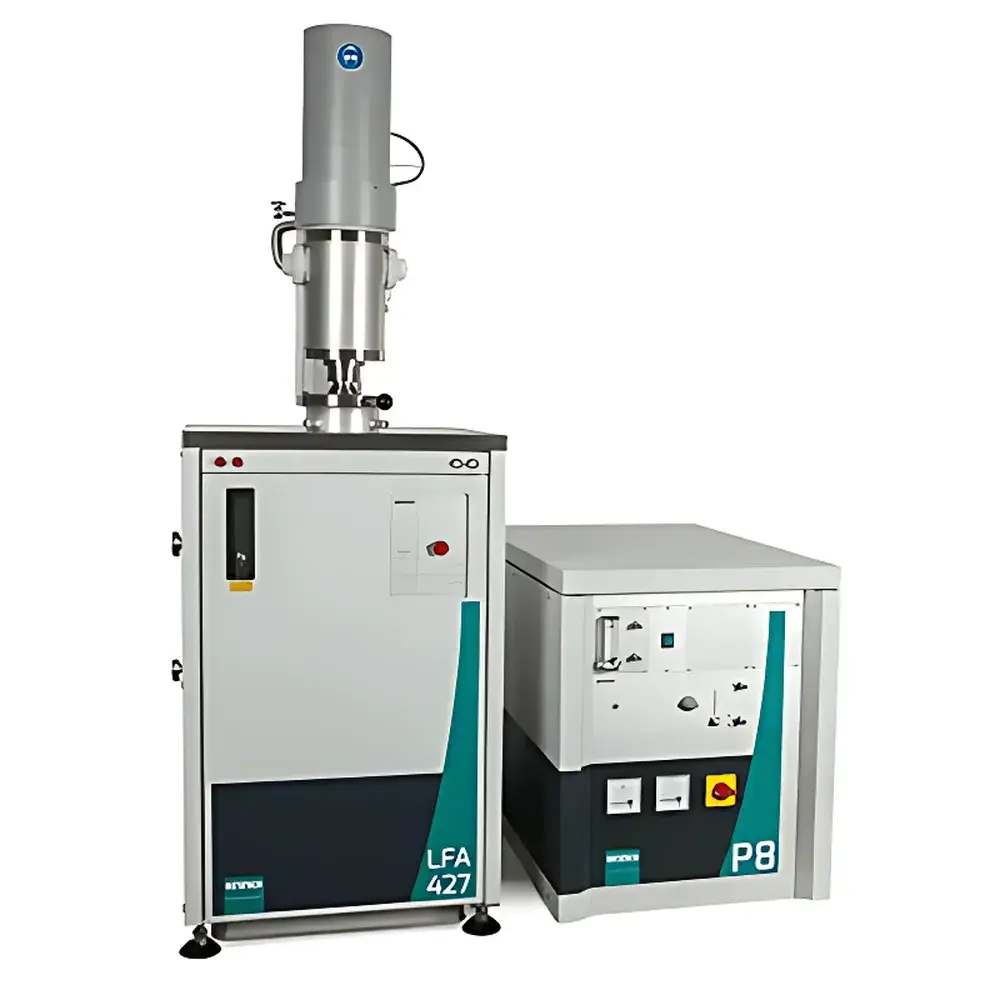
Netzsch LFA 427 Laser Flash Thermal Conductivity Analyzer
| Brand | Netzsch |
|---|---|
| Origin | Germany |
| Model | LFA 427 |
| Measurement Principle | Laser Flash Method (LFM) |
| Temperature Range | –120 °C to 2800 °C (depending on furnace configuration) |
| Laser Source | Nd:Glass, energy-adjustable pulse |
| Thermal Conductivity Range | 0.1–2000 W/(m·K) |
| Accuracy | ±3% |
| Repeatability | ±2% |
| Vacuum Level | ≤10⁻⁵ mbar |
| Sample Dimensions | Square: 8×8 mm, 10×10 mm |
| Circular | Ø6, Ø10, Ø12.7, Ø20 mm |
| Thickness | 0.1–6 mm |
| Sample Types | Solids, powders, thin films, liquids (with specialized holders) |
| Furnace Options | Dual-furnace capability |
| Pulse Control | Software-adjustable pulse width |
| Key Technology | PulseMapping™ |
| Atmosphere Control | Vacuum, inert (Ar, N₂), or reactive gases (e.g., O₂, CO₂) |
| Sample Holders | Graphite, alumina, silicon carbide |
| Dimensions (L×W×H) | 800 mm × 800 mm × 1900 mm |
Overview
The Netzsch LFA 427 Laser Flash Thermal Conductivity Analyzer is a high-precision, modular instrument engineered for the direct determination of thermal diffusivity (α) via the laser flash method (ASTM E1461, ISO 13826, DIN EN 821-2). From measured thermal diffusivity and independently determined specific heat capacity (cp) — typically acquired via DSC or supplied as literature data — thermal conductivity (λ) is calculated using the fundamental relation λ = α · ρ · cp, where ρ denotes material density. Designed for rigorous R&D and quality control environments, the LFA 427 supports extreme temperature operation from cryogenic conditions (–120 °C) up to ultra-high temperatures (2800 °C), enabled by interchangeable furnace modules including graphite, molybdenum, and tungsten configurations. Its robust architecture integrates high-energy Nd:Glass laser excitation with synchronized infrared detection, delivering traceable, reproducible results across metallic alloys, ceramics, composites, refractories, and advanced functional materials.
Key Features
- Dual-furnace mounting capability allows rapid switching between low- and high-temperature measurement configurations without system revalidation.
- Software-controlled, continuously adjustable laser pulse width ensures optimal energy delivery for diverse sample absorptivity and thermal effusivity profiles.
- PulseMapping™ technology enables spatially resolved analysis of heterogeneous samples, detecting localized thermal anomalies and enabling gradient-aware data interpretation.
- High-vacuum environment (≤10⁻⁵ mbar) minimizes convective and radiative heat losses, critical for accurate low-conductivity measurements and high-temperature stability.
- Modular sample holder system accommodates standardized geometries (square: 8×8 mm, 10×10 mm; circular: Ø6–Ø20 mm) and thicknesses from 0.1 mm to 6 mm, with chemically inert options (graphite, alumina, SiC) for aggressive atmospheres.
- Full atmosphere control supports vacuum, inert (Ar, N₂), oxidizing (O₂), and reducing (H₂/Ar) environments — essential for simulating service conditions in aerospace, nuclear, and energy applications.
Sample Compatibility & Compliance
The LFA 427 accepts solid discs, pressed powders, sintered compacts, thin films (with substrate correction protocols), and encapsulated liquids. Sample preparation follows ISO 22007-4 guidelines for geometry uniformity and surface finish. Instrument compliance includes adherence to ASTM E1461 (standard test method for thermal diffusivity), ISO 13826 (laser flash method for thermal diffusivity), and DIN EN 821-2 (advanced ceramics testing). Data acquisition and reporting support GLP/GMP audit trails per FDA 21 CFR Part 11 when integrated with validated software environments. All furnace modules are CE-marked and designed to meet IEC 61000-6-3 EMC requirements.
Software & Data Management
ThermAnalysis® software provides full instrument control, real-time pulse monitoring, automatic baseline correction, and multi-layer thermal modeling (e.g., for coated substrates or anisotropic systems). Raw thermogram data is stored in HDF5 format with embedded metadata (timestamp, operator ID, furnace ID, atmosphere log). Export options include CSV, Excel, and XML for LIMS integration. Batch processing, statistical trend analysis, and uncertainty propagation (per GUM framework) are built-in. Optional validation packages include IQ/OQ documentation templates aligned with pharmaceutical and aerospace QA standards.
Applications
- Thermal management material qualification for EV battery separators, heat spreaders, and power electronics substrates.
- High-temperature characterization of turbine blade coatings, nuclear fuel cladding, and refractory linings under simulated operational atmospheres.
- Development of thermoelectric materials requiring precise λ(Τ) curves across wide temperature spans.
- Quality assurance of additive-manufactured metal parts, where directional thermal anisotropy must be quantified.
- Research into phase-change materials (PCMs), where transient thermal response correlates directly with latent heat storage efficiency.
- Validation of computational models (e.g., finite element thermal simulations) using experimentally derived α(T) datasets.
FAQ
What temperature ranges are supported, and how are they achieved?
The LFA 427 achieves –120 °C to 2800 °C through interchangeable furnace modules: cryo-cooled copper furnaces for sub-ambient work, resistively heated graphite for up to 3000 °C in inert gas, and high-purity Mo/W furnaces for oxidizing or ultra-high-temp applications.
Can the system measure anisotropic or layered materials?
Yes — PulseMapping™ and optional radial thermography detectors enable lateral thermal profiling; combined with customized sample orientation stages, directional thermal conductivity (in-plane vs. cross-plane) can be resolved.
Is calibration traceable to national standards?
All thermal diffusivity calibrations use NIST-traceable reference materials (e.g., NIST SRM 735a, Pyroceram 9606), with certificate of calibration provided per IEC/ISO 17025-accredited procedures.
How is data integrity ensured in regulated environments?
ThermAnalysis® supports electronic signatures, role-based access control, automated audit logs, and 21 CFR Part 11-compliant electronic records when deployed on validated Windows Server platforms.
What sample preparation standards apply?
Samples must exhibit parallel, flat surfaces (Ra < 0.8 µm); thickness uniformity within ±1% is recommended. Powder samples require cold/isostatic pressing to minimize interfacial resistance artifacts.



