
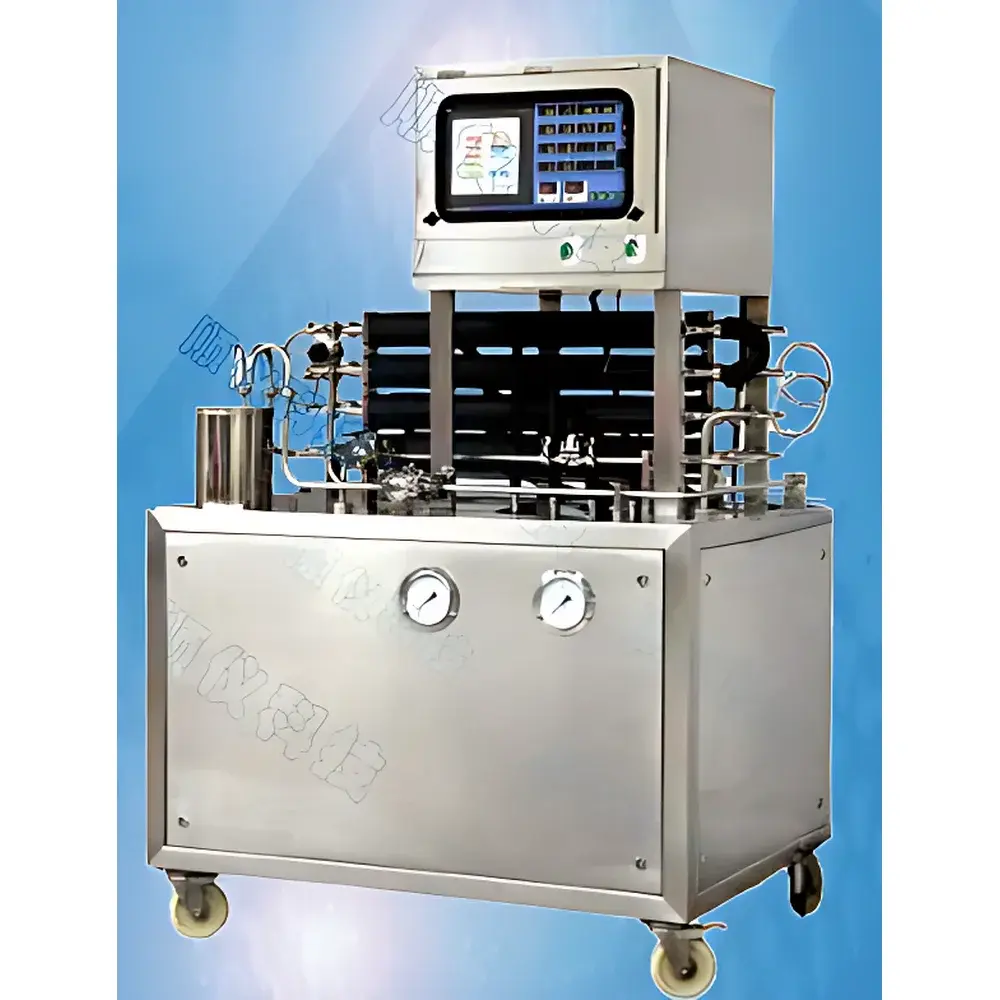
ST-20 Laboratory-Scale Ultra-High Temperature (UHT) Sterilization System
| Origin | Shanghai, China |
|---|---|
| Manufacturer Type | Authorized Distributor |
| Origin Category | Domestic (China) |
| Model | ST-20 |
| Pricing | Upon Request |
| Standard Throughput | 20 L/h (adjustable 5–40 L/h) |
| Minimum Batch Volume | 3–5 L |
| Max Sterilization Temp | 150 °C |
| Holding Time Options | 5 s / 15 s / 30 s (at 20 L/h) |
| Fill Temp Range | 20–90 °C |
| SIP Capability | Integrated |
| CIP Flow Rate | 400 L/h |
| Max Operating Pressure | 10 bar |
| Power Supply | 3-phase, 380 V, 10 kW |
| Dimensions (UHT Unit) | 1600 H × 1200 L × 950 W mm |
| CT-20 Aseptic Filling Chamber | HEPA Filtration ≥99.999% @ 0.3 µm, Class 100 (Fed. Std. 209E), 850 × 660 × 2100 mm (L×W×H), 220–240 V / 50 Hz / 0.25 kW |
Overview
The ST-20 Laboratory-Scale Ultra-High Temperature (UHT) Sterilization System is an engineered platform for thermal process development and validation of low-acid and acidified fluid foods, dairy analogs, plant-based beverages, nutritional emulsions, and functional drinks. Based on the principle of continuous-flow indirect heating via plate or tubular heat exchangers, the system subjects liquids to precisely controlled high-temperature, short-time (HTST) or ultra-high temperature (UHT) thermal profiles—enabling microbial inactivation (including spores of *Geobacillus stearothermophilus* and *Bacillus subtilis*) while minimizing thermal degradation of heat-labile components. Designed as a scalable research tool, it replicates critical unit operations found in commercial UHT lines—including product preheating, homogenization (optional), sterilization, cooling, and aseptic filling—within a footprint under 3 m². Its architecture supports direct correlation between lab-scale kinetic data and full-scale production parameters, satisfying requirements for process equivalence assessment per ISO 11133, ISO 20417, and FDA Guidance for Industry: “Process Validation: General Principles and Practices.”
Key Features
- Compact, mobile design with integrated frame and casters; requires only single-point electrical connection (380 V, 3-phase) and potable water supply
- PID-controlled thermal management with ±0.5 °C accuracy across all heating/cooling zones, validated per ASTM E2875 for thermal uniformity
- Full digital interface: real-time monitoring and adjustment of flow rate, temperature setpoints, holding time, pressure differentials, and energy consumption
- Built-in steam generator for on-demand saturated steam generation; optional chiller integration for rapid post-sterilization cooling
- Modular configuration supporting optional inline homogenization (pre- or post-sterilization) and sterile filtration (0.22 µm)
- Validated SIP (Steam-in-Place) and CIP (Clean-in-Place) cycles compliant with ASME BPE-2022 standards for hygienic system design
- Pressure-rated construction up to 10 bar, suitable for viscous fluids (up to 500 mPa·s at 20 °C) and particulate-containing formulations
Sample Compatibility & Compliance
The ST-20 accommodates aqueous, oil-in-water, and water-in-oil systems—including milk, soy beverage, juice blends, protein-fortified drinks, and probiotic suspensions—with viscosity ranges from 1 to 500 mPa·s and particle sizes up to 200 µm. All wetted surfaces are electropolished AISI 316L stainless steel (Ra ≤ 0.4 µm), passivated per ASTM A967, and certified for food contact compliance (EC 1935/2004, FDA 21 CFR 178.3570). The CT-20 Aseptic Filling Module maintains ISO Class 5 (Federal Standard 209E Class 100) environment via dual-stage HEPA filtration (99.999% efficiency at 0.3 µm), laminar airflow control, and UV-C sterilization of internal surfaces. Both units support audit-ready electronic records meeting FDA 21 CFR Part 11 requirements when paired with validated third-party SCADA software.
Software & Data Management
Data acquisition is performed via embedded PLC (Siemens S7-1200 series) with OPC UA server functionality, enabling seamless integration into existing laboratory informatics systems (LIMS) or MES platforms. All process variables—including thermocouple readings (Type T, Class A), Coriolis mass flow output, pressure transducer signals, and actuator positions—are sampled at 10 Hz and timestamped with UTC synchronization. Raw datasets export in CSV or HDF5 format; trend visualization, deviation reporting, and batch summary PDF generation are supported through the optional ST-Control Suite v3.x. Audit trails record user logins, parameter changes, alarm events, and cycle execution history with immutable SHA-256 hashing—fully traceable for GLP/GMP-regulated studies.
Applications
- Thermal stability screening of novel stabilizers, emulsifiers, and pH-sensitive bioactives (e.g., vitamins, enzymes, peptides)
- Determination of D-value and z-value for target microorganisms under defined time–temperature profiles
- Shelf-life prediction modeling (e.g., Arrhenius-based kinetics) using accelerated storage trials with microbiological, physicochemical, and sensory endpoints
- Process mapping for regulatory submissions (e.g., USDA-FSIS, EFSA, Health Canada) requiring demonstration of commercial sterility
- Development of aseptic packaging protocols for pouches, PET bottles, cartons, and glass containers
- Training platform for food science curricula and industrial technician certification programs
FAQ
Can the ST-20 be used for acidified products (pH < 4.6)?
Yes—the system supports both low-acid (pH ≥ 4.6) and acidified product processing, with thermal profiles configurable to meet FDA 21 CFR Part 113 (acidified foods) or Part 119 (juice HACCP) requirements.
Is validation documentation provided with the system?
Each ST-20 ships with Factory Acceptance Test (FAT) reports, IQ/OQ protocol templates aligned with ASTM E2500, and calibration certificates for all critical sensors traceable to NIST standards.
What is the minimum viable batch volume for method development?
The system operates reliably down to 3–5 L total system holdup volume, enabling statistically robust trials without excessive raw material consumption.
Does the CT-20 chamber support automated cap sealing?
Yes—integrated servo-driven capping modules are available for screw caps, induction seals, and aluminum foil lidding, synchronized with fill volume and conveyor speed.
Can historical batches be reprocessed using stored parameter sets?
All executed cycles are archived with full metadata; users may reload and replay any prior configuration with one-click recall, ensuring inter-batch reproducibility.



