
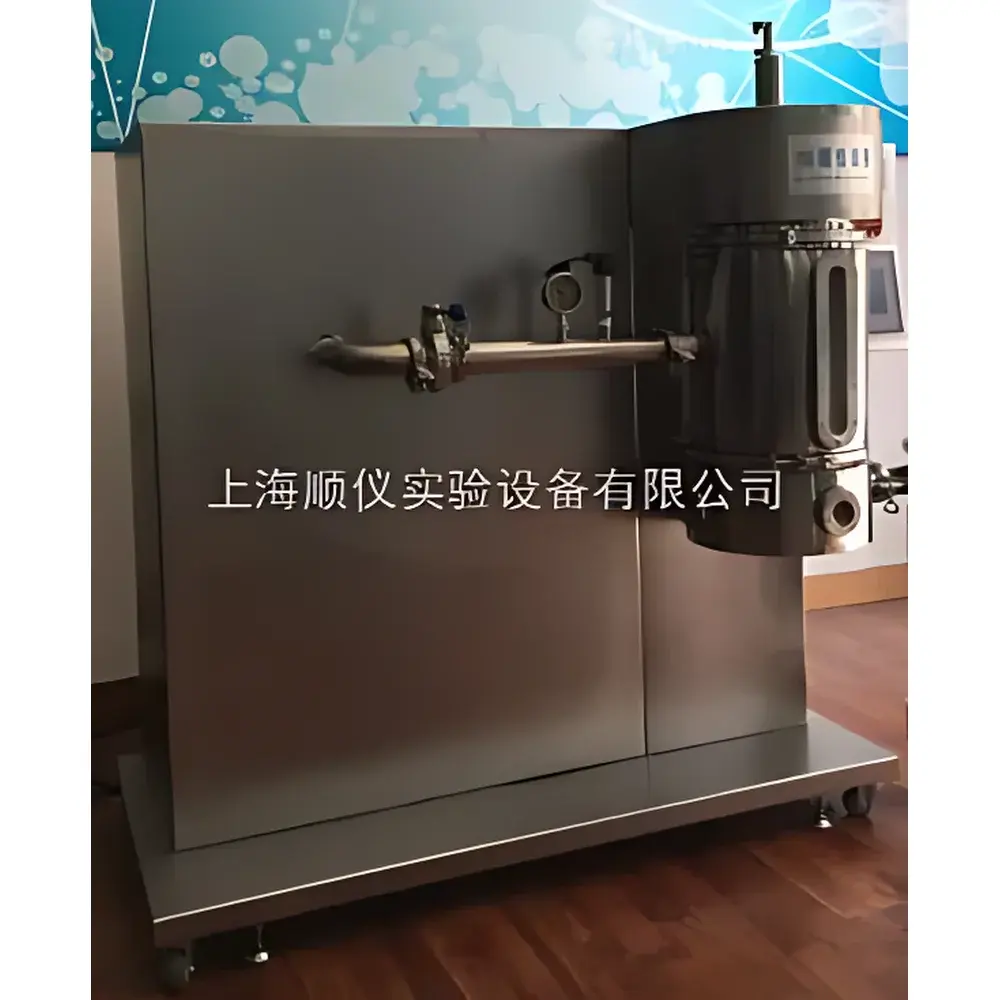
SP-300000 High-Low Temperature Spray Freeze Dryer
| Origin | Shanghai, China |
|---|---|
| Manufacturer Type | Authorized Distributor |
| Origin Category | Domestic (PRC) |
| Model | SP-300000 |
| Price Range | USD 28,000–42,500 |
| Processing Capacity | 30–1000 mL per batch |
| Spray Freeze Temperature | ≤ −15 °C |
| Cold Trap Temperature | ≤ −60 °C |
| Ultimate Vacuum Pressure (Empty Chamber) | < 20 Pa |
| Spray Pressure Range | 2–5 bar (adjustable) |
| Compressed Air Supply | Built-in oil-free air compressor (4.2 m³/h, 0.2 kW, noise < 50 dB(A)) |
| Drying Air Flow Rate | 0–330 m³/h (max), max static pressure 686 Pa |
| Jet Cleaner (Needle Probe) Frequency | Adjustable, integrated 2.3 bar air supply |
| Refrigeration System | Internal air-cooled hermetic compressor |
| Vacuum Connection | Standard ISO-KF 25/40 flange |
| Control Interface | 7-inch color LCD touchscreen, bilingual (English/Chinese), real-time display of drying chamber temperature, peristaltic pump speed, fan frequency, needle probe frequency, and chamber pressure |
| Power Supply | 9 kW, 380 V, 50 Hz |
| Dimensions (L×W×H) | 1150 × 770 × 1350 mm |
| Dual-Mode Capability | Upgradable to conventional hot-air spray dryer configuration |
Overview
The SP-300000 High-Low Temperature Spray Freeze Dryer is an integrated laboratory-scale system engineered to combine the rapid atomization of spray drying with the low-temperature preservation principles of lyophilization. Unlike conventional spray dryers that rely on thermal evaporation at elevated inlet temperatures (typically >100 °C), this instrument performs simultaneous cryogenic atomization and vacuum-assisted sublimation—enabling moisture removal from thermolabile, viscous, or sugar-rich solutions without denaturation or Maillard degradation. The process begins with controlled atomization of feedstock into fine droplets within a chilled drying chamber (<−15 °C), followed by rapid freezing upon contact with cold surfaces or ambient cryo-air. Subsequent primary drying occurs under high vacuum (<20 Pa) via radiant and conductive heat transfer, allowing ice to sublime directly from solid to vapor phase while preserving native conformational integrity. This hybrid methodology bridges critical gaps between traditional spray drying (high throughput but poor stability for biologics) and standard freeze-drying (excellent stability but slow, batch-limited, and prone to collapse). The SP-300000 is designed for reproducible, scalable process development in compliance with GLP-aligned laboratory practices.
Key Features
- Integrated dual-mode architecture: factory-configured for spray freeze-drying; optionally upgradable to standard hot-air spray drying via hardware/software reconfiguration—supporting comparative process studies and formulation screening.
- Self-contained refrigeration: air-cooled hermetic compressor system achieves cold trap temperatures ≤−60 °C and maintains consistent spray zone cooling at ≤−15 °C—eliminating external chiller dependency.
- Bilingual 7-inch capacitive touchscreen interface with real-time monitoring of nine critical parameters: drying chamber temperature, peristaltic pump rotational speed (0.1–200 rpm), fan frequency (0–60 Hz), needle probe actuation frequency (0–5 Hz), and absolute chamber pressure (digital Pirani gauge).
- Built-in oil-free scroll air compressor (4.2 m³/h, <50 dB(A)) supplies clean, particle-free compressed air for both nozzle atomization and automated needle clearing—ensuring sterility-critical compatibility and eliminating external air line contamination risks.
- Safety interlocked control logic: heater activation is physically inhibited until fan and refrigeration systems confirm stable operation—preventing thermal runaway or ice melt during vacuum ramp-up.
- Modular vacuum manifold with ISO-KF 25/40 quick-release flanges enables tool-free disassembly of drying chamber, cold trap, and vacuum pump interface—facilitating cleaning, maintenance, and GMP-compliant residue verification.
- Dual-stage airflow management: adjustable axial fan (0–330 m³/h, 686 Pa max static pressure) coupled with regulated cryo-air injection ensures uniform droplet trajectory, minimized wall deposition, and enhanced powder recovery (>85% typical for aqueous extracts).
Sample Compatibility & Compliance
The SP-300000 accommodates a broad spectrum of challenging feedstocks—including aqueous herbal extracts (e.g., Salvia miltiorrhiza, Ginkgo biloba), protein-containing suspensions (monoclonal antibody formulations, vaccine adjuvants), high-Brix fruit juices (≥65°Bx), polymeric nanosuspensions (PLGA, chitosan), and enzyme-loaded microparticles. Its sub-zero atomization environment suppresses caramelization and hydrolytic cleavage in sucrose- or lactose-based matrices, enabling direct conversion of sticky, low-glass-transition (Tg) liquids into free-flowing, spherical microgranules (D50 ≈ 10–50 µm, tunable via pump speed and airflow). All wetted components are electropolished 316L stainless steel or food-grade PTFE-lined; surface finish Ra ≤ 0.4 µm supports cleaning validation per ASTM E2500 and EU Annex 15. Vacuum and temperature logging comply with FDA 21 CFR Part 11 requirements when paired with optional audit-trail-enabled software.
Software & Data Management
The embedded control firmware records all operational parameters at 1-second intervals to internal non-volatile memory (16 GB) and supports export via USB 2.0 to CSV or Excel-compatible formats. Optional PC-based data acquisition software provides synchronized time-series visualization, alarm event tagging (e.g., pressure excursion >50 Pa), and batch report generation compliant with ALCOA+ principles (Attributable, Legible, Contemporaneous, Original, Accurate, Complete, Consistent, Enduring, Available). Raw datasets include timestamped metadata (operator ID, batch number, ambient lab conditions) and are digitally signed to prevent post-hoc modification—meeting ICH-GCP and ISO/IEC 17025 traceability mandates.
Applications
- Rapid stabilization of labile biopharmaceuticals: monoclonal antibodies, recombinant enzymes, viral vectors, and mRNA-LNP complexes—retaining ≥92% activity post-drying vs. lyophilized controls.
- Preformulation screening of natural product extracts: conversion of hygroscopic, amorphous herbal concentrates into stable, inhalable or orally disintegrating powders without excipient dilution.
- Functional food ingredient development: encapsulation of probiotics, anthocyanins, or omega-3 oils into matrix-protected microparticles with controlled release profiles.
- Materials science: synthesis of uniform ceramic precursors (e.g., LiFePO₄ nanoparticles), MOF composites, and stimuli-responsive polymer microparticles for additive manufacturing feedstocks.
- Academic research: kinetic modeling of ice nucleation dynamics, mass transfer limitations in frozen droplets, and structure–function relationships in dried biomacromolecules.
FAQ
What types of solvents are compatible with the SP-300000?
Aqueous solutions are fully supported; low-boiling organic solvents (e.g., acetone, ethanol) require optional explosion-proof configuration and solvent recovery add-on module.
Can the system handle highly viscous feeds (e.g., >500 cP)?
Yes—via pre-chilling to 2–5 °C and use of the integrated ultrasonic-assisted nozzle (optional accessory), enabling stable atomization of methylcellulose or alginate solutions up to 1200 cP.
Is GMP documentation available for installation qualification (IQ) and operational qualification (OQ)?
Yes—factory-supplied IQ/OQ protocols, calibration certificates (NIST-traceable pressure and temperature sensors), and FAT reports are provided with each unit.
What maintenance intervals are recommended for the compressor and vacuum pump?
Compressor oil and filter replacement every 3,000 operating hours; vacuum pump oil change every 500 hours or per manufacturer specifications (Edwards RV8 or equivalent).
Does the system support remote monitoring via Ethernet or Wi-Fi?
Standard Ethernet port enables Modbus TCP integration with building SCADA or LIMS; Wi-Fi capability requires optional industrial-grade wireless adapter (IEEE 802.11ac, WPA3-Enterprise).



