
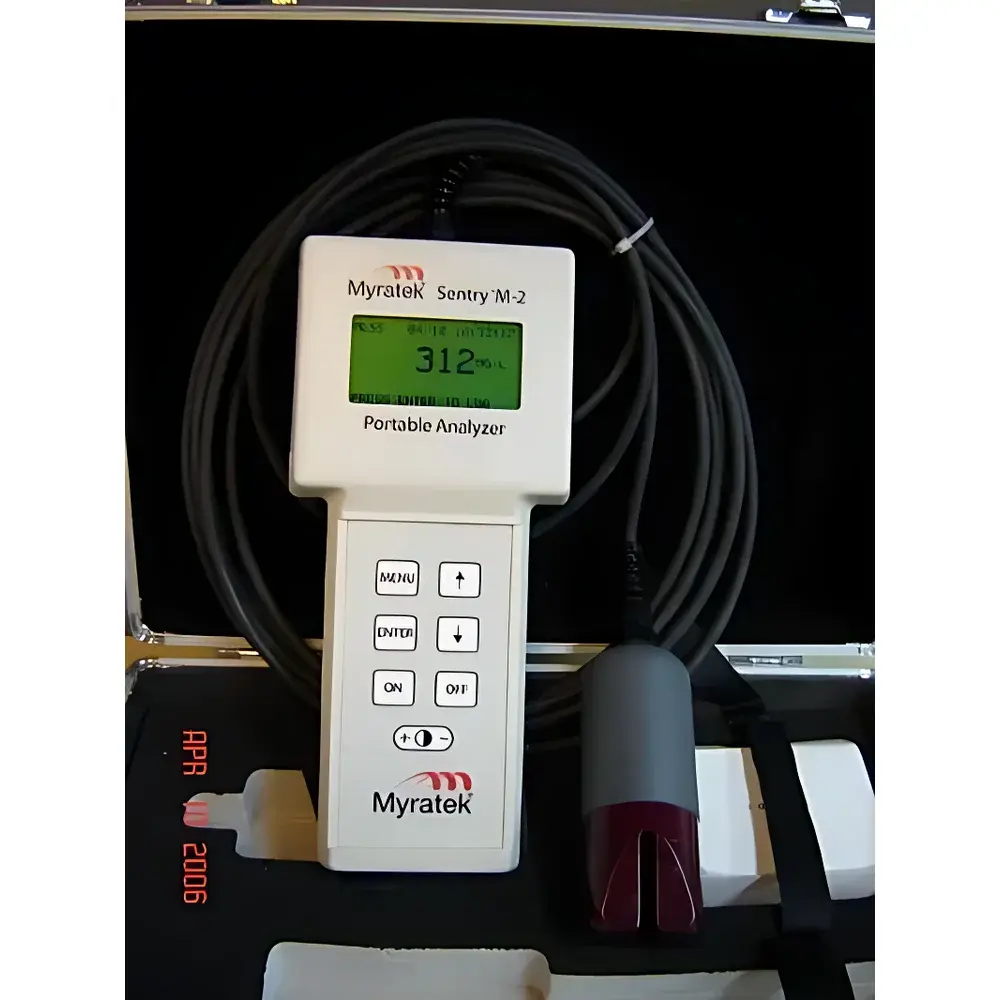
Myratek Portable SS Sentry M-2 Suspended Solids Analyzer
| Brand | Myratek |
|---|---|
| Origin | USA |
| Model | Portable SS Sentry M-2 |
| Instrument Type | Portable |
| Measurement Range | 0–30,000 mg/L (or 0–1,500 mg/L selectable) |
| Accuracy | ±3% of reading or ±20 mg/L, whichever is greater |
| Sensitivity | 1 mg/L (≤1,000 mg/L), 10 mg/L (1,001–9,999 mg/L), 100 mg/L (≥10,000 mg/L) |
| Repeatability | ±0.5% |
| Drift | <1% per year |
| Operating Temperature | 0–65°C |
| Probe Diagnostic | Automatic self-diagnostic |
| Output | RS-232 serial interface |
| Data Storage | 50 records with timestamp |
| Display | UV-resistant graphical LCD with adjustable backlight contrast |
| Sensor Cable Length | 6.0 m |
| Ambient Operating Conditions | –20 to +70°C, 0–100% RH |
| Enclosure Rating | IP66 |
| Housing Materials | Epoxy, polyurethane, PVC |
| Maximum Pressure Rating | 100 PSI |
| Shipping Weight | ~1.8 kg |
Overview
The Myratek Portable SS Sentry M-2 Suspended Solids Analyzer is a field-deployable optical turbidimetric instrument engineered for real-time, in-situ quantification of total suspended solids (TSS) in aqueous environments. It operates on the principle of infrared (IR) light absorption—employing a single-beam, dual-wavelength IR emitter and detector pair—to minimize interference from colored dissolved organic matter (CDOM), chlorophyll, and other chromophores commonly present in wastewater, surface water, and activated sludge streams. Unlike traditional gravimetric TSS methods (e.g., EPA Method 160.2 or ISO 11923), which require laboratory filtration, drying, and weighing, the M-2 delivers rapid, operator-independent measurements with traceable calibration stability. Its microprocessor-based architecture supports two interchangeable optical sensor configurations—one optimized for low-range clarity (0–1,500 mg/L) in secondary effluent or drinking water pre-filtration, and another for high-range robustness (0–30,000 mg/L) in mixed liquor, return activated sludge (RAS), and primary clarifier sludge blankets.
Key Features
- Infrared optical sensing with temperature-compensated emitter output to maintain measurement integrity across 0–65°C process temperatures
- Auto-diagnostic probe health monitoring—including LED intensity verification, photodetector response validation, and cable continuity checks
- Backlit, UV-stabilized graphical LCD with user-adjustable contrast for legibility under direct sunlight or low-light field conditions
- Integrated real-time clock (RTC) with date/time stamping for all stored readings—enabling chronological trend analysis without external synchronization
- IP66-rated rugged enclosure constructed from epoxy-coated aluminum, polyurethane elastomer seals, and chemical-resistant PVC housing—validated for outdoor deployment and splash-prone environments
- Rechargeable lithium-ion battery system supporting >12 hours of continuous operation; includes low-battery warning and graceful shutdown protocol
- RS-232 serial interface compliant with EIA/TIA-232-F standards for direct connection to laptops, data loggers, or SCADA front-end processors
Sample Compatibility & Compliance
The M-2 is validated for use across diverse water matrices including municipal wastewater influent/effluent, aerated bioreactors, anaerobic digesters, stormwater runoff, river and reservoir sampling points, and potable water treatment plant clarification basins. Its IR-based optical design conforms to ASTM D3921–22 (Standard Practice for Determination of Total Suspended Solids in Water by Optical Methods) and aligns with performance criteria outlined in US EPA Guidance Document OW-2021-003 for field-deployable TSS surrogates. While not a replacement for regulatory-grade gravimetric analysis in compliance reporting, the instrument meets GLP-aligned operational requirements for process optimization, alarm triggering, and trending—particularly where rapid feedback is critical to clarifier control, sludge blanket depth monitoring, or membrane bioreactor (MBR) fouling mitigation. Calibration traceability follows NIST-traceable standards via certified suspension standards (e.g., Formazin or AMCO AEPA-1).
Software & Data Management
Data acquisition and configuration are managed through Myratek’s proprietary PC utility software, compatible with Windows 10/11 (64-bit) and requiring no administrative privileges. The application enables full bidirectional communication: uploading custom calibration curves (up to four independent points per range), downloading timestamped datasets (including raw analog counts, compensated absorbance values, and derived TSS concentrations), and exporting CSV-formatted files compatible with LIMS, Excel, or statistical process control (SPC) platforms. All stored records include metadata—probe ID, operator tag, location code, ambient temperature, and measurement duration—supporting audit readiness under FDA 21 CFR Part 11 when deployed in GMP-regulated utilities or pharmaceutical water systems. Memory retention persists during battery replacement or power loss due to non-volatile EEPROM storage.
Applications
- Real-time monitoring of mixed liquor suspended solids (MLSS) in activated sludge processes to support F/M ratio adjustments and aeration control
- Sludge blanket profiling in rectangular or circular clarifiers using vertical probe profiling kits (optional accessory)
- Performance verification of tertiary filtration systems and membrane modules prior to disinfection
- Stormwater quality assessment at outfall points to detect illicit discharges or sediment resuspension events
- Field validation of online fixed-mount TSS analyzers during commissioning or routine QA/QC audits
- Academic and research applications involving nutrient loading studies, sediment transport modeling, and wetland hydrology surveys
FAQ
Is the M-2 suitable for drinking water applications?
Yes—when configured with the low-range sensor (0–1,500 mg/L), it meets sensitivity requirements for turbidity-correlated TSS estimation in filtered surface water supplies, though it does not replace nephelometric turbidity units (NTU) per EPA Method 180.1.
Can calibration be performed in the field without lab equipment?
Yes—using Myratek’s certified portable calibration standards and the onboard two-point calibration routine, users can perform traceable calibrations at site-specific matrix conditions.
Does the instrument comply with cybersecurity requirements for industrial networks?
The M-2 operates as a standalone data acquisition device with no embedded OS, Wi-Fi, or remote access capability—eliminating attack surface concerns; RS-232 communication is inherently isolated and non-networked.
What maintenance intervals are recommended for long-term reliability?
Optical windows require weekly cleaning with lint-free tissue and deionized water; annual verification of zero offset and span drift against reference standards is advised per ISO/IEC 17025-aligned QA protocols.
Is pressure compensation available for submerged deployments?
No—the sensor is rated for static head up to 100 PSI (≈69 m H₂O); for deep submersion (>10 m), optional pressure-rated housings and cable gland upgrades must be specified at time of order.







