
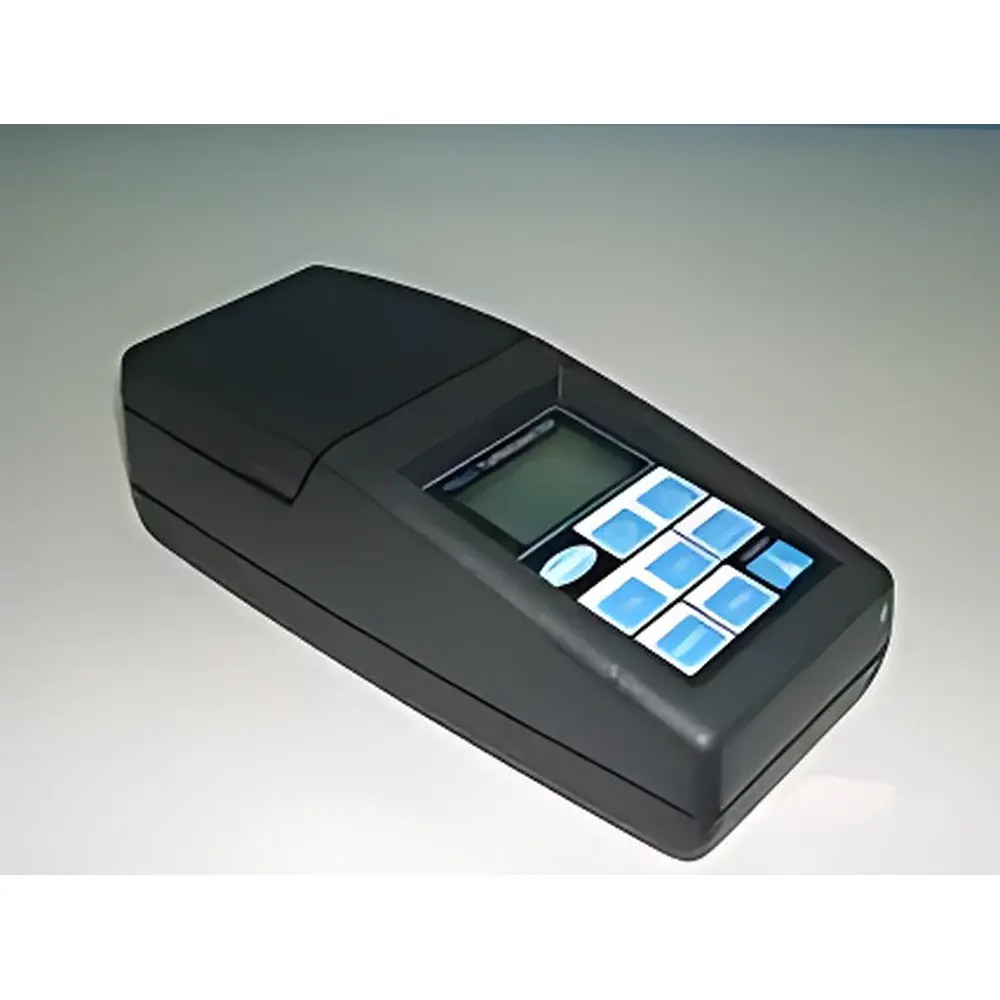
Hach 1900C Portable Turbidimeter
| Brand | Hach |
|---|---|
| Origin | USA |
| Model | 1900C |
| Measurement Principle | Nephelometric (90° light scattering) per USEPA Method 180.1 |
| Range | 0–1000 NTU (auto-ranging) |
| or manual ranges | 0–9.99 / 0–99.9 / 0–1000 NTU |
| Resolution | 0.01 NTU (at lowest range) |
| Accuracy | ±1% linearity error |
| Repeatability | ≤1% (0–1000 NTU) |
| Zero Drift | ±1.5% F.S. |
| Stability | ±1.5% F.S. |
| Power | 4 × AA alkaline batteries or optional AC adapter |
| Operating Temperature | 0–50 °C |
| Weight | 520 g |
| Compliance | Fully compliant with USEPA Method 180.1 |
| Optical System | Dual-detector ratiometric optical design with signal averaging |
Overview
The Hach 1900C Portable Turbidimeter is a field-deployable, EPA-compliant nephelometric instrument engineered for high-reliability turbidity measurement across diverse water quality applications. It operates on the principle of 90° scattered light detection—quantifying the intensity of light scattered by suspended particles in a water sample—as defined in U.S. Environmental Protection Agency (USEPA) Method 180.1. Unlike single-detector systems, the 1900C employs a patented ratiometric dual-optical-path architecture: one detector measures forward-scattered light while the other captures side-scattered (90°) light. The microprocessor continuously calculates their ratio, effectively compensating for color interference, lamp intensity drift, stray light, and minor variations in sample cell alignment. Signal averaging further mitigates transient fluctuations caused by particle settling or flow-induced turbulence during handheld or benchtop operation. Designed for robustness in variable environmental conditions, the 1900C delivers laboratory-grade precision without requiring temperature-controlled environments or dedicated power infrastructure.
Key Features
- Ratiometric dual-detector optical system compliant with USEPA Method 180.1 for traceable, regulatory-accepted measurements
- Auto-ranging capability (0–1000 NTU) with selectable fixed ranges (0–9.99 NTU, 0–99.9 NTU, 0–1000 NTU) to optimize resolution and dynamic response
- 0.01 NTU resolution at the lowest range—enabling sensitive detection of low-turbidity samples such as purified process water or post-filtration drinking water
- Integrated self-diagnostic firmware that monitors lamp output, detector response, battery voltage, and optical path integrity; alerts users via on-screen prompts for proactive maintenance
- Lightweight (520 g), ergonomic housing with IP67-rated sealing against dust and incidental water exposure—suitable for outdoor sampling, mobile labs, and routine plant-floor QC checks
- Four AA alkaline battery operation (typical >2,000 measurements per set) with optional AC adapter support for extended stationary use
Sample Compatibility & Compliance
The 1900C is validated for use with standard 25-mm round glass sample cells (included: two vials). Its optical design accommodates samples with moderate coloration (e.g., humic-stained surface waters) and non-uniform particle distributions without requiring chemical decolorization or filtration—provided particulate composition remains within the scope of Method 180.1 (i.e., non-absorbing, non-fluorescent, sub-micron to ~10 µm suspended solids). The instrument meets all performance criteria specified in USEPA Method 180.1, including zero stability, linearity, repeatability, and inter-laboratory reproducibility benchmarks. While not certified under ISO 7027, its measurement protocol aligns with the fundamental nephelometric principles referenced in ISO 7027-1:2016 for drinking water analysis. Data generated are suitable for regulatory reporting in U.S. public water systems subject to the Safe Drinking Water Act (SDWA) and wastewater discharge monitoring under NPDES permits.
Software & Data Management
The 1900C operates as a standalone, embedded-system instrument with no external software dependency. All calibration coefficients, date/time stamps, and measurement metadata are stored internally in non-volatile memory. Each reading includes automatic timestamping and range identification. While the device lacks Bluetooth or USB connectivity, its stable analog/digital architecture ensures long-term data integrity and immunity to electromagnetic interference—critical for GMP-aligned facilities where electronic records must remain tamper-evident and audit-ready. Calibration verification is performed using the supplied 4000 NTU formazin standard (100 mL), traceable to NIST SRM 2134. Users may implement internal SOPs requiring daily zero checks and weekly span verification—practices consistent with GLP documentation requirements and FDA 21 CFR Part 11 expectations for instrument qualification in regulated environments.
Applications
- Drinking water treatment: raw intake screening, coagulation/flocculation optimization, filter effluent monitoring, and distribution system integrity verification
- Wastewater treatment: primary clarifier performance, activated sludge health assessment, and tertiary filtration validation
- Industrial process water: boiler feedwater clarity control, semiconductor rinse water certification, and pharmaceutical purified water (PW) release testing
- Environmental field studies: lake/reservoir trophic status evaluation, stormwater runoff characterization, and sediment transport modeling support
- Recreational water safety: swimming pool and spa turbidity compliance per CDC Model Aquatic Health Code (MAHC) Chapter 5 guidelines
- Food & beverage QA: carbonated soft drink clarity, brewing wort filtration confirmation, and bottled water final product release
FAQ
Does the 1900C require annual factory recalibration?
No. The 1900C is designed for user-performed calibration using the included 4000 NTU standard. Annual verification against an accredited secondary standard is recommended for ISO/IEC 17025 or regulatory audit readiness—but full recalibration is only necessary if diagnostic routines detect optical or electronic deviation beyond specification limits.
Can the 1900C measure samples below 0.01 NTU?
The instrument displays down to 0.01 NTU in its lowest range, but its stated resolution does not imply validated accuracy at sub-0.05 NTU levels. For ultra-low turbidity applications (e.g., USP particle counts in injectables), a laser-based turbidimeter meeting ISO 7027 Class 1 specifications is recommended.
Is the 4000 NTU standard reusable?
Yes—when stored sealed, protected from light, and maintained at ambient temperature, the formazin suspension remains stable for up to 12 months post-opening. Always inspect for visible precipitation or discoloration before use.
How does the signal averaging function affect measurement time?
Signal averaging applies over three sequential 0.5-second acquisition cycles, resulting in a total measurement duration of ≤1 second—not 1 minute. The “under 1 minute” reference in legacy documentation refers to total operator workflow time (sample loading, measurement, recording), not instrument response latency.




