
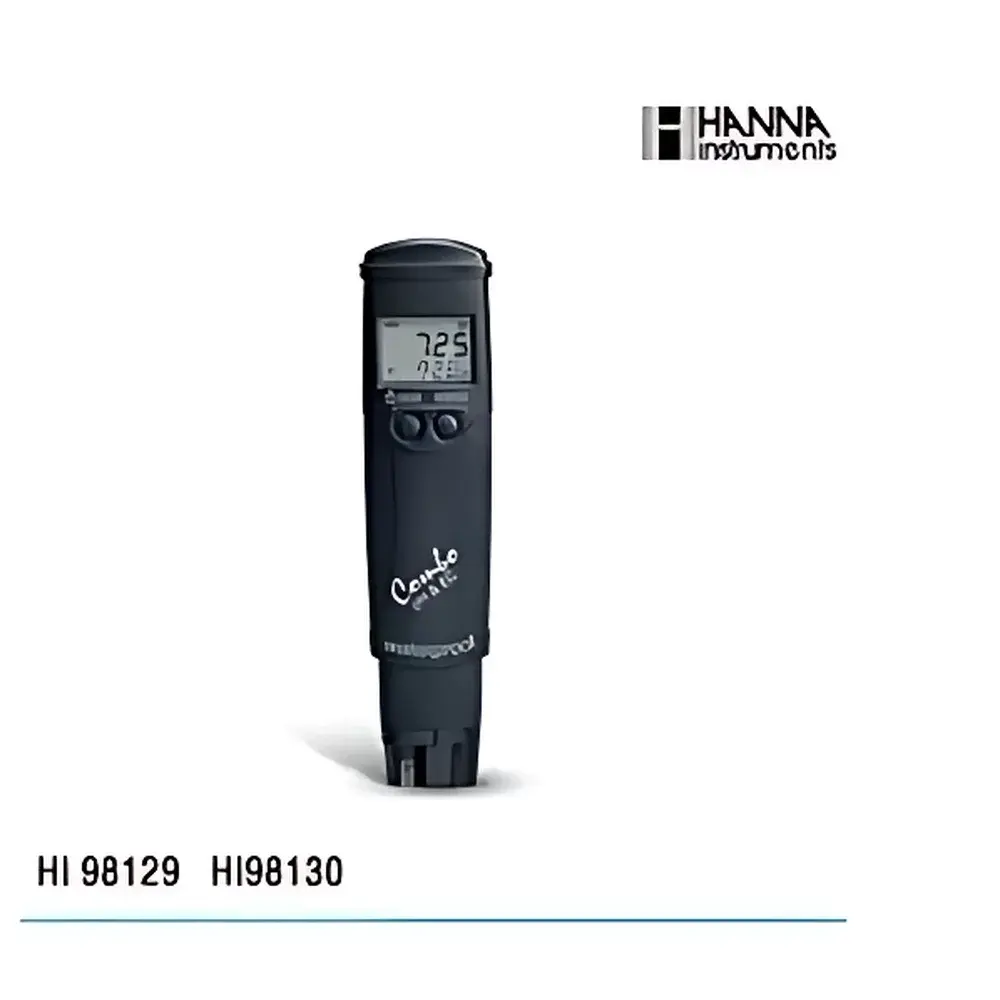
Hanna Instruments HI98129 / HI98130 Portable Multiparameter Pen Tester for pH, EC, TDS & Temperature
| Brand | Hanna Instruments |
|---|---|
| Origin | Italy |
| Model | HI98129 / HI98130 |
| pH Range | 0.00–14.00 pH |
| EC Range | 0–3999 µS/cm (HI98129) / 0.00–20.00 mS/cm (HI98130) |
| TDS Range | 0–2000 ppm (HI98129) / 0.00–10.00 ppt (HI98130) |
| Temperature Range | 0.0–60.0°C |
| pH Resolution | 0.01 pH |
| EC Resolution | 1 µS/cm (HI98129) / 0.01 mS/cm (HI98130) |
| TDS Resolution | 1 ppm (HI98129) / 0.01 ppt (HI98130) |
| Temp Resolution | 0.1°C / 0.1°F |
| pH Accuracy | ±0.05 pH |
| EC/TDS Accuracy | ±2% F.S. |
| Temp Accuracy | ±0.5°C |
| Calibration | Auto 1-/2-point pH |
| ATC | 0.0–60.0°C |
| Power | 4 × 1.5 V AAA batteries |
| IP Rating | IP67 |
| Dimensions | 163 × 40 × 26 mm |
| Weight | 100 g |
Overview
The Hanna Instruments HI98129 and HI98130 are rugged, field-deployable multiparameter pen testers engineered for simultaneous, high-reproducibility measurement of pH, electrical conductivity (EC), total dissolved solids (TDS), and temperature in aqueous samples. Based on potentiometric pH sensing, two-electrode AC conductivity measurement, and linear TDS conversion algorithms, these instruments deliver laboratory-grade accuracy in a handheld, waterproof form factor. Designed for routine quality control, environmental monitoring, hydroponics, aquaculture, and educational applications, the dual-model architecture addresses distinct operational needs: the HI98129 targets low-conductivity environments (e.g., freshwater, rainwater, nutrient solutions), while the HI98130 extends dynamic range for higher-salinity applications such as brackish water, irrigation runoff, or industrial process streams. Both models feature automatic temperature compensation (ATC) across 0.0–60.0°C, ensuring thermally corrected readings compliant with ISO 7888 and ASTM D1125 standards for conductivity reporting.
Key Features
- True multiparameter capability: single-device measurement of pH, EC, TDS, and temperature without manual probe swapping or external modules.
- Replaceable pH electrode (HI73127) with integrated temperature sensor and pull-out dialysis membrane—enabling rapid, tool-free electrolyte replenishment and extended sensor service life.
- Graphite-based EC/TDS sensor resistant to fouling by salts, organic residues, and colloidal particulates—minimizing drift and recalibration frequency in challenging matrices.
- IP67-rated housing certified for immersion up to 1 meter for 30 minutes—suitable for wet-lab, greenhouse, and outdoor field use under variable humidity and splash conditions.
- User-configurable TDS conversion factor (0.4–1.0) and β temperature coefficient (0.0–2.5%/°C) to align with sample-specific ionic composition and regulatory reporting requirements (e.g., USP , EPA Method 120.1).
- Auto-off after 8 minutes of inactivity; low-battery indicator; large backlit LCD with simultaneous parameter display and unit identification.
Sample Compatibility & Compliance
The HI98129/HI98130 is validated for use with aqueous solutions having total dissolved solids ≤20 g/L (HI98130) or ≤2 g/L (HI98129), pH 0–14, and temperatures between 0.0–60.0°C. It complies with CE marking directives (2014/30/EU EMC, 2011/65/EU RoHS), and its measurement methodology supports adherence to GLP documentation practices when paired with Hanna’s optional data logging accessories. While not FDA 21 CFR Part 11–certified as a standalone device, audit trails generated via connected software (e.g., HI92000) meet basic ALCOA+ data integrity principles for non-GMP environments. Calibration protocols follow traceable NIST-traceable buffer and standard solutions (HI7004L, HI7030L, HI7031L), enabling verification against ISO/IEC 17025–accredited reference materials.
Software & Data Management
Data export is supported via optional USB-to-serial adapter (HI92000 interface cable) and Hanna’s HI92000 Windows software. This platform enables real-time graphing, statistical analysis (mean, SD, min/max), customizable report generation (PDF/CSV), and timestamped calibration log archiving. The software enforces user-defined access levels and provides electronic signatures for QC personnel—facilitating compliance with internal SOPs and external audits. No cloud connectivity or mobile app integration is provided; all data remains locally controlled, satisfying data sovereignty requirements common in academic, municipal, and regulated industrial settings.
Applications
- Aquaculture & hydroponics: daily monitoring of nutrient solution pH stability, EC-driven osmotic balance, and ambient temperature effects on ion mobility.
- Environmental field screening: rapid assessment of stream, pond, or well water quality per EPA Region 10 protocols for baseline TDS and conductivity trends.
- Food & beverage processing: verification of rinse water conductivity post-CIP, brine concentration checks, and pH validation of cleaning agents.
- Education & vocational training: hands-on instruction in electrochemical fundamentals, calibration hierarchy, and matrix interference mitigation strategies.
- Facility maintenance: leak detection in cooling towers via sudden TDS spikes, or boiler feedwater pretreatment verification prior to RO membrane staging.
FAQ
What is the difference between HI98129 and HI98130?
The HI98129 is optimized for low-conductivity samples (0–3999 µS/cm); the HI98130 extends upper range to 20.00 mS/cm and reports TDS in ppt (g/L), making it suitable for saline or wastewater applications.
Can I calibrate pH and EC simultaneously?
No—pH and EC calibrations are independent procedures. pH requires two-point calibration using certified buffers; EC uses a single-point standard (HI7030L or HI7031L) at 1413 µS/cm or 12.88 mS/cm respectively.
Is the temperature sensor replaceable?
Temperature sensing is integrated into the pH electrode assembly (HI73127); replacement of the entire electrode restores full thermal compensation functionality.
Does this instrument meet ISO 5725 precision criteria?
Repeatability (within-run precision) is ≤±0.03 pH and ≤±1% EC under controlled lab conditions; reproducibility (between-operator, between-day) meets ISO 5725-2:2019 intermediate precision benchmarks for field-portable electrochemical sensors.
How often should I replace the pH electrode membrane?
The pull-out dialysis membrane should be refreshed every 2–3 months under continuous use or immediately upon visible clogging, drying, or calibration drift exceeding ±0.1 pH.




