
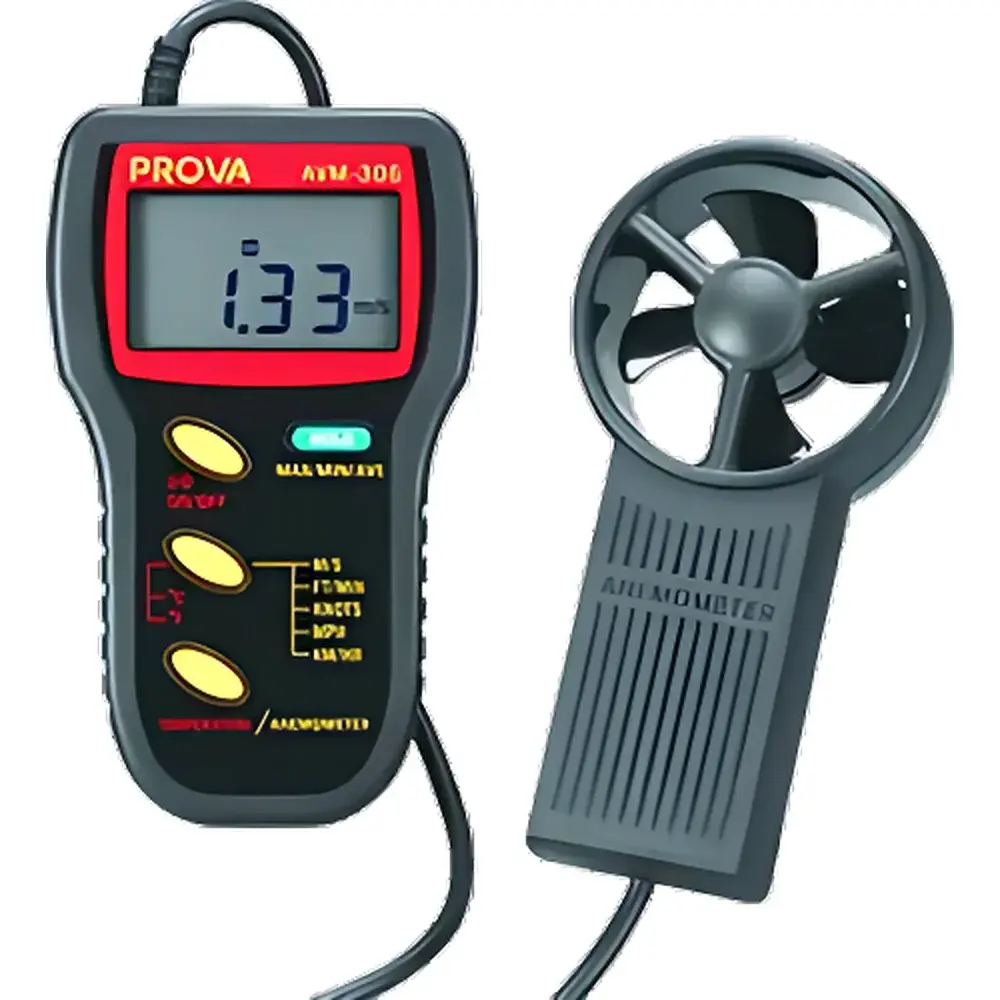
TES AVM-305 Digital Vane Anemometer with Integrated Air Temperature Measurement
| Brand | TES |
|---|---|
| Origin | Taiwan |
| Model | AVM-305 |
| Wind Speed Range | 0.0–45.0 m/s (0.0–100.0 mph, 0.0–88.0 knots, 0.0–160.0 km/h, 0.0–8800 ft/min) |
| Resolution | 0.01 m/s (selectable units) |
| Accuracy | ±3% ±0.2 m/s (threshold: 0.3 m/s) |
| Air Temperature Range | –5.0–60.0 °C / 32.0–140.0 °F |
| Temp Accuracy | ±1.0 °C / ±1.8 °F |
| Display | 4-digit LCD |
| Power | 2 × 1.5 V AA batteries (6 mA typical, ~200 h life) |
| Operating Temp | 0–50 °C (instrument), 0–60 °C (vane probe) |
| Humidity | <80% RH |
| Pressure Range | 500 mbar–2 bar |
| Dimensions (meter) | 78 × 130 × 40 mm |
| Dimensions (vane) | 66 × 132 × 29.2 mm |
| Weight | 250 g (with batteries) |
| Mounting | 1/4″–20 threaded port |
| Compliance | CE-marked, RoHS-compliant |
Overview
The TES AVM-305 is a handheld digital vane anemometer engineered for field and laboratory-grade air velocity and ambient temperature measurement in HVAC commissioning, indoor air quality (IAQ) assessments, cleanroom validation, fume hood performance testing, and environmental health & safety (EHS) audits. It employs a precision-calibrated axial vane sensor that rotates proportionally to airflow, converting rotational speed into linear wind velocity via microprocessor-based signal conditioning. The device operates on the principle of mechanical drag torque balance—where aerodynamic force on the calibrated vane induces rotation at a rate directly proportional to local airspeed—ensuring high reproducibility across turbulent and laminar flow regimes. Its dual-sensor architecture simultaneously acquires wind speed and dry-bulb air temperature, enabling real-time calculation of volumetric flow when paired with duct cross-sectional area input. Designed for operational robustness in variable environmental conditions, the AVM-305 meets industrial-grade reliability requirements while maintaining metrological traceability to NIST-traceable calibration standards.
Key Features
- Precision vane sensor with low-threshold response (0.3 m/s minimum detectable velocity) and ±3% ±0.2 m/s accuracy across full range
- Simultaneous real-time measurement of air velocity and ambient temperature (–5.0 to 60.0 °C)
- Multi-unit display with automatic conversion: m/s, ft/min, knots, km/h, mph
- 4-digit backlit LCD with dedicated indicators for data hold, min/max/avg tracking, and low-battery status
- Integrated statistical functions: real-time min, max, average, and instantaneous value lock
- Auto power-off after 10 minutes of inactivity to conserve battery life (typical 200-hour operation on two AA cells)
- RS-232C serial interface with included USB-to-RS232 adapter and PC software for data logging and export (CSV, TXT)
- 1/4″–20 threaded mounting port compatible with tripods, duct clamps, or fixed-position brackets
- IP54-rated enclosure for dust and splash resistance during portable use
Sample Compatibility & Compliance
The AVM-305 is optimized for measuring airflow in non-corrosive, particle-free gaseous environments—including ambient indoor air, supply/return ducts, ventilation grilles, and laminar flow hoods. It is not intended for high-velocity jet streams (>45 m/s), explosive atmospheres, or saturated/humidified airstreams exceeding 80% RH. The instrument complies with IEC 61000-4 electromagnetic immunity standards and carries CE marking under the EU EMC and RoHS Directives. While not certified to ISO/IEC 17025 as a standalone calibration standard, its factory calibration is performed against reference-grade anemometers traceable to national metrology institutes. For regulated applications requiring audit-ready documentation (e.g., HVAC validation per ASHRAE Standard 110 or ISO 14644-3), users may perform periodic verification using NIST-traceable reference sources and document results per internal GLP procedures.
Software & Data Management
The bundled Windows-compatible software enables real-time data streaming, time-stamped logging (up to 10,000 records), and post-acquisition analysis including trend plotting, statistical summary generation (mean, SD, CV%), and customizable report templates. All logged sessions include metadata: date/time stamp, unit selection, measurement mode (instant/min/max/avg), and ambient temperature reading. The software supports FDA 21 CFR Part 11–compatible audit trail configuration (when deployed on validated systems), including user login, session duration, parameter changes, and export history. Raw data exports are ASCII-formatted and fully interoperable with Excel, MATLAB, and LIMS platforms. Optional integration with PROVA 300XP thermal printer allows on-site hardcopy generation of measurement reports compliant with field service documentation requirements.
Applications
- HVAC system balancing and airflow verification per ASHRAE Guideline 12 and ISO 16813
- Cleanroom air change rate and uniformity mapping (ISO 14644-3 Class 5–8 environments)
- Fume hood face velocity validation (OSHA 1910.1200 and ANSI/AIHA Z9.5)
- Industrial ventilation surveying for OEL compliance (NIOSH Manual of Analytical Methods, Method 0600)
- Indoor air quality (IAQ) baseline studies and post-remediation verification
- Educational laboratory experiments in fluid mechanics and environmental engineering
- Building commissioning and retro-commissioning (RCx) airflow documentation
FAQ
What is the minimum measurable air velocity?
The AVM-305 has a detection threshold of 0.3 m/s; velocities below this value are displayed as “0.00” and are not quantified.
Can the device be used in high-humidity environments?
Operation is specified up to 80% relative humidity; prolonged exposure above this level may affect vane bearing longevity and temperature sensor drift.
Is calibration certificate included with purchase?
A factory calibration report is supplied; however, formal ISO/IEC 17025 calibration certificates require third-party accredited lab services.
Does the RS-232 interface support Modbus or other industrial protocols?
No—the interface uses proprietary ASCII command protocol; it does not natively support Modbus RTU or BACnet MS/TP.
How often should recalibration be performed?
Annual recalibration is recommended for critical applications; more frequent verification is advised after mechanical shock, extreme temperature exposure, or sustained operation near upper measurement limits.







