
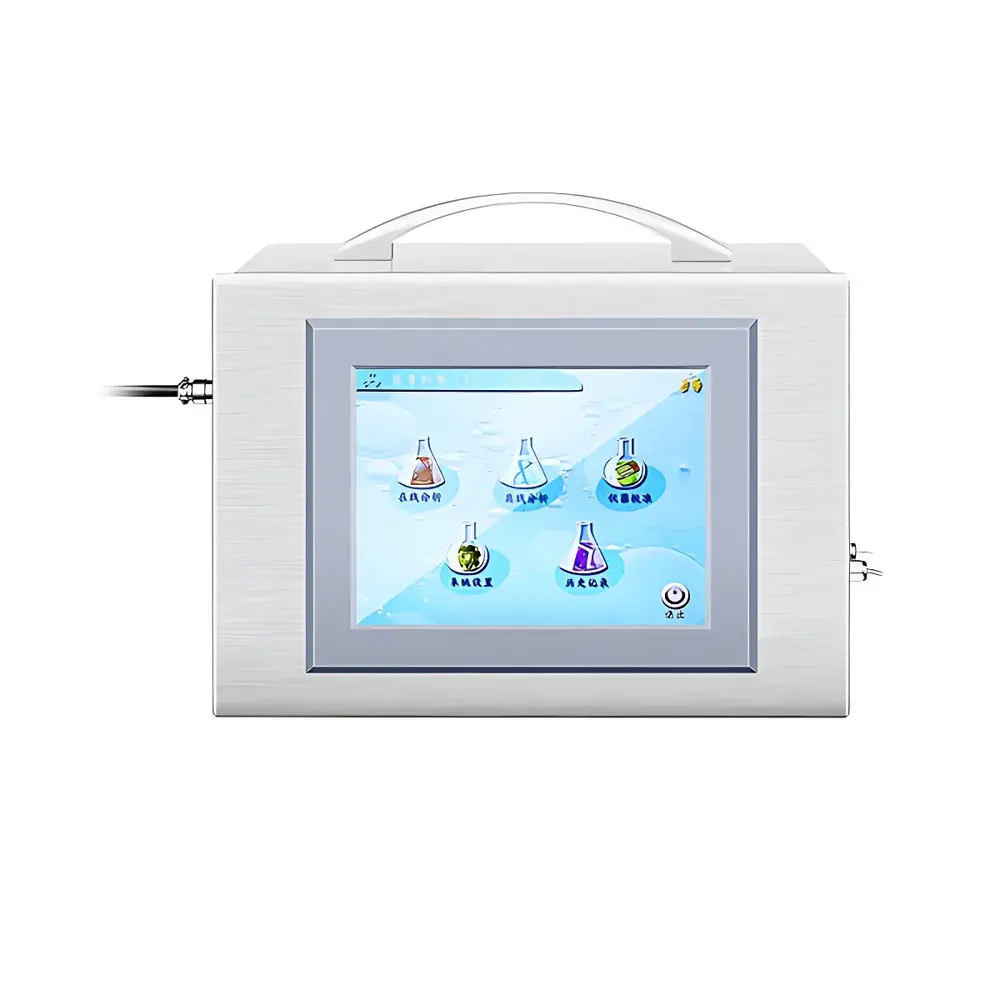
NeuronBC TA-3.0 Online Total Organic Carbon (TOC) Analyzer
| Brand | NeuronBC |
|---|---|
| Origin | Beijing, China |
| Model | TA-3.0 |
| Instrument Type | Online TOC Analyzer |
| Detection Principle | Direct Conductivity Method |
| Oxidation Method | UV Photolysis (185/254 nm) |
| Measurement Range | 0.001–1.0 mg/L (1–1000 ppb) |
| Accuracy | ±3% of reading |
| Resolution | 0.001 mg/L |
| Detection Limit | 0.001 mg/L |
| Repeatability | ±3% RSD |
| Conductivity Detection Range | 0.055–8.000 µS/cm |
| Response Time | ≤5 minutes |
| Sample Temperature Range | 1–95 °C |
| Ambient Operating Temperature | 5–65 °C |
| Power Supply | 100–240 VAC, 50 Hz, 120 W |
| Data Logging Capacity | >5,000 records |
| Audit Trail | 16-event timestamped log |
| User Access Control | 4-tier role-based authentication (compliant with FDA 21 CFR Part 11) |
| Display | Color TFT touchscreen (7-inch) |
| Dimensions (L×W×H) | 300 × 210 × 250 mm |
| Weight | 8.5 kg |
| Enclosure Material | 304 stainless steel |
| IP Rating | IP54 (splash-resistant) |
Overview
The NeuronBC TA-3.0 Online Total Organic Carbon (TOC) Analyzer is an industrial-grade, continuously operating instrument engineered for real-time monitoring of organic carbon content in ultrapure water (UPW), pharmaceutical process water, semiconductor rinse water, and regulated environmental effluent streams. It employs the direct conductivity detection principle following low-pressure ultraviolet (UV) photolysis at dual wavelengths (185 nm and 254 nm), enabling complete oxidation of non-purgeable organic compounds—including alcohols, aldehydes, carboxylic acids, and low-molecular-weight organics—into CO₂, which is subsequently quantified via high-stability conductivity measurement. Unlike combustion-based TOC analyzers, the TA-3.0 eliminates catalyst degradation, carrier gas dependency, and high-temperature maintenance cycles, delivering stable baseline performance over extended unattended operation. Its 304 stainless steel enclosure and IP54-rated front panel ensure operational integrity in humid, temperature-variable environments typical of cleanrooms, utility corridors, and municipal water treatment control rooms.
Key Features
- Modular architecture supporting seamless integration with DCS, SCADA, and PLC systems via Modbus RTU/TCP and optional Profibus DP protocols;
- Dual-mode deployment flexibility: configurable for either continuous single-point monitoring or time-multiplexed multi-point sampling (up to 8 channels with external manifold);
- UV oxidation module with quartz immersion lamp and optimized reaction chamber geometry ensures >95% oxidation efficiency across the full 0.001–1.0 mg/L range;
- High-precision conductivity cell calibrated against NIST-traceable KCl standards, featuring automatic temperature compensation (ATC) and drift-compensated zero stabilization;
- Embedded 7-inch color TFT touchscreen interface with intuitive navigation, real-time trend graphs, and alarm status visualization;
- FDA 21 CFR Part 11-compliant software stack including 4-level user authentication (Administrator, Supervisor, Operator, Viewer), electronic signatures, and immutable audit trail logging (16 discrete event categories with timestamps and operator IDs);
- Onboard data storage (>5,000 measurement records) with USB export capability for CSV-formatted datasets compatible with LIMS and statistical process control (SPC) platforms.
Sample Compatibility & Compliance
The TA-3.0 is validated for use with Type I–III purified water per ISO 3696 and USP , as well as drinking water and wastewater matrices meeting EPA Method 415.3 specifications. Its low detection limit (0.001 mg/L) and linear response across three orders of magnitude enable compliance verification against stringent regulatory thresholds—including ASTM D5905 for UPW in microelectronics, EU Annex 1 requirements for sterile manufacturing water, and Chinese Pharmacopoeia ChP 0682. The system meets electromagnetic compatibility (EMC) per IEC 61326-1 and safety requirements per IEC 61010-1. All firmware and configuration changes are subject to version-controlled change management logs accessible via secure administrator login.
Software & Data Management
Firmware v3.2 includes embedded data handling logic supporting automated calibration validation, periodic system suitability checks (SSC), and configurable alarm thresholds (high/low, rate-of-change, deviation from historical mean). Raw conductivity and TOC values are timestamped with millisecond precision and stored with metadata (sample ID, operator, method ID, ambient conditions). Audit trail entries record login/logout events, parameter modifications, calibration actions, and report generation—each cryptographically signed and non-erasable. Data export supports both manual USB transfer and scheduled FTP push to central servers. Optional OPC UA server add-on enables bidirectional communication with enterprise MES and QMS platforms under GxP-aligned infrastructure.
Applications
- Real-time TOC surveillance in pharmaceutical water-for-injection (WFI) and purified water (PW) distribution loops;
- Monitoring of UPW quality pre- and post-EDI in semiconductor fab utilities;
- Compliance-driven effluent tracking in municipal wastewater treatment plants subject to discharge permits;
- Validation support during cleaning-in-place (CIP) cycle verification in biopharmaceutical facilities;
- Trend analysis of organic fouling onset in reverse osmosis (RO) and ultrafiltration (UF) membrane systems;
- Environmental compliance reporting for surface water bodies under national water quality standards.
FAQ
What oxidation method does the TA-3.0 use, and why is UV photolysis preferred for UPW applications?
The TA-3.0 utilizes low-pressure UV lamps emitting at 185 nm (for hydroxyl radical generation) and 254 nm (for direct organic bond cleavage). This approach avoids particulate carryover, thermal decomposition artifacts, and catalyst poisoning common in high-temperature combustion systems—critical for maintaining integrity in ultrapure water circuits.
Does the analyzer require reagents or consumables beyond the UV lamp?
No acid, persulfate, or carrier gases are required. The only scheduled consumable is the UV lamp, rated for ≥12,000 hours of operation. Conductivity cell cleaning is performed automatically during daily zero calibration using deionized water rinse cycles.
How is data integrity ensured for regulatory submissions?
All measurements are digitally signed, time-stamped, and logged in a write-once audit trail compliant with FDA 21 CFR Part 11 Subpart B. Password-protected user roles enforce separation of duties; no record can be modified or deleted without traceable administrative override.
Can the TA-3.0 interface with our existing DeltaV DCS?
Yes—native Modbus TCP support enables direct tag mapping into DeltaV’s CIO database. Configuration files and driver documentation are provided with each shipment, along with commissioning support from NeuronBC-certified application engineers.
What is the recommended calibration frequency for routine GMP operations?
Initial calibration is performed using certified TOC standard solutions (e.g., potassium hydrogen phthalate, 500 ppb and 5,000 ppb). For GMP environments, system suitability testing (SST) is required before each shift; full calibration verification is recommended every 72 hours or per internal SOP, whichever is more frequent.
Related Products







