
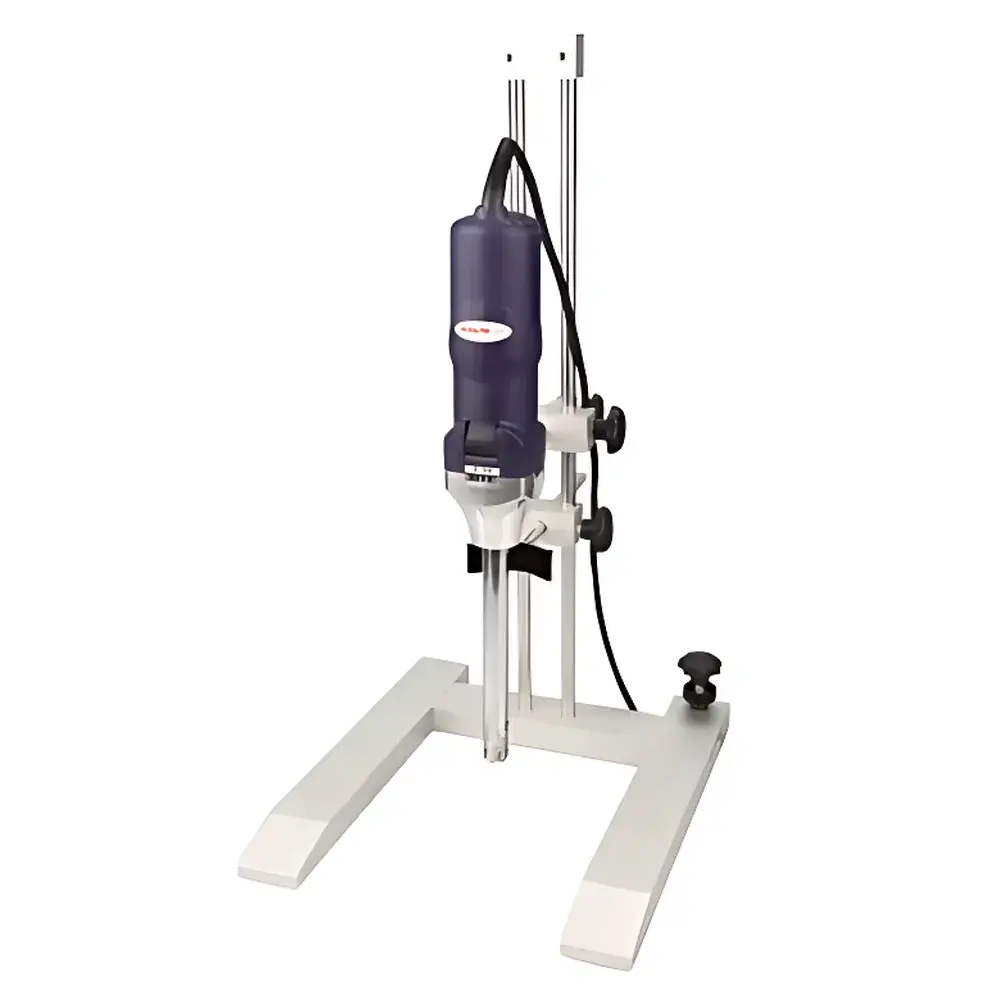
DLAB D-500 High-Speed Rotational Homogenizer
| Brand | DLAB |
|---|---|
| Model | D-500 |
| Rated Voltage | 220 V / 50 Hz |
| Input Power | 500 W |
| Output Power | 380 W |
| Speed Range | 10,000–30,000 rpm |
| Speed Control | 7-step continuous adjustment |
| Rotor Tip Speed | 22.7–36 m/s |
| Max. Viscosity | 10,000 mPa·s |
| Processing Volume (H₂O) | 10–40,000 mL |
| Material in Contact | 316L stainless steel / PTFE |
| Weight | 1.3 kg |
| Noise Level | 79 dB(A) |
| Ambient Temperature | 5–40 °C |
| Relative Humidity | ≤85% |
| Duty Cycle | Continuous (100%) |
| Ingress Protection | IP20 |
| Dimensions | 70 × 70 × 255 mm |
Overview
The DLAB D-500 High-Speed Rotational Homogenizer is an engineered solution for rapid, reproducible mechanical homogenization and dispersion of diverse laboratory samples. It operates on the principle of high-shear rotor-stator interaction: sample fluid is drawn into the narrow annular gap between a rapidly rotating rotor and a stationary stator, where intense hydrodynamic shear forces—generated by tip speeds up to 36 m/s—induce turbulent flow, cavitation, and laminar stretching. This mechanism enables efficient cell lysis, tissue disintegration, emulsification, and nanoparticle deagglomeration without thermal degradation or chemical additives. Designed for benchtop use in regulated and research-intensive environments, the D-500 delivers consistent energy input across variable viscosities (up to 10,000 mPa·s) and volumes (10 mL to 40 L), making it suitable for both small-scale assay development and scalable process optimization.
Key Features
- Seven-step speed control (10,000–30,000 rpm) ensures precise matching of shear intensity to sample rheology and stability requirements.
- Interchangeable rotor-stator assemblies mount onto a single drive shaft—reducing inventory complexity and enabling rapid configuration changes for different applications.
- Tool-free disperser head assembly/disassembly (<5 seconds) supports fast cleaning, sterilization (autoclavable 316L stainless steel + PTFE components), and cross-contamination prevention.
- Triple-layer safety architecture: momentary emergency stop switch, electronic motor overload protection, and soft-start motor control to suppress torque surge and prevent sample splashing during acceleration.
- Robust thermal management and continuous-duty-rated motor (380 W output, 500 W input) sustain stable performance under prolonged operation at maximum load.
- Compact footprint (70 × 70 × 255 mm) and low mass (1.3 kg) facilitate integration into biosafety cabinets, cold rooms, and automated workstations.
Sample Compatibility & Compliance
The D-500 accommodates biological tissues (e.g., liver, muscle, mammary gland), microbial cultures, polymer solutions, oil-in-water emulsions, pigment dispersions, and nanomaterial suspensions. Its 316L stainless steel wetted parts meet ISO 8502-3 and ASTM A967 standards for passivation and corrosion resistance, while PTFE components comply with USP Class VI biocompatibility requirements. The device is compatible with GLP- and GMP-aligned workflows: all operational parameters (speed, duration, batch ID) can be manually logged for audit trails; optional integration with LIMS via RS-232 enables timestamped data capture per FDA 21 CFR Part 11 guidelines. CE marking confirms conformity with EU Machinery Directive 2006/42/EC and EMC Directive 2014/30/EU.
Software & Data Management
While the D-500 operates as a stand-alone instrument with analog speed selection, its design supports digital traceability through external logging systems. The motor controller outputs TTL-level pulse signals proportional to actual rotational speed, enabling real-time monitoring via oscilloscopes or DAQ modules. For laboratories requiring full electronic records, third-party software (e.g., LabArchives, Benchling) may be configured to capture operator entries, timestamps, and protocol versions. All firmware logic adheres to deterministic timing constraints—no background tasks interfere with speed regulation accuracy or safety interlock responsiveness.
Applications
- Biochemical sample prep: Complete homogenization of mammalian tissues in ≤30 s; efficient nuclear extraction and organelle isolation.
- Pharmaceutical formulation: Stable nanoemulsion generation for topical delivery systems; viscosity-controlled dispersion of API nanoparticles in non-aqueous carriers.
- Materials science: Exfoliation of 2D materials (e.g., graphene oxide), carbon nanotube debundling, and uniform pigment distribution in coating matrices.
- Food & dairy R&D: Standardized fat globule reduction in milk analogs; stabilization of plant-based protein emulsions.
- Environmental analysis: Extraction of microplastics from sediment slurries; homogenization of biofilm-coated filter membranes prior to DNA recovery.
- Agrochemical development: Wettable powder dispersion testing per ISO 7497-1; suspension concentrate stability assessment.
FAQ
What is the maximum processing volume achievable with the D-500 using standard disperser heads?
Standard configurations support 10–2,000 mL with tapered generators; extended-volume kits (e.g., large-cup dispersers) enable up to 40,000 mL with appropriate flow management.
Can the D-500 be used under sterile conditions in a laminar flow hood?
Yes—the unit’s IP20 rating permits indoor cleanroom use; all contact surfaces are autoclavable at 121°C for 20 min, and the compact form factor fits within most Class II A2 cabinets.
Is speed calibration traceable to national standards?
Factory calibration uses NIST-traceable tachometers; users may perform field verification with optical or magnetic pickup sensors compliant with ISO 2954.
How does the D-500 compare to ultrasonic homogenizers for heat-sensitive samples?
Unlike probe sonicators, the D-500 generates minimal localized heating (<2°C rise in 30 s aqueous homogenization), eliminating the need for active cooling in most routine applications.
Does the motor support variable-frequency drive (VFD) retrofitting?
No—the internal electronics integrate a fixed-frequency AC motor controller; external VFDs are incompatible and void the safety certification.
Related Products



